Rubble Wall Types: Styles, Components, and Characteristics
Rubble Wall Types and Details
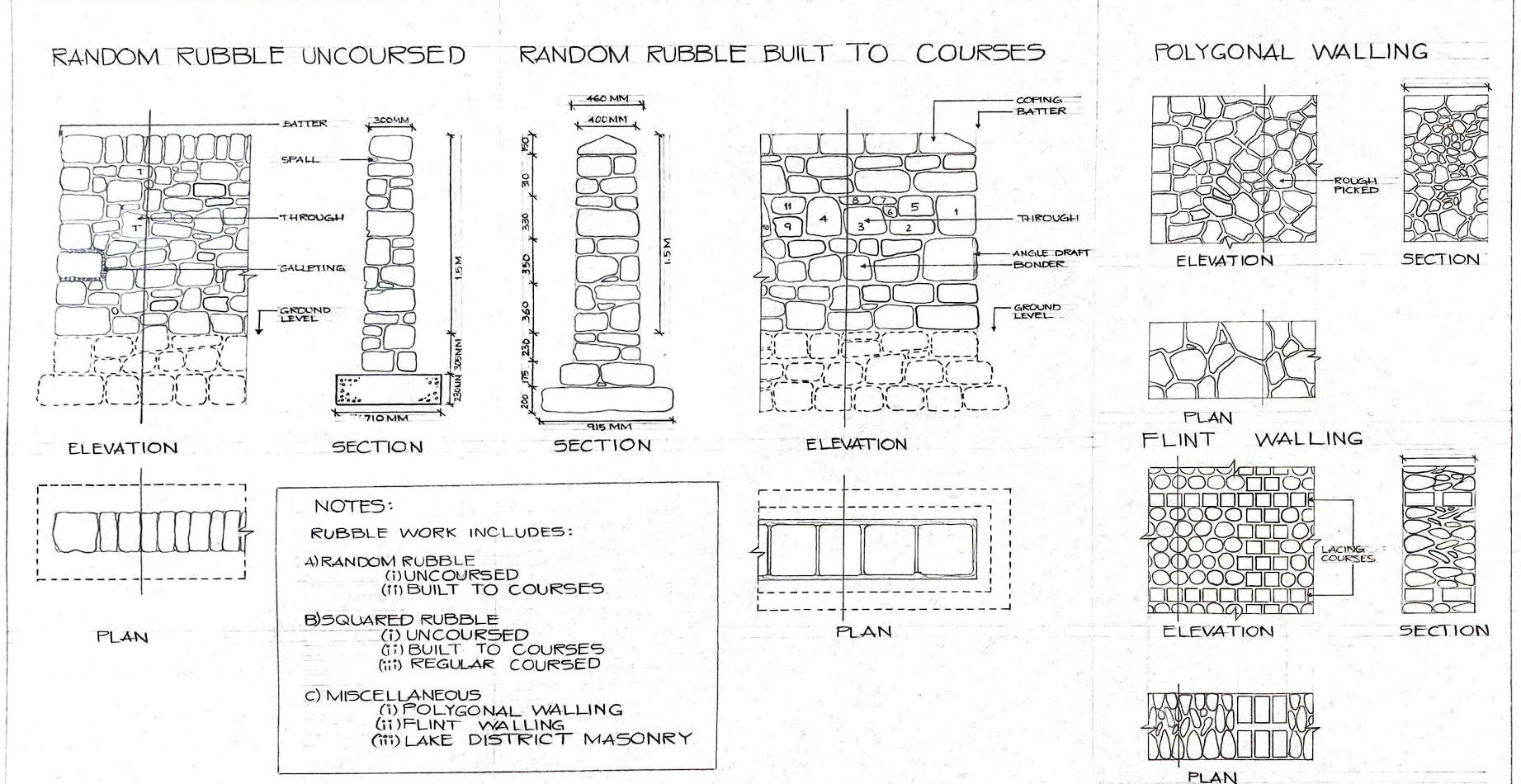
Random Rubble Uncoursed
-
Elevation and Section:
- Uses irregular stones placed without a structured pattern.
- Components:
- Batter: A slight incline or slope backwards on a wall for stability.
- Spalls: Small stone chips or fragments used to fill gaps.
- Through-stones: Stones spanning the full thickness of the wall, adding lateral strength.
- Galleting: Small stones packed between larger stones, enhancing appearance and stability.
- Dimensions: The height is 1.5m; the thickness varies.
-
Plan:
- Top view illustrating the position and irregularity of stones.
Random Rubble Built to Courses
-
Elevation and Section:
- Stones arranged in rough horizontal courses or layers.
- Additional Components:
- Coping: Protective covering at the top of a wall.
- Angle Draft Bonder: Stone at corners providing additional strength.
-
Dimensions: Differs slightly in height, visible distinct courses.
Polygonal Walling
-
Elevation and Section:
- Uses stones with irregular, multi-sided shapes tightly fitted.
- Rough Picked Finish: Basic surface smoothing or shaping for aesthetics and fit.
-
Plan:
- Illustrates the complex interlocking of shapes.
Flint Walling
-
Elevation and Section:
- Utilizes flint stones known for hardness and durability.
- Lacing Courses: Horizontal lines of stones reinforcing the flint sections.
-
Plan:
- Exhibits strategic interlocking of flint with other stone shapes for robustness.
Notes:
Rubble Work Includes:
-
Random Rubble
- Uncoursed: Stones placed irregularly without horizontal layers.
- Built to Courses: Stones arranged roughly in horizontal lines.
-
Squared Rubble
- Uncoursed: Squared stones placed without regular structure.
- Built to Courses: Squared stones aligned in rows.
- Regular Coursed: Systematic use of equal height courses.
-
Miscellaneous
- Polygonal Walling: Combining irregular multi-sided stones.
- Flint Walling: Using tough stone historically for defensive structures.
- Lake District Masonry: Masonry style known for using local stone types, distinct within the UK.
These construction styles are often chosen for their aesthetic appeal, historical significance, or structural advantages in specific climates and landscapes.