The No-BS Approach to Effective Prompt Engineering
The No-BS Guide to Prompt Engineering
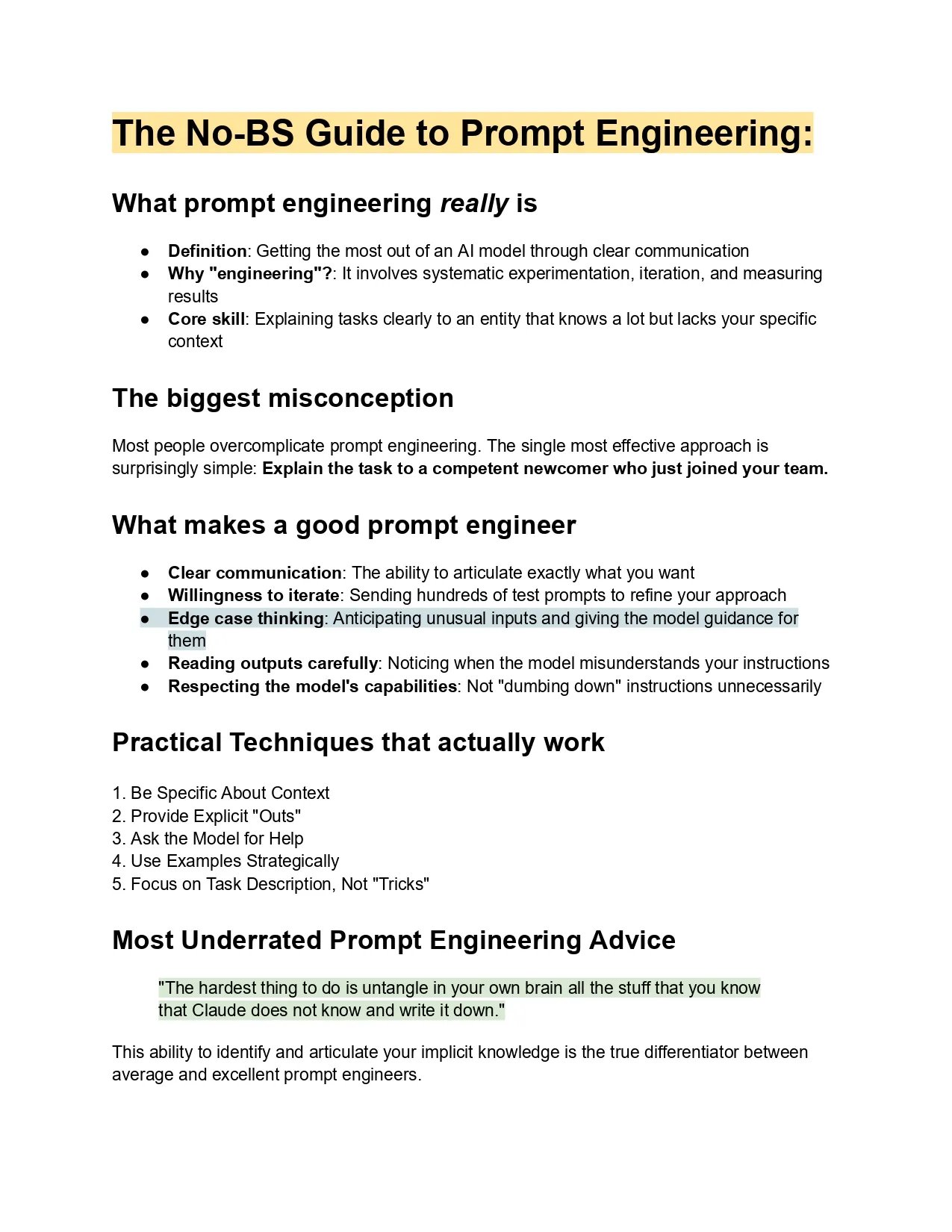
What prompt engineering really is
-
Definition: Getting the most out of an AI model through clear communication
Insight: Prompt engineering is fundamentally about communication, not about finding "hacks" or secret commands that make AI models do special things.
-
Why "engineering"? : It involves systematic experimentation, iteration, and measuring results
Insight: The term "engineering" is appropriate because effective prompting requires methodical testing and refinement, similar to other engineering disciplines.
-
Core skill: Explaining tasks clearly to an entity that knows a lot but lacks your specific context
Insight: AI models have broad knowledge but don't have access to your particular situation, goals, or implicit understanding. Bridging this gap is the essence of prompt engineering.
The biggest misconception
Most people overcomplicate prompt engineering. The single most effective approach is surprisingly simple: Explain the task to a competent newcomer who just joined your team.
Insight: This mental model helps you provide the right level of detail without overcomplicating. Think of the AI as a smart colleague who needs context but doesn't need to be micromanaged.
What makes a good prompt engineer
-
Clear communication: The ability to articulate exactly what you want
Insight: Being precise about your requirements helps the AI understand your goals and constraints.
-
Willingness to iterate: Sending hundreds of test prompts to refine your approach
Insight: Effective prompt engineering is rarely achieved on the first try. Persistence and systematic refinement are key to success.
-
Edge case thinking: Anticipating unusual inputs and giving the model guidance for them
Insight: Consider how your prompt might fail or be misinterpreted, and build in guardrails to prevent these issues.
-
Reading outputs carefully: Noticing when the model misunderstands your instructions
Insight: Careful analysis of AI responses helps identify where your prompt needs clarification or additional context.
-
Respecting the model's capabilities: Not "dumbing down" instructions unnecessarily
Insight: Modern AI models are quite capable, so focus on being clear rather than oversimplifying to the point of losing nuance.
Practical Techniques that actually work
-
Be Specific About Context
Insight: Provide relevant background information, goals, and constraints to help the AI understand the full picture.
-
Provide Explicit "Outs"
Insight: Give the AI permission to say "I don't know" or ask clarifying questions when appropriate, rather than forcing it to guess.
-
Ask the Model for Help
Insight: AI models can often suggest better approaches or help refine your prompt if you're not getting the results you want.
-
Use Examples Strategically
Insight: Well-chosen examples can communicate your expectations more clearly than lengthy explanations.
-
Focus on Task Description, Not "Tricks"
Insight: Clearly describing what you want is more effective than trying to use special formatting or keywords that you think might "hack" the AI.
Most Underrated Prompt Engineering Advice
"The hardest thing to do is untangle in your own brain all the stuff that you know that Claude does not know and write it down."
This ability to identify and articulate your implicit knowledge is the true differentiator between average and excellent prompt engineers.
<br />Insight: We often don't realize how much contextual knowledge we take for granted. The skill of making implicit knowledge explicit is perhaps the most valuable aspect of prompt engineering.