Calculus, Functions, and Circle Equations Overview
Calculus and Functions Notes
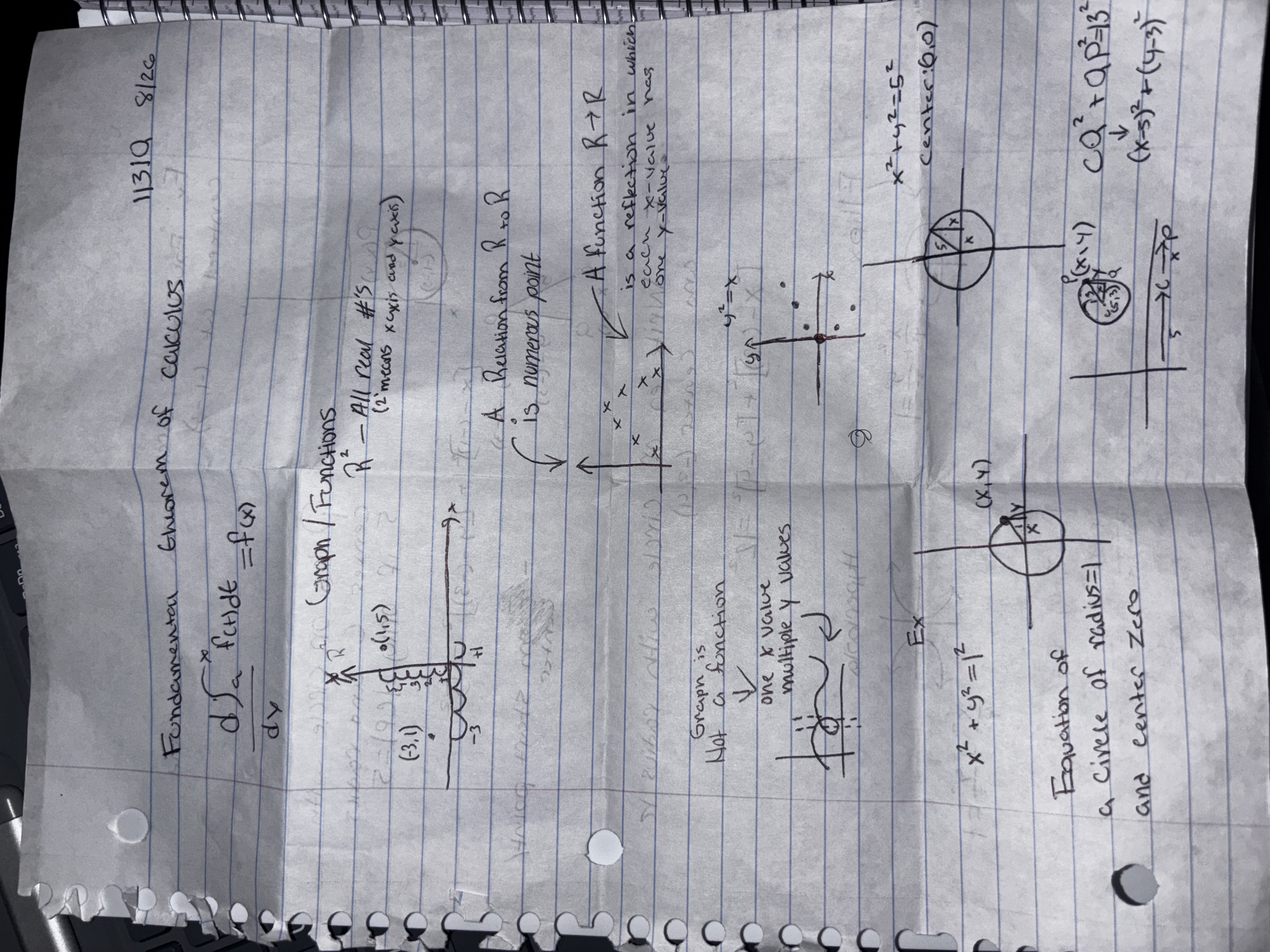
Fundamental Theorem of Calculus
- Equation:
- Insight: This theorem connects differentiation and integration, showing that differentiation is the reverse process of integration.
- Additional Information: The theorem has two parts; this is the first part, which deals with the derivative of an integral.
Graphs and Functions
-
Graph of a Function:
- Example: A function from
- Insight: A function assigns exactly one output for each input.
- Additional Information: The vertical line test can be used to determine if a graph represents a function.
-
Graph Not a Function:
- Insight: If a vertical line intersects the graph at more than one point, it is not a function.
- Example: A circle is not a function because it fails the vertical line test.
Circle Equations
- Equation of a Circle:
- Standard Form:
- Example:
- Center: (0, 0)
- Radius: 5
- Example:
- Center: (4, 3)
- Radius: 3
- Insight: The equation of a circle is derived from the Pythagorean theorem.
- Additional Information: The center-radius form makes it easy to identify the circle's center and radius.
Graphical Representations
- Graphical Example:
- Point: (3, 1)
- Line: y = x
- Insight: Graphs can visually represent relationships between variables.
Additional Notes
- Vertical Line Test: A method to determine if a curve is a graph of a function.
- Function Notation: represents the output of function for input .
These notes cover the fundamental theorem of calculus, the concept of functions and their graphical representations, and the equations of circles, providing a comprehensive overview of these mathematical concepts.
Geometric Equations and Concepts
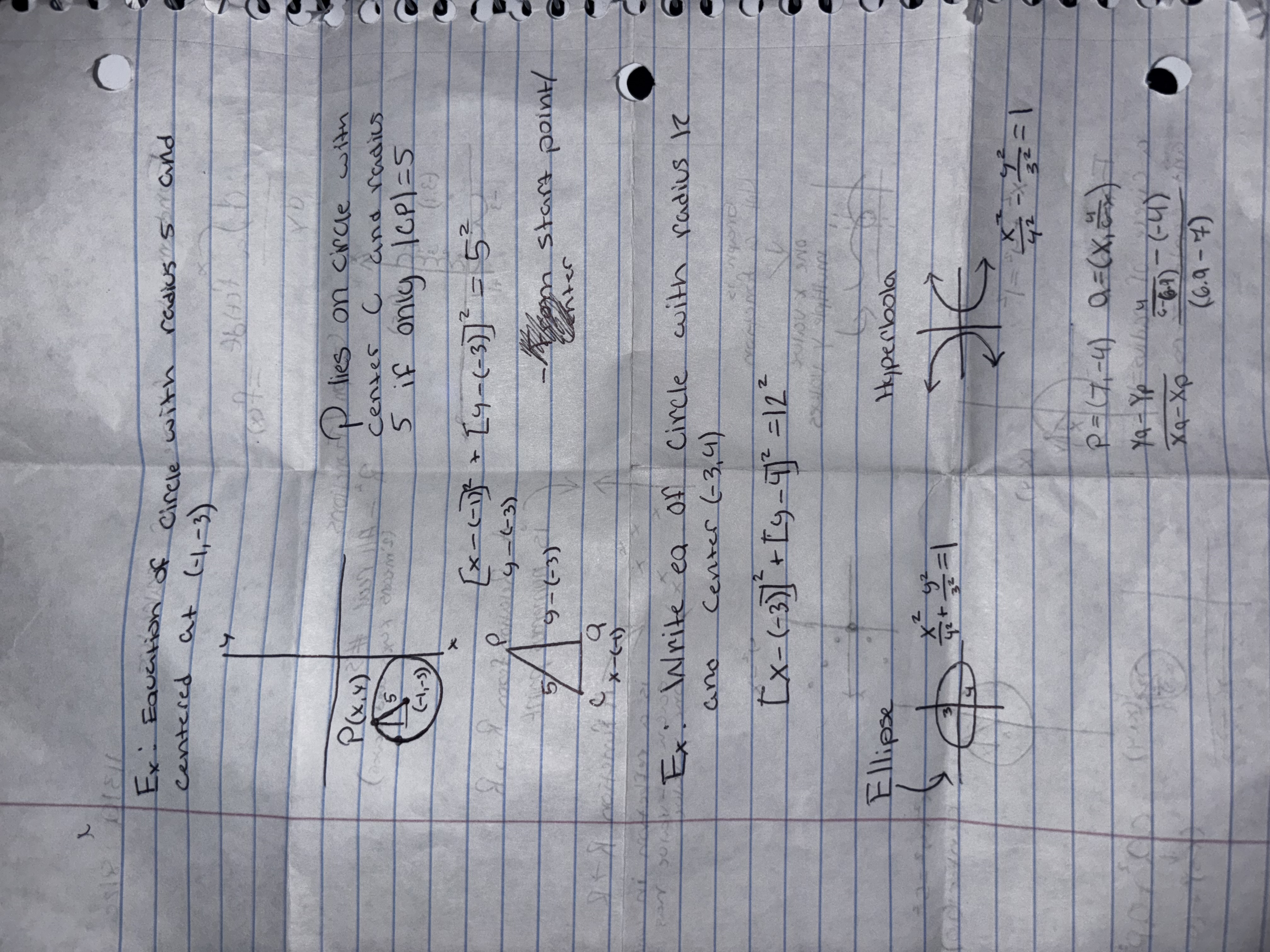
Circle Equations
Equation of a Circle
- General Form:
- : Coordinates of the center of the circle.
- : Radius of the circle.
- Insight: This equation represents all points that are at a distance from the center .
Example: Circle with Radius 5
- Center:
- Equation:
- Explanation: Points that satisfy this equation lie on the circle with the specified center and radius.
Ellipse
Equation of an Ellipse
- Standard Form:
- : Semi-major and semi-minor axes.
- Insight: An ellipse is a set of points where the sum of the distances from two fixed points (foci) is constant.
Hyperbola
Equation of a Hyperbola
- Standard Form:
- Insight: A hyperbola consists of two separate curves, and it represents the set of points where the difference of the distances to two foci is constant.
Additional Concepts
Distance Formula
- Formula:
- Usage: Calculate the distance between two points and .
Example: Area of Circle
- Radius: 12
- Center:
- Equation:
- Explanation: This equation defines a circle with a specified center and radius.
Visual Representations
Diagram Insights
- Circle Diagram: Illustrates the relationship between the center, radius, and any point on the circle.
- Triangle Representation: Used to visualize the distance from the center to a point on the circle.
These notes provide a comprehensive overview of basic geometric equations and their applications, including circles, ellipses, and hyperbolas. Understanding these concepts is crucial for solving problems related to conic sections and their properties.
Sets
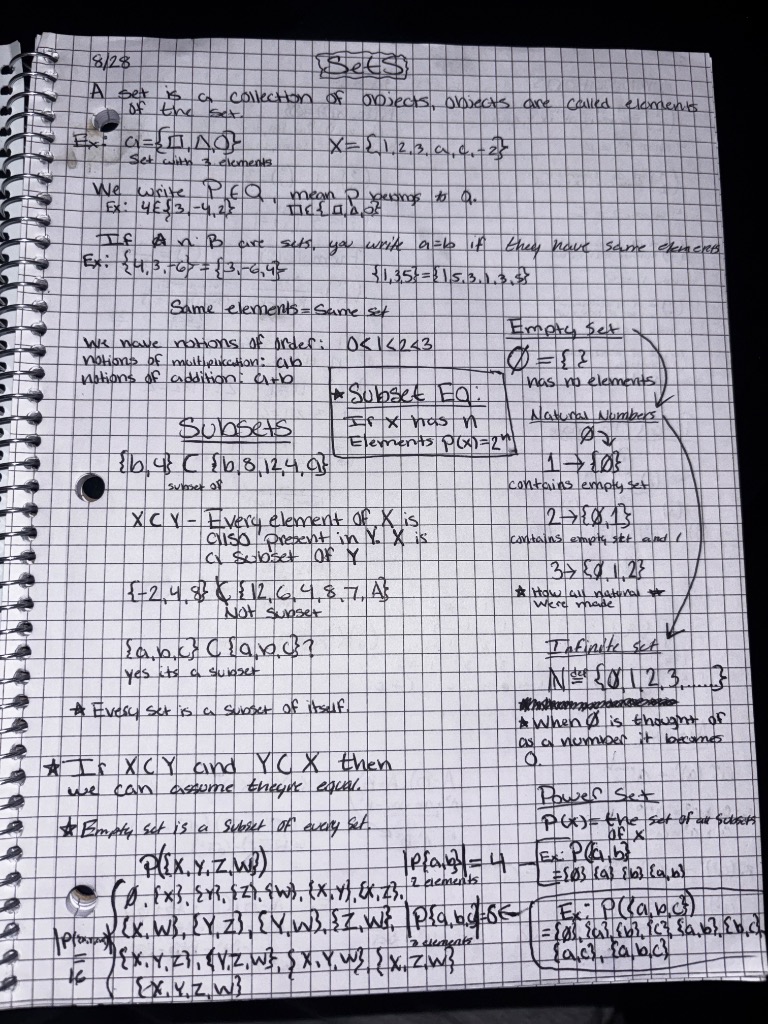
Definition of a Set
- Set: A collection of objects, where each object is called an element of the set.
- Example:
- Notation:
Notation
- Element of a Set: We write to mean belongs to set .
- Example:
- Not an Element: means does not belong to set .
- Example:
Equality of Sets
- Two sets and are equal if they have the same elements.
- Example:
Subsets
- Subset: means every element of is also an element of .
- Example:
- Not a Subset:
Properties
- Every set is a subset of itself.
- The empty set is a subset of every set.
Empty Set
- Empty Set:
- Contains no elements.
- Subset of every set.
Infinite Set
- Infinite Set: A set with no end.
- Example:
Power Set
- Power Set: The set of all subsets of a set .
- Notation:
- Example: If , then
Insights
- Power Set Size: If a set has elements, its power set has elements.
- Natural Numbers: Often include zero, denoted as .
Additional Notes
- Order of Elements: The order of elements in a set does not matter.
- Repeated Elements: Repeated elements in a set are not counted multiple times.
These notes provide a foundational understanding of sets, subsets, and related concepts, essential for further study in mathematics and logic.