Concise Notes on Light Energy and Mirrors
Notes on Refraction and Related Concepts in Physics
Key Concepts of Refraction
- Refraction of Light:
- Refraction occurs when light passes from one medium to another, causing it to bend.
- When light travels from a denser to a rarer medium, it bends away from the normal, while it bends towards the normal when moving from a rarer to a denser medium. This is essential for understanding how we perceive images in different environments.
Experiment with a Coin and Pencil in Water
-
Visibility of Objects in Water:
- Observation:
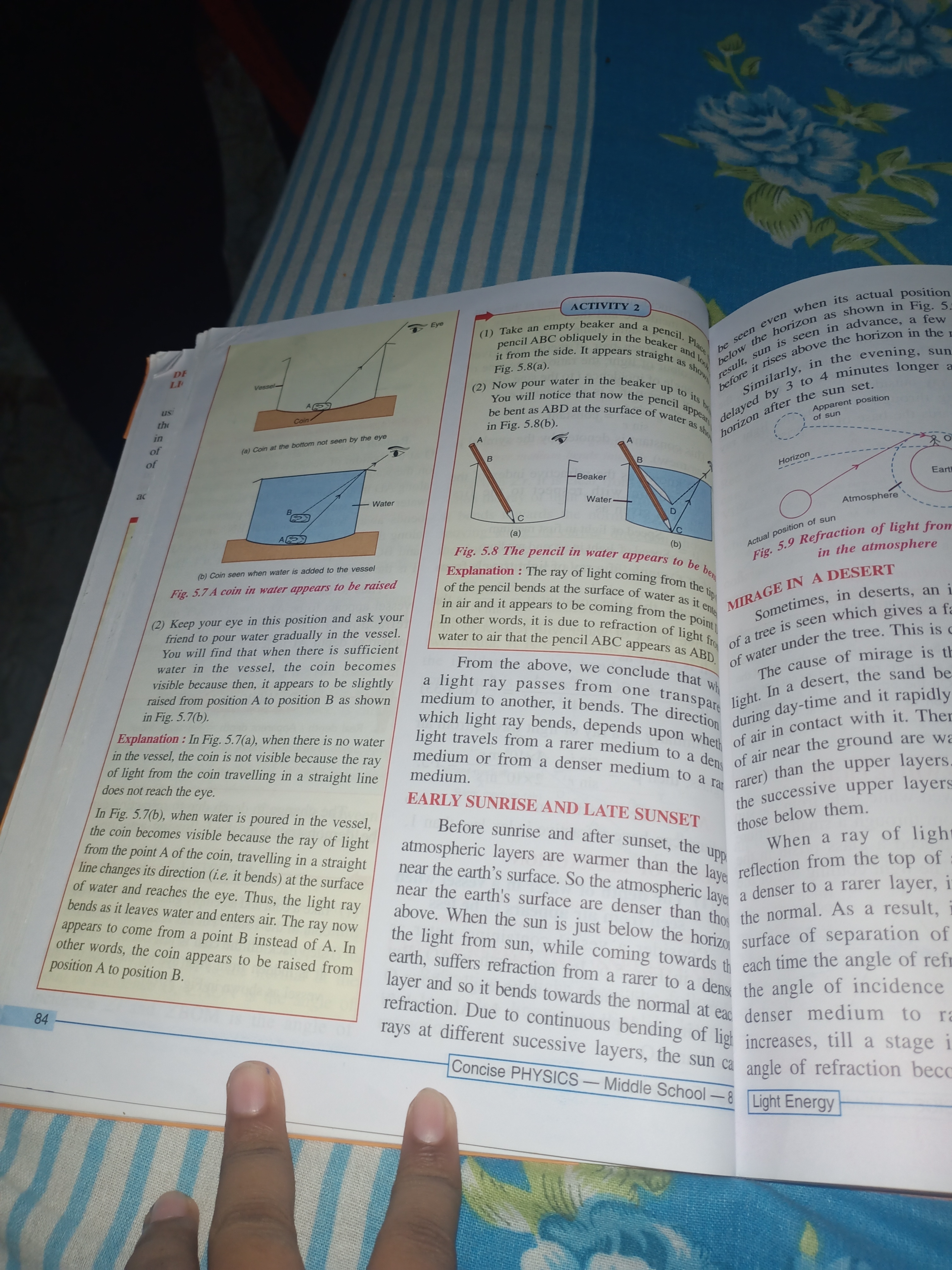
- When a coin is at the bottom of a vessel filled with water, it may not be visible until water is added. As water is poured, the light rays bending at the surface allow the coin to be seen.
- Activity Steps:
- Use an empty beaker and a pencil placed obliquely in the beaker to observe how light bends in water.
- Add water to the beaker and note how the pencil's position appears to change due to refraction.
- Observation:
-
Explanation of Phenomenon:
- In the initial state, the coin at the bottom is not visible because light travels in a straight line and doesn't reach the observer's eye. Once water is added, the light begins to bend at the interface, allowing the coin’s image to travel toward the observer.
- This demonstrates how the refractive index varies between air and water.
Mirage and Refraction in the Atmosphere
- Mirage Formation:
- In desert conditions, hot air near the ground is less dense than the cooler air above, leading to light bending as it passes through these layers.
- This bending creates the illusion of water or reflections, showing that temperature and density gradients in the atmosphere can significantly affect perception.
Early Sunrise and Late Sunset
- Effect of Atmospheric Layers:
- Phenomenon Description:
- As the sun rises or sets, its light gets refracted through the atmosphere, causing it to appear above the horizon longer than it physically is.
- Understanding Refraction in Context:
- The different densities of air layers cause the light to bend towards the normal when it enters regions of varying temperature and density, making sunrise and sunset appear delayed.
- Phenomenon Description:
| Concept | Description |
|---|---|
| Refraction | Bending of light as it passes from one medium to another, significantly affecting how we see objects. |
| Coin Experiment | Demonstrates how the visual perception of submerged objects changes when water is added, illustrating the principle of refraction in practice. |
| Mirage | Optical illusion caused by refraction in hot air, leading to distortions in how we perceive distant objects. |
| Early Sunrise/Late Sunset | Occurs due to the bending of light through various atmospheric layers, altering the apparent position of the sun at dawn and dusk. |
Reference:
Notes on Refraction and Refractive Index
Key Concepts
-
Incidence, Normal, and Refraction:
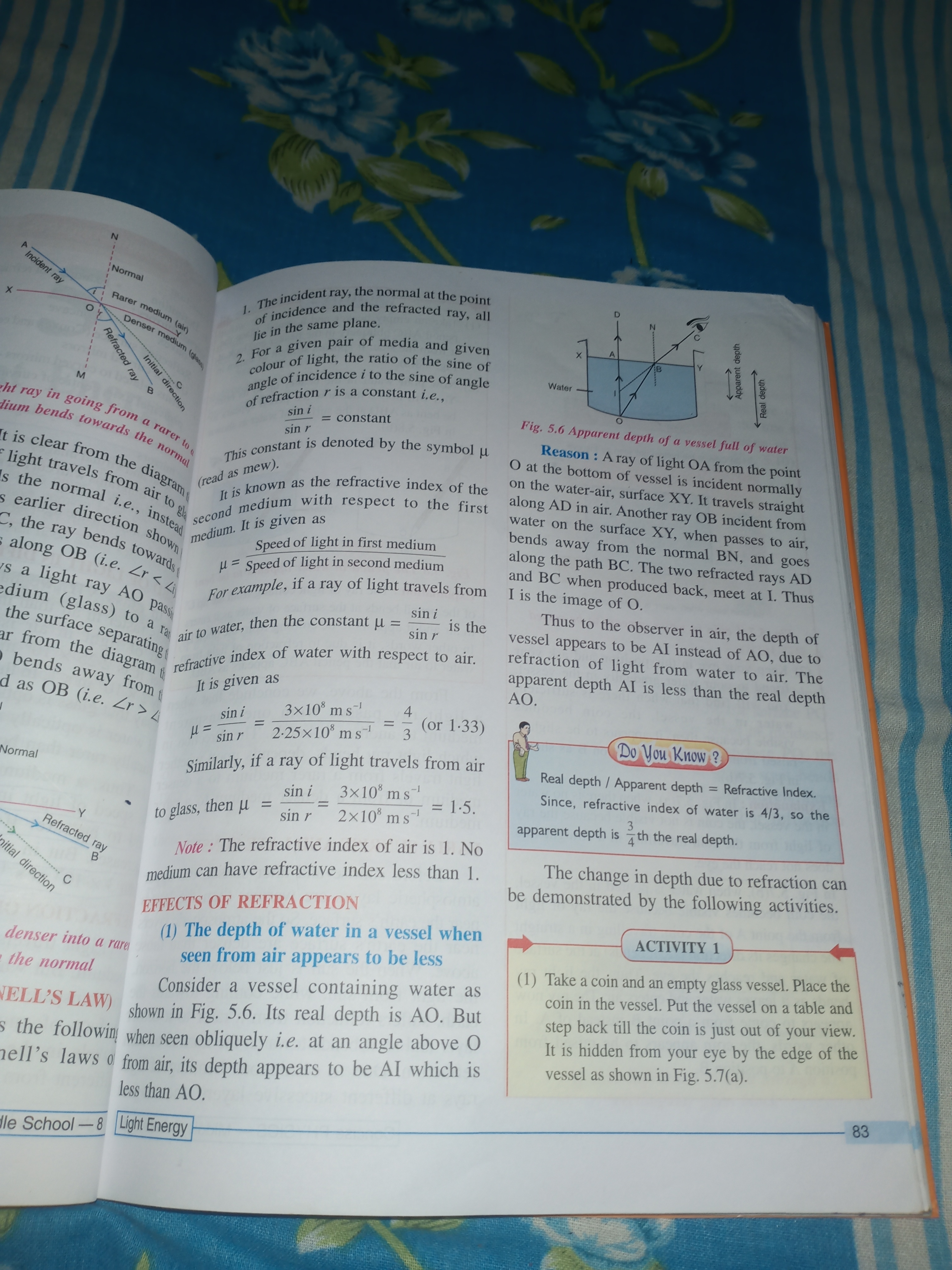
- The incident ray, normal at the point of incidence, and refracted ray all lie in the same plane.
- This highlights the two-dimensional nature of light behavior at surfaces, essential for understanding optical phenomena.
-
Snell's Law:
- For a given pair of media with known colors, the ratio of the sine of the angle of incidence () to the sine of the angle of refraction () is constant:
- This relationship helps in calculating how light changes direction as it transitions between different media.
-
Refractive Index:
- The refractive index () of a medium is defined as:
- Understanding refractive indices of different substances enables predictions about light behavior and enhances applications in optics, such as lenses and prisms.
-
Example Calculation of Refractive Indices:
- For water:
- For glass:
- These calculations provide clarity on the relative speeds of light in different materials, crucial for designing optical instruments.
Effects of Refraction
-
Apparent Depth:
- The depth of water as seen from the air appears less due to refraction. For instance, when looking at a vessel filled with water, the actual depth (AO) is greater than the apparent depth (AI).
- This occurs because light bends away from the normal as it exits water into air, making the water appear shallower than it is.
-
Relation with Refractive Index:
- The relationship between real depth and apparent depth can be summarized as:
- For water, this can be expressed as:
- Recognizing this relation is vital in fields like underwater photography and architecture.
Activity to Demonstrate Refraction
- Experiment Setup:
- Take a coin and place it at the bottom of an empty glass vessel.
- As you distance yourself from the vessel's edge, observe how the coin seems to disappear from view due to the refraction of light.
Summary:
Understanding the principles of light refraction is crucial for various applications in physics and engineering. The calculations and observations made during experiments reinforce the theoretical aspects of light behavior in different media, illustrating fundamental concepts in optics.
Reference:
Notes on Refraction of Light
Key Concepts of Refraction
-
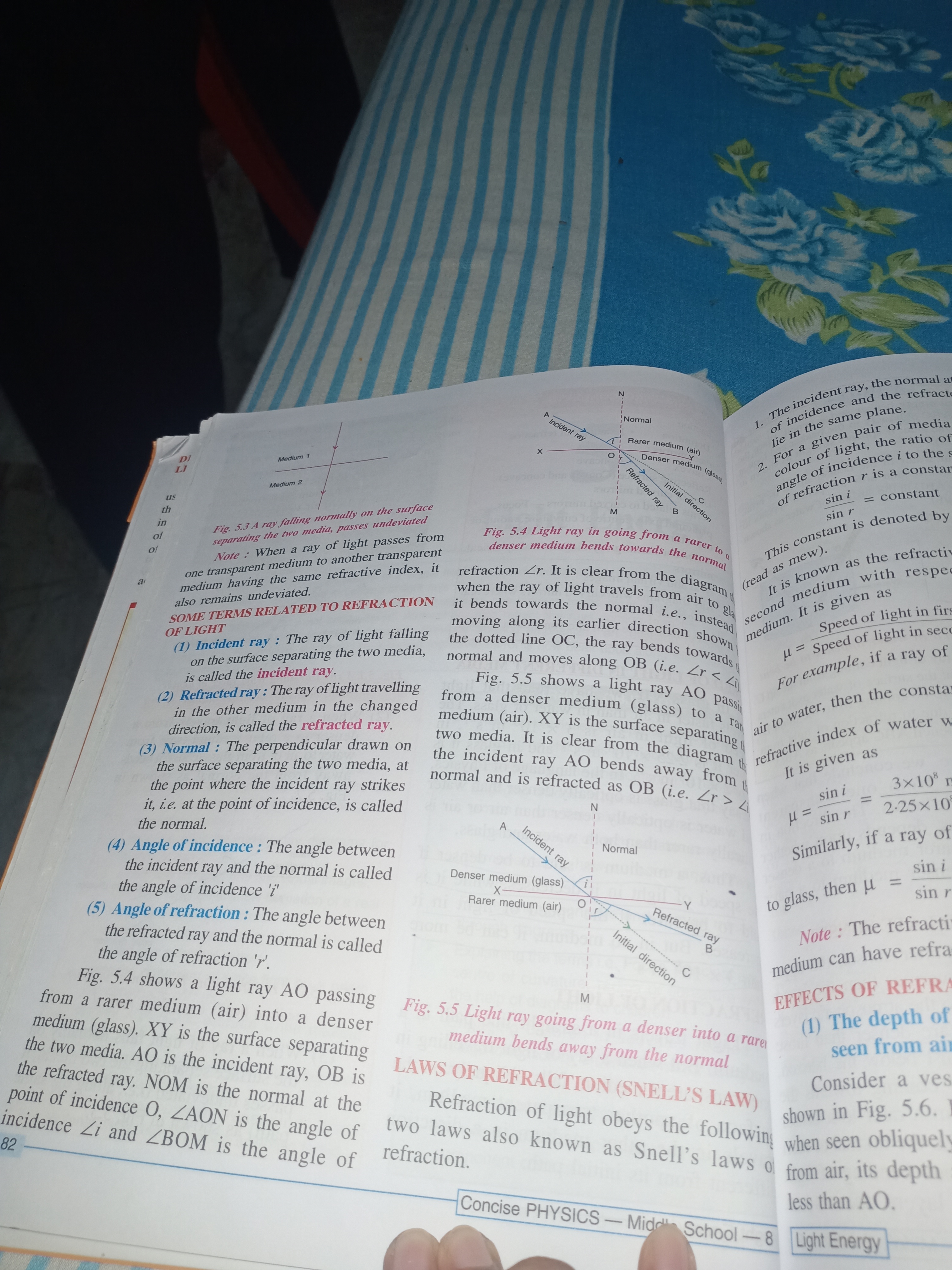
Incident Ray: The ray of light that strikes the surface between two media.
- Thoughts: Understanding the incident ray is crucial for analyzing how light behaves as it encounters different materials.
-
Refracted Ray: The ray of light that has changed direction after passing into another medium.
- Additional Info: This change of direction occurs because of the different optical densities of the two media, influencing light speed.
-
Normal Line: A perpendicular line drawn at the point of incidence on the surface separating the two media.
- Importance: It helps in measuring angles of incidence and refraction accurately.
-
Angle of Incidence (i) : The angle between the incident ray and the normal line.
- Connection to Real Life: This angle helps predict whether light will bend towards or away from the normal.
-
Angle of Refraction (r) : The angle between the refracted ray and the normal line.
- Insight: The relationship between the angle of incidence and angle of refraction is defined by Snell’s Law.
Laws of Refraction (Snell's Law)
-
Refraction of light follows two important laws:
- First Law: The incident ray, the refracted ray, and the normal all lie in the same plane.
- Second Law: The ratio of the sine of the angles of incidence (i) and refraction (r) for two media is constant, defined as:
where and are the speeds of light in the respective media, and and are the refractive indices.
Diagrams Referenced
- Figure 5.4: Illustrates light ray bending from a rarer medium (air) to a denser medium (glass).
- Figure 5.5: Depicts light ray moving from a denser medium (glass) to a rarer medium (air), bending away from the normal.
Summary of Key Points
- The behavior of light as it passes through different media is fundamental in physics and various applications, like optics and vision correction.
- Understanding refraction is vital for practical situations such as designing lenses and understanding phenomena like rainbows or mirages.
Reference:
Light Energy
Refraction
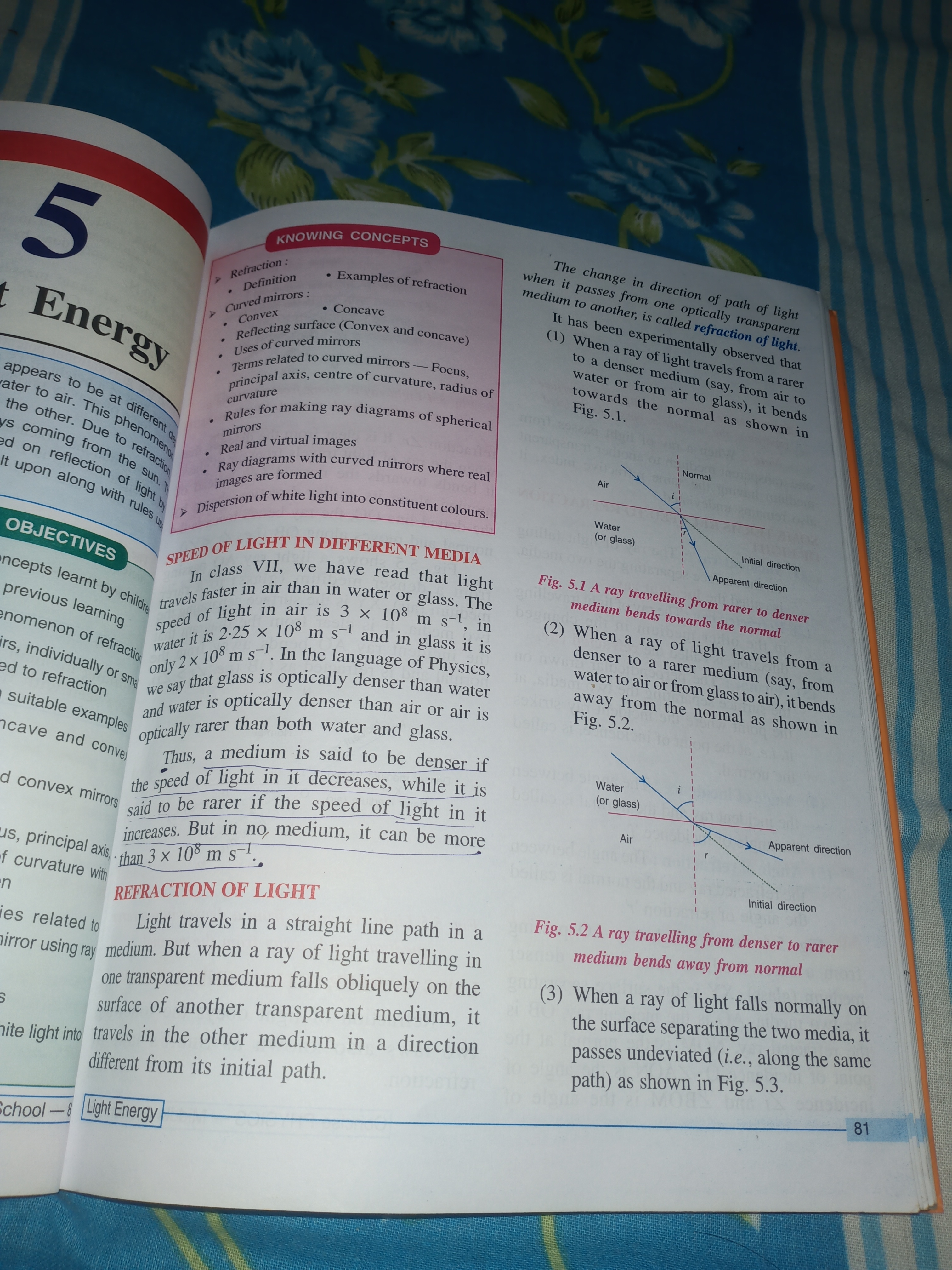
- Definition: Refraction is the change in direction of the path of light when it passes from one optically transparent medium to another.
- Thoughts: This process is vital in understanding how light behaves in different materials, which is crucial for applications like lenses and optical devices.
- Examples of Refraction:
- Bending of light when it moves from air to glass.
Curved Mirrors
- Types:
- Concave: Reflecting surface curves inward.
- Convex: Reflecting surface curves outward.
- Additional Info: Concave mirrors can focus light rays, while convex mirrors diverge light rays, which is useful in applications like security and rear-view mirrors.
Ray Diagrams
- Useful for visualizing the path of light in different scenarios.
- Commentary: Understanding ray diagrams helps in predicting how light will interact with various optical elements.
Speed of Light in Different Media
-
Light travels faster in air (approximately ) than in water or glass, where the speed is around .
- Thoughts: This difference in speed is what causes refraction. When light enters a denser medium, it slows down and bends towards the normal.
-
Density and Speed:
- A medium is denser if the speed of light in it decreases. Conversely, it is rarer if the speed of light increases.
- Additional Info: This concept is important for understanding how lenses work and the principle behind phenomena like the bending of a straw in water.
Key Principles of Refraction
-
Path Change When Entering Denser Medium: Light bends towards the normal line when moving from a rare medium (air) to a denser medium (water or glass).
- Illustration: This illustrates how lenses can converge light rays.
-
Path Change When Entering Rarer Medium: Light bends away from the normal when moving from a denser to a rarer medium.
- Illustration: This principle explains the divergence of light rays in glasses and prisms.
-
Normal Incidence: When light falls normally (perpendicularly) on the interface between two media, it continues in a straight line without bending.
- Important Note: This is a key aspect for designing optical devices where light needs to pass through without distortion.
This summary encompasses the fundamental concepts pertaining to light energy, particularly focusing on refraction and the behavior of light in different media, which are crucial for both theoretical understanding and practical applications in optics.
Reference: