SaaS Annual Report 2023-2024: Key Insights and Trends
Innovation in a Depopulating Society
Overview
- Theme: Innovation in a Depopulating Society
- Context: This concept explores how societies facing population decline can leverage innovation to maintain and improve living standards.
Key Insights
-
Depopulation Challenges:
- Economic Impact: Shrinking labor force, reduced economic output.
- Social Impact: Aging population, increased healthcare needs.
- Infrastructure: Declining demand for infrastructure can lead to excess capacity.
-
Opportunities for Innovation:
- Automation and AI: Implementing technologies to compensate for reduced human workforce.
- Smart Infrastructure: Designing adaptable infrastructure that scales with population.
- Healthcare Technology: Innovations in telemedicine and home care for aging populations.
-
Strategic Approaches:
- Policy Adjustments: Implement policies that attract talent and retain population.
- Sustainable Development: Focus on sustainable practices to ensure resource efficiency.
Conclusion
Societies experiencing depopulation can harness technology and innovative practices to address the challenges arising from reduced populations. By focusing on smart, adaptable solutions, these societies can sustain their economic and social systems effectively.
Extended readings:
Japan's Workforce Decline and GDP Growth
Overview
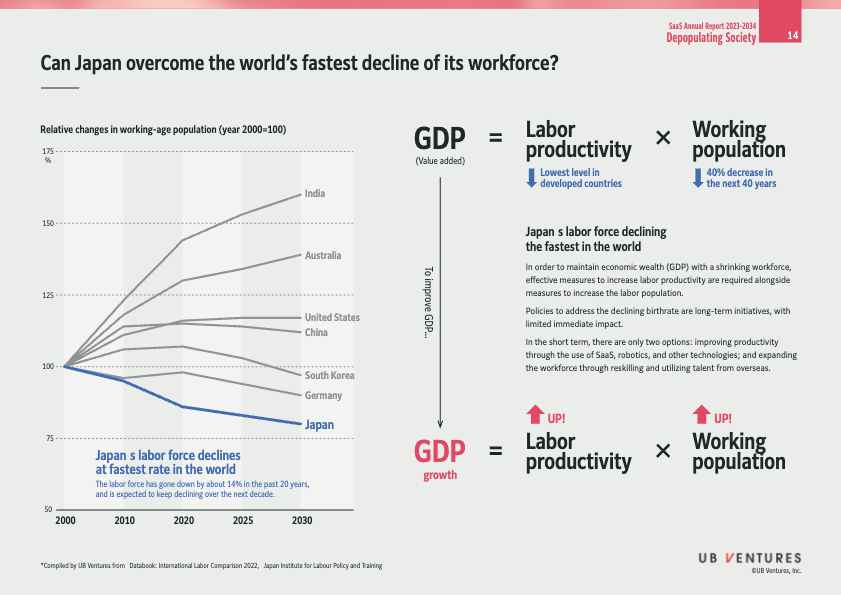
Japan faces the world's fastest decline in its working-age population, impacting its GDP growth. This decline necessitates strategic measures to address labor productivity and workforce size.
Relative Changes in Working-Age Population (2000-2030)
-
Japan:
- Decline of around 14% over the past 20 years.
- Expected further decline over the next decade.
- Insight: With the lowest growth compared to other countries, Japan needs innovative strategies to counteract these trends.
-
Other Countries (Indexed to 2000=100):
- India: Significant growth toward 175%.
- Australia, United States, China, South Korea, Germany: Moderate growth.
- Insight: Japan is unique among developed nations, facing a steep decline, which requires targeted economic policies.
Key Challenges and Solutions
GDP Equation
- GDP (Value added) = Labor Productivity x Working Population
Challenges
-
Low Labor Productivity:
- Among the lowest in developed countries.
- Insight: Enhancing productivity is crucial, especially through technology.
-
Decreasing Working Population:
- Projected 40% decrease in the next 40 years.
- Insight: A shrinking workforce necessitates both productivity improvements and workforce expansion.
Solutions
- Improving Productivity:
- Utilize SaaS, robotics, and advanced technologies.
- Insight: Technological adoption can offset productivity losses due to a diminishing labor force.
- Expanding Workforce:
- Reskill existing workers.
- Utilize international talent.
- Insight: Diversifying and upskilling the workforce can fill labor gaps.
Policy Recommendations
-
Long-Term Initiatives:
- Address the declining birthrate.
- Limitation: Limited immediate impact but crucial for future sustainability.
-
Short-Term Focus:
- Prioritize technological integration and workforce diversification to stabilize GDP growth.
By implementing these strategies effectively, Japan can mitigate the economic impacts of its declining workforce and leverage new opportunities for growth.
Extended readings:
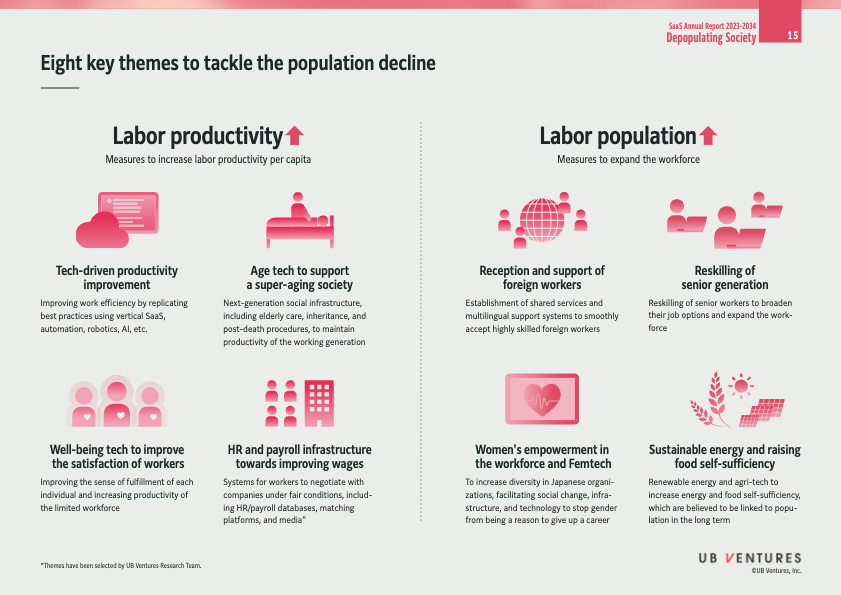
Eight Key Themes to Tackle Population Decline
Labor Productivity
Measures to Increase Labor Productivity per Capita
-
Tech-Driven Productivity Improvement
- Uses vertical SaaS, automation, robotics, and AI to improve efficiency.
- Insight: These technologies can streamline processes, reduce errors, and enable workers to focus on more strategic tasks.
-
Age Tech to Support a Super-Aging Society
- Develops social infrastructure for elderly care, inheritance, and post-death processes.
- Insight: Ensuring support systems for aging populations can help maintain economic productivity and reduce burdens on the workforce.
-
Well-Being Tech to Improve the Satisfaction of Workers
- Aims to enhance individuals' fulfillment and productivity.
- Insight: A fulfilled workforce is typically more engaged and productive, reducing turnover and increasing company performance.
-
HR and Payroll Infrastructure Towards Improving Wages
- Provides systems for fair negotiation and conditions.
- Insight: Transparent HR systems can lead to better employee-management relations and fairer compensation.
Labor Population
Measures to Expand the Workforce
-
Reception and Support of Foreign Workers
- Establishes shared services and multilingual systems to integrate foreign workers.
- Insight: Welcoming skilled foreign workers can fill labor gaps and bring diverse perspectives and innovations.
-
Reskilling of Senior Generation
- Broadens job options for senior workers to expand the workforce.
- Insight: Reskilling can tap into the potential of experienced workers, offering new career pathways and extending their employability.
-
Women's Empowerment in the Workforce and Femtech
- Increases diversity by removing gender barriers in Japanese organizations.
- Insight: Encouraging gender equality in the workplace can lead to a more comprehensive and balanced workforce.
-
Sustainable Energy and Raising Food Self-Sufficiency
- Invests in renewable energy and agri-tech to enhance self-sufficiency.
- Insight: Sustainable practices support long-term economic stability and can mitigate risks associated with dependency on external resources.
The themes reflect strategies to mitigate the challenges of a declining population, focusing on enhancing productivity and expanding the workforce through various innovative and inclusive measures.
Extended readings:
Vertical SaaS in Regional Economies: Barriers and Solutions
Overview
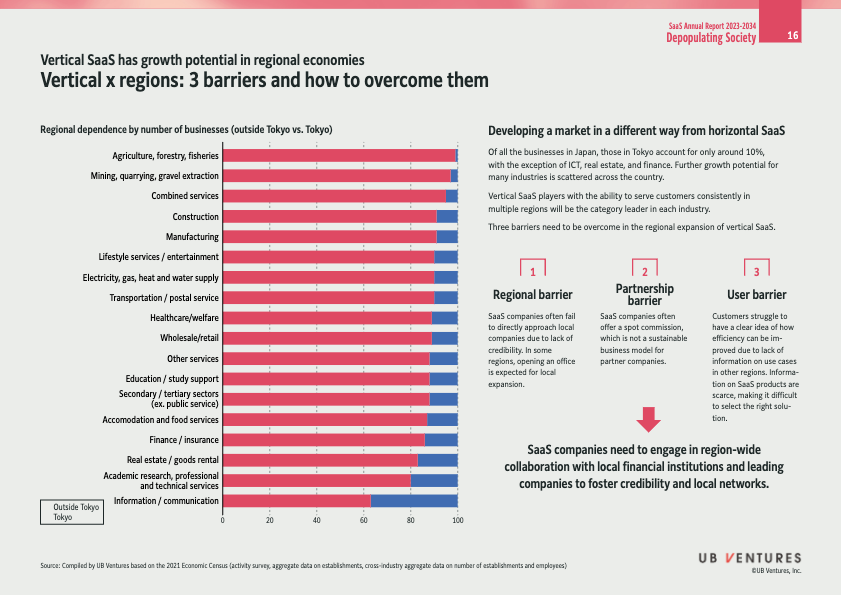
Vertical SaaS has significant growth potential in Japan's regional economies. While Tokyo hosts about 10% of all businesses (except ICT, real estate, and finance), other industries show potential across various regions. Success in regional expansion depends on overcoming several barriers.
Barriers to Regional Expansion
1. Regional Barrier
- Description: SaaS companies often struggle to gain credibility and directly approach local companies. In many regions, it's essential to establish a local presence through offices.
- Insight: Building trust through local engagement is crucial. Collaborating with local leaders and institutions can overcome this barrier.
2. Partnership Barrier
- Description: Offering spot commissions is common but isn't a sustainable business model for SaaS partners.
- Insight: Developing long-term, mutually beneficial partnerships could improve sustainability and collaboration.
3. User Barrier
- Description: Customers often lack information on SaaS products and use cases, making it hard to select the right solutions.
- Insight: Increasing user education and information flow can help customers make informed decisions. Providing localized user case studies may also aid in understanding benefits.
Regional Business Dependence
Here's a breakdown of regional dependence by industry, comparing businesses outside Tokyo to those within Tokyo:
| Industry | Outside Tokyo (%) | Tokyo (%) |
|---|---|---|
| Agriculture, forestry, fisheries | High | Low |
| Mining, quarrying, gravel extraction | High | Low |
| Combined services | Moderate | Moderate |
| Construction | Higher | Lower |
| Manufacturing | Higher | Lower |
| Lifestyle services / entertainment | Moderate | Higher |
| Electricity, gas, heat, and water supply | Higher | Lower |
| Transportation / postal service | Moderate | Moderate |
| Healthcare/welfare | Moderate | Moderate |
| Wholesale/retail | Higher | Lower |
| Other services | Moderate | Moderate |
| Education / study support | Higher | Lower |
| Secondary / tertiary sectors (ex. public service) | Moderate | Moderate |
| Accommodation and food services | Higher | Lower |
| Finance / insurance | Low | High |
| Real estate / goods rental | Low | High |
| Academic research, professional and technical | Moderate | Moderate |
| Information / communication | Low | High |
Strategic Recommendations
- Local Collaboration: Engage with local financial institutions and leading companies to enhance credibility and build networks.
- Sustainable Models: Develop sustainable partnership models beyond spot commissions.
- Information Access: Improve access to SaaS product information and regional use cases to aid customer decision-making.
These strategies can position Vertical SaaS companies as leaders in regional economies by addressing critical barriers effectively.
Extended readings:
Good and Bad Mindsets for SaaS Expansion
Overview
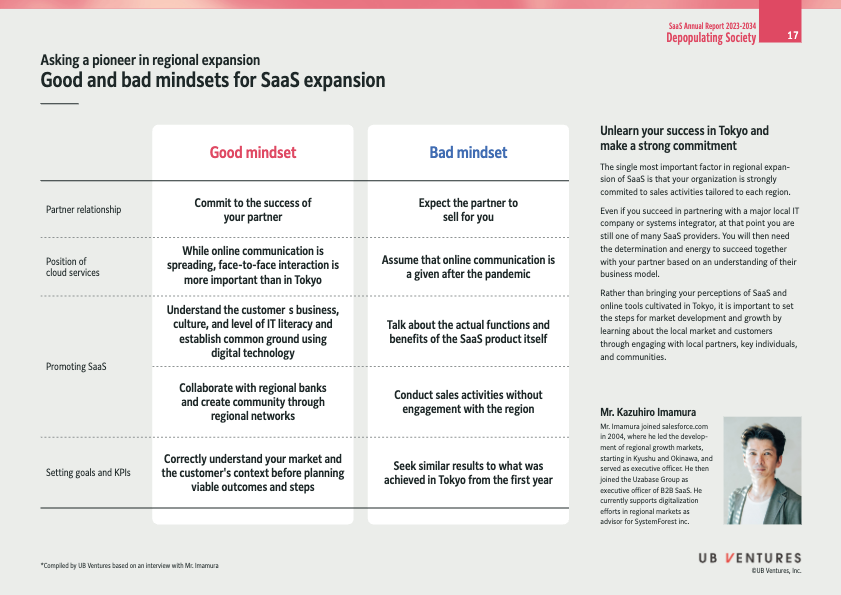
This document provides insights from Mr. Kazuhiro Imamura on effective strategies for SaaS expansion in regional markets. It emphasizes the importance of adapting approaches used in Tokyo to fit local contexts and highlights mindsets that contribute to successful regional expansion.
Good vs. Bad Mindsets
| Aspect | Good Mindset | Bad Mindset |
|---|---|---|
| Partner Relationship | Commit to the success of your partner. This creates mutual benefits and long-term relationships. | Expect the partner to sell for you, which can lead to disengagement and lack of trust. |
| Position of Cloud Services | While online communication is spreading, prioritize face-to-face interaction, especially outside major cities like Tokyo. | Assume that online communication is sufficient post-pandemic, possibly neglecting personal connections. |
| Promoting SaaS | Understand the customer’s business, culture, and IT literacy. Establish common ground using digital technology to ensure relevance. | Focus solely on the product’s functions and benefits without considering the user’s context. |
| Community Collaboration | Collaborate with regional banks and create community through regional networks to build trust and credibility. | Conduct sales without regional engagement can lead to missed opportunities and connections. |
| Setting Goals and KPIs | Correctly understand your market and customer context before planning viable outcomes and steps to ensure realistic expectations. | Seek results similar to Tokyo’s immediately, potentially ignoring differing market dynamics. |
Key Insights
- Localized Commitment: Customize sales activities for each region. A one-size-fits-all approach can ignore unique local market dynamics.
- Partner Synergy: Collaborate deeply with partners, learning about their business models to enhance mutual growth.
- Beyond Tokyo’s Success: Use experiences from Tokyo as a foundation, but adapt strategies by engaging with local communities and understanding regional needs.
About Mr. Kazuhiro Imamura
Mr. Imamura has extensive experience in developing regional growth markets. He began his career at Salesforce.com, later moving to the Uzabase Group, and currently advises SystemForest Inc. His work focuses on supporting digital transformation in regional markets.
Conclusion
For successful SaaS expansion, it is crucial to adopt a mindset that prioritizes local engagement and understanding. By building strong partnerships and customizing approaches, businesses can achieve sustainable growth in regional markets.
Extended readings:
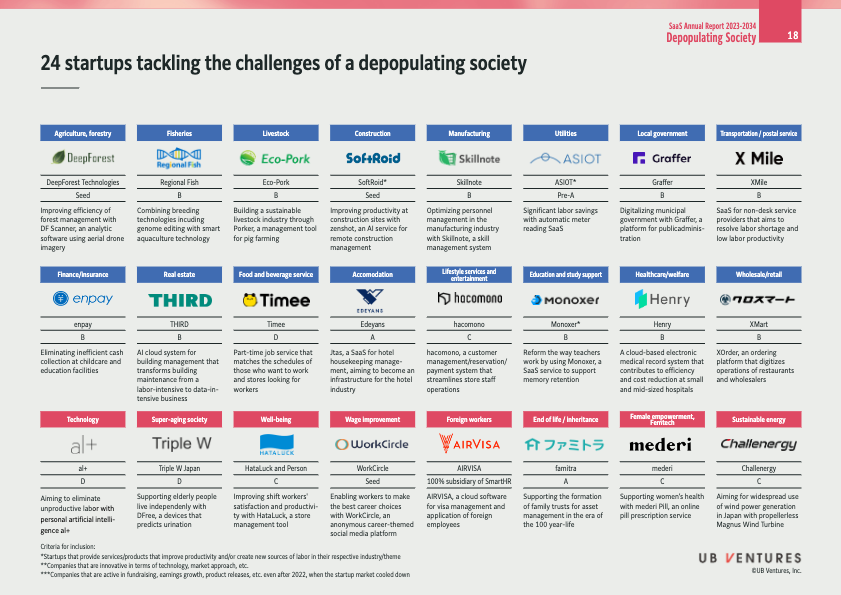
24 Startups Tackling the Challenges of a Depopulating Society
Agriculture, Forestry
- DeepForest Technologies: Focuses on improving forest management efficiency using DF Scanner, an analytic software with aerial drone imagery.
- Insight: Effective forestry management could help in sustainable resource use and environmental conservation.
Fisheries
- Regional Fish: Uses breeding technologies, including genome editing, combined with smart aquaculture.
- Insight: Advanced breeding techniques can enhance fish yield and sustainability in fisheries.
Livestock
- Eco-Pork: Aims to build a sustainable livestock industry through 'Porker', a management tool for pig farming.
- Insight: Streamlined livestock management could enhance productivity and sustainability in animal husbandry.
Construction
- SoftRoid: Offers AI-based services for remote construction management to boost productivity.
- Insight: Automation in construction can address labor shortages and enhance project efficiency.
Manufacturing
- Skillnote: Provides skill management systems to optimize personnel management in manufacturing.
- Insight: Effective workforce management is crucial in maintaining productivity in manufacturing sectors.
Utilities
- ASIOT: Develops solutions for significant labor savings with automatic meter reading SaaS.
- Insight: Automation in utilities management can lead to cost savings and efficiency improvements.
Local Government
- Graffer: Digitalizes municipal government operations to streamline public administration.
- Insight: Digitization in government can improve service delivery and citizen engagement.
Transportation / Postal Service
- XMile: Aims to enhance non-desk service provider operations to combat labor shortages.
- Insight: Efficiency in transportation services can improve overall logistics and supply chain effectiveness.
Finance / Insurance
- enpay: Eliminates inefficient cash collection in childcare and education facilities.
- Insight: Efficient financial transactions can support administrative operations in various sectors.
Real Estate
- THIRD: Offers AI cloud solutions transforming building management from labor-intensive to data-intensive processes.
- Insight: Data-driven management in real estate can optimize operations and maintenance.
Food and Beverage Service
- Timee: Provides part-time job services matching workers with store schedules.
- Insight: Flexible employment solutions can benefit both workers seeking part-time roles and businesses needing staff.
Accommodation
- Edeyans: A SaaS solution for hotel housekeeping management aiming to become industry infrastructure.
- Insight: Efficient management solutions are key in hospitality to maintain service standards.
Lifestyle Services and Entertainment
- hacomono: Provides a customer management system streamlining store operations.
- Insight: Integrated management systems can enhance customer service experiences.
Education and Study Support
- Monoxer: Reforms educational methods by supporting memory retention through SaaS.
- Insight: Innovative educational tools can improve learning outcomes and teacher efficiency.
Healthcare / Welfare
- Henry: Cloud-based electronic medical records system for small and mid-sized hospitals.
- Insight: Digitized healthcare records can enhance patient care and reduce operational costs.
Wholesale / Retail
- XMart: Develops a platform for digitizing restaurant and wholesaler operations.
- Insight: Digital transaction platforms can streamline vendor operations and improve service delivery.
Technology
- al+ : Targets eliminating unproductive labor through personal AI.
- Insight: AI in technology can significantly alter labor dynamics and enhance productivity.
Super-Aging Society
- Triple W Japan: Supports elderly living autonomy with predictive urination devices.
- Insight: Health tech innovations can improve the quality of life for aging populations.
Well-being
- HataLuck and Person: Boosts worker satisfaction and productivity using management tools.
- Insight: Tools that enhance workplace satisfaction can lead to improved performance and retention.
Wage Improvement
- WorkCircle: Empowers workers in making career decisions via a social media platform.
- Insight: Career guidance platforms can support informed career growth decisions for workers.
Foreign Workers
- AIRVISA: Cloud software for managing visas and applications for foreign employees.
- Insight: Efficient management of foreign workers can ease integration and compliance processes.
End of Life / Inheritance
- famitra: Supports family trust formation for asset management in a long-lived society.
- Insight: Planning tools can assist in effective wealth transfer in aging demographics.
Female Empowerment, Femtech
- mederi: Offers an online pill prescription service supporting women’s health.
- Insight: Femtech solutions enhance women's health management and access to care.
Sustainable Energy
- Challenergy: Develops wind turbines aiming for extensive adoption of wind power in Japan.
- Insight: Sustainable energy solutions are crucial in transitioning to a greener future.
Extended readings:
Issues and Solutions in the Construction Industry
Fact
-
Worker Shortage Prediction
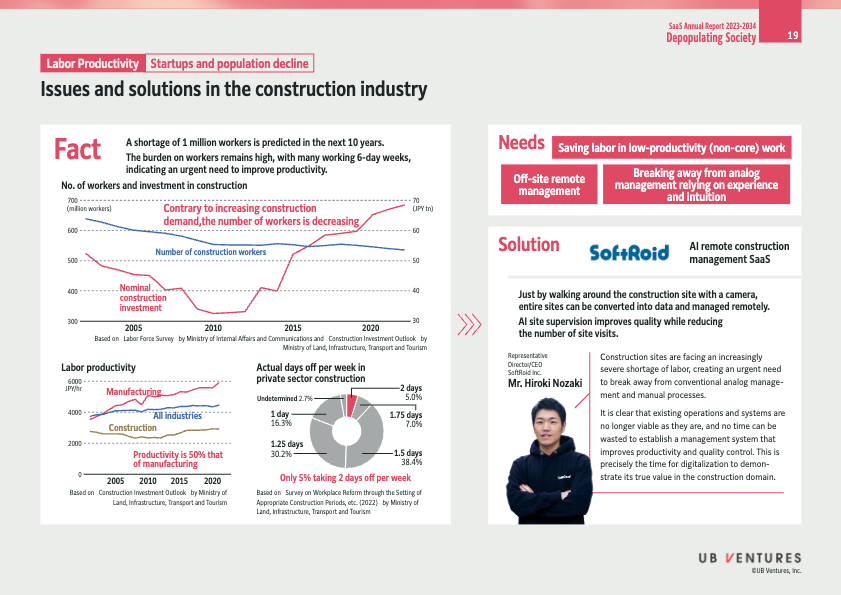
- A shortage of 1 million workers is anticipated over the next 10 years.
- Explanation: The construction industry faces a declining workforce against a backdrop of high demand, increasing the burden on existing workers.
-
Labor Burden
- Most workers endure 6-day work weeks, highlighting severe productivity issues.
- Insight: This high workweek norm indicates a need for better work-life balance and efficiency improvements.
Key Data
Number of Workers and Investment in Construction
- Trends (2005-2020)
- While construction demand increases, the number of workers decreases.
- Nominal construction investment has fluctuated but generally increased.
Labor Productivity
- Comparison with Manufacturing
- Productivity in construction is only 50% of that in manufacturing.
- Idea: Strategies to boost productivity should borrow from manufacturing efficiencies.
Actual Days Off Per Week in Private Sector Construction
- Statistics
- 38.4% of workers take 1.5 days off per week.
- Only 5% of workers take 2 full days off weekly.
Days Off Percentage 2 Days 5.0% 1.75 Days 7.0% 1.5 Days 38.4% 1.25 Days 30.2% 1 Day 16.3% Undetermined 2.7%
Needs
- Efficiency Improvements
- Save labor in non-core low-productivity tasks.
- Implement off-site remote management.
- Transition from analog management based on experience and intuition.
Solution: SoftRoid
-
AI Remote Construction Management SaaS
- Method: Capturing site data with a camera for remote management.
- Result: AI supervision enhances quality and reduces site visit frequency.
- Significance: Digital transformation is critical to addressing labor shortages by optimizing operations.
-
Leadership
- Representative: Mr. Hiroki Nozaki, Director/CEO of SoftRoid Inc.
Insight: This approach underscores the shift towards digital solutions to meet the growing demands and constraints of modern construction sites.
Issues and Solutions in Employment of Foreign Workers
Overview
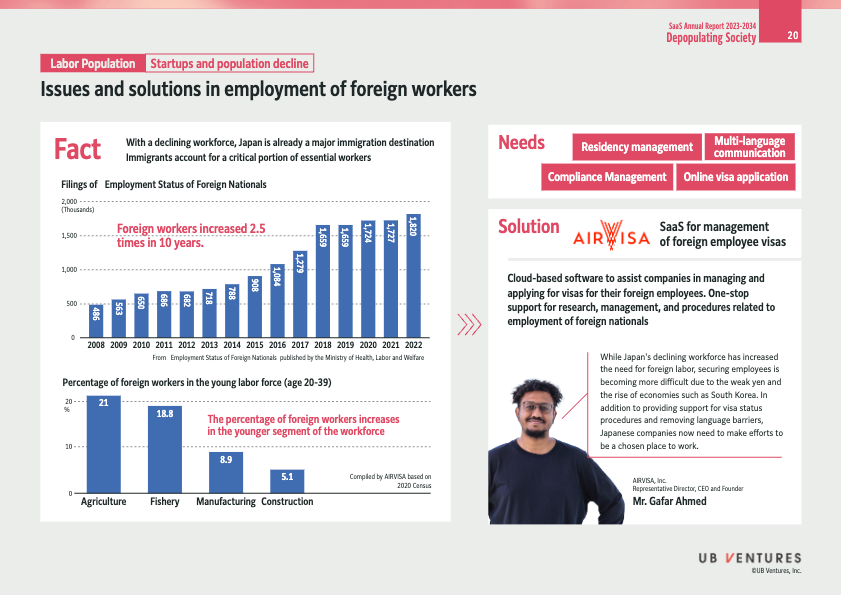
Japan's declining workforce has increased its reliance on foreign workers. Immigrants play a crucial role in maintaining essential services due to a shrinking native workforce.
Trends and Statistics
-
Increase in Foreign Workers:
- From 2008 to 2022, the number of foreign workers in Japan increased 2.5 times.
- The number of filings for employment status of foreign nationals rose from 486,000 in 2008 to 1,820,000 in 2022.
Year Employment Filings (Thousands) 2008 486 2022 1,820 -
Young Labor Force Participation:
- A significant portion of foreign workers are young (age 20-39).
- The percentage of foreign workers is highest in agriculture (21%) and lowest in construction (5.1%).
Sector Percentage of Young Foreign Workers (%) Agriculture 21.0 Fishery 18.8 Manufacturing 8.9 Construction 5.1
Needs and Challenges
- Key Requirements:
- Residency management
- Multi-language communication
- Compliance management
- Online visa application
- Challenges:
- Declining domestic workforce
- Economic conditions (e.g., weak yen)
- Competing economies (e.g., South Korea)
Solutions
-
AIRVISA: SaaS for Foreign Employee Visa Management:
- A cloud-based platform that assists companies in managing visas for foreign employees.
- Provides comprehensive support for research, management, and compliance related to employing foreign nationals.
- Aims to streamline visa applications and overcome language barriers, making Japan a more attractive place to work.
-
Strategic Adjustments:
- Companies are encouraged to improve work conditions to attract foreign talent.
- Focus on creating a supportive and inclusive work environment for international employees.
Key Insight
While Japan faces demographic challenges, leveraging technology like AIRVISA can help manage and integrate foreign labor effectively. This presents opportunities for innovation in HR practices and increased competitiveness in the global market.
Extended readings:
UB Ventures Overview
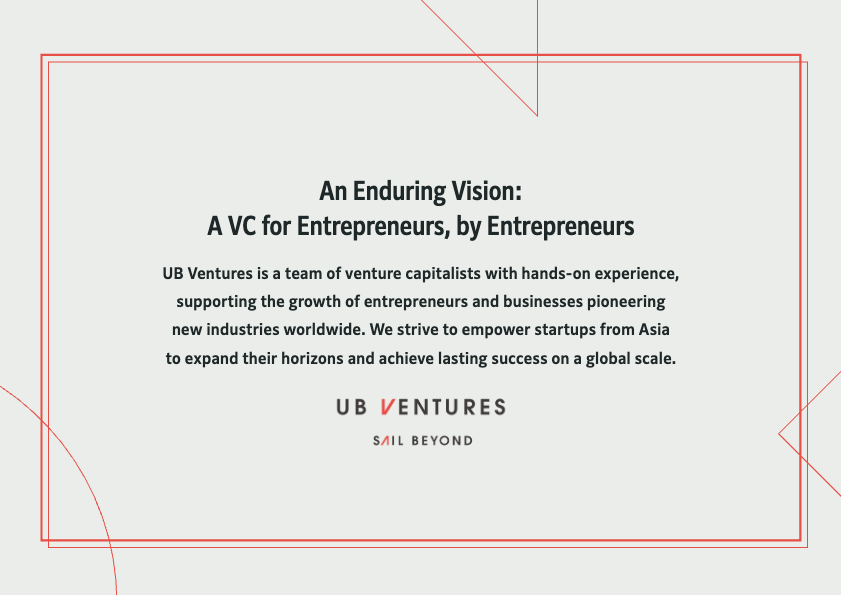
Vision and Mission
- Enduring Vision: UB Ventures aspires to be a venture capital leader by entrepreneurs, for entrepreneurs.
- Insight: This vision highlights a peer-to-peer approach, suggesting they understand the challenges and opportunities entrepreneurs face.
- Additional Information: Venture capital (VC) firms invest in startups and small businesses with perceived long-term growth potential.
Team and Approach
- Hands-on Experience: The team comprises venture capitalists with direct entrepreneurial experience.
- Insight: This can make UB Ventures particularly valuable to startups, as the team is likely to provide mentorship and practical business insights.
- Additional Information: "Hands-on" typically means they are actively involved, beyond just financial investment.
Global Focus
- Supporting Industry Pioneers: Aimed at fostering growth for businesses that are innovating across global markets.
- Insight: Their focus might be on sectors that are ripe for innovation and disruption, which can provide high returns but also entail high risk.
Regional Empowerment
- Asian Startups: Emphasis on empowering Asian startups to achieve global success.
- Insight: This suggests a strong understanding of regional markets and opportunities, and the potential to leverage local innovations on a global stage.
- Additional Information: Asia's growing economy and tech scene provide numerous opportunities for startup growth.
Slogan
- Sail Beyond: This slogan suggests a focus on ambitious, forward-thinking growth and exploration.
- Insight: It implies a commitment to helping businesses navigate beyond their current capabilities and markets.
Brand Identity
- Logo and Design: The branding, including the logo with "UB Ventures" and "Sail Beyond," emphasizes a modern and dynamic approach.
- Insight: Effective branding can attract potential entrepreneurs and partners by conveying professionalism and innovation.
Extended readings:
UB Ventures, Inc. Overview
Company Profile
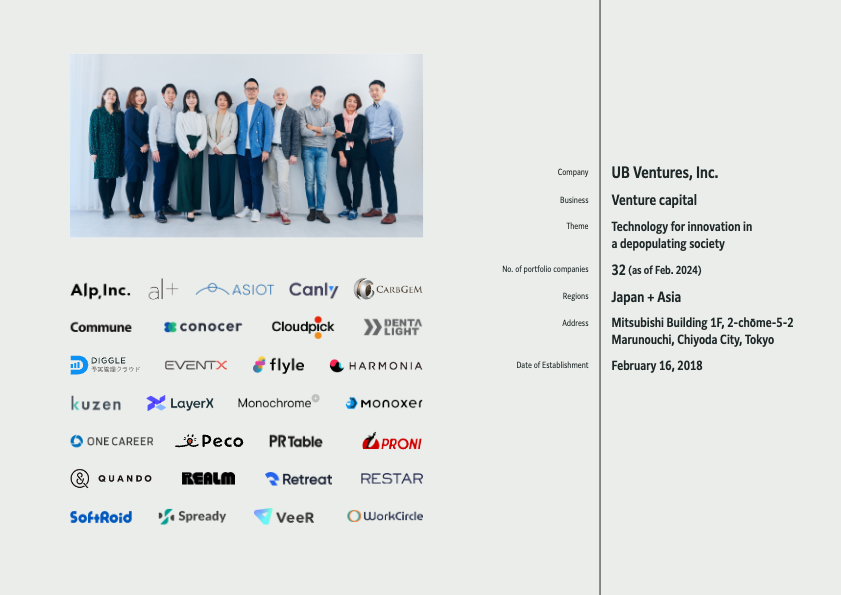
Name: UB Ventures, Inc.
Business: Venture Capital
Theme: Technology for innovation in a depopulating society
Insight: The focus on depopulation suggests investment in solutions that address challenges such as workforce shortages, elder care, and rural revitalization.
Number of Portfolio Companies: 32 (as of February 2024)
Insight: A moderate-sized portfolio allows for focused nurturance of startups, fostering growth through targeted mentorship and investment.
Regions: Japan + Asia
Insight: Focusing on Asia, especially Japan, indicates investments in a region with unique demographic challenges and opportunities for technological advancement.
Address: Mitsubishi Building 1F, 2-chōme-5-2 Marunouchi, Chiyoda City, Tokyo
Insight: The location in Tokyo’s business district reflects a strategic position within a major financial and innovation hub.
Date of Establishment: February 16, 2018
Insight: Being relatively new allows the firm to leverage modern technologies and methodologies in venture capital.
Portfolio Companies
UB Ventures includes a diverse range of companies in its portfolio:
- Alp, Inc.
- alt
- ASIOT
- Canly
- CarbGem
- Commune
- conocer
- Cloudpick
- Denta Light
- DIGGLE
- EVENTX
- flyle
- HARMONIA
- kuzen
- LayerX
- Monochrome®
- monoxer
- ONE CAREER
- Peco
- PR Table
- PRONI
- QUANDO
- REALM
- Retreat
- RESTAR
- SoftRoid
- Spready
- VeeR
- WorkCircle
Insight: These companies span various industries, indicating a diversified investment strategy aiming to mitigate risks associated with sector-specific downturns.
Additional Observations
- Innovation Focus: The emphasis on technology highlights a strong interest in scalable, impactful solutions.
- Regional Specialization: Although the focus is on Japan and Asia, these regions offer unique demographic and market challenges for innovative solutions.
Key Terms:
- Venture Capital: A form of private equity financing provided to startups and small businesses with perceived long-term growth potential.
- Portfolio Companies: Companies in which a venture capital firm has invested. Their progress reflects the success and strategic direction of the venture firm.
Extended readings:
Tackling Japan's Social Issue of Depopulation
Our Purpose
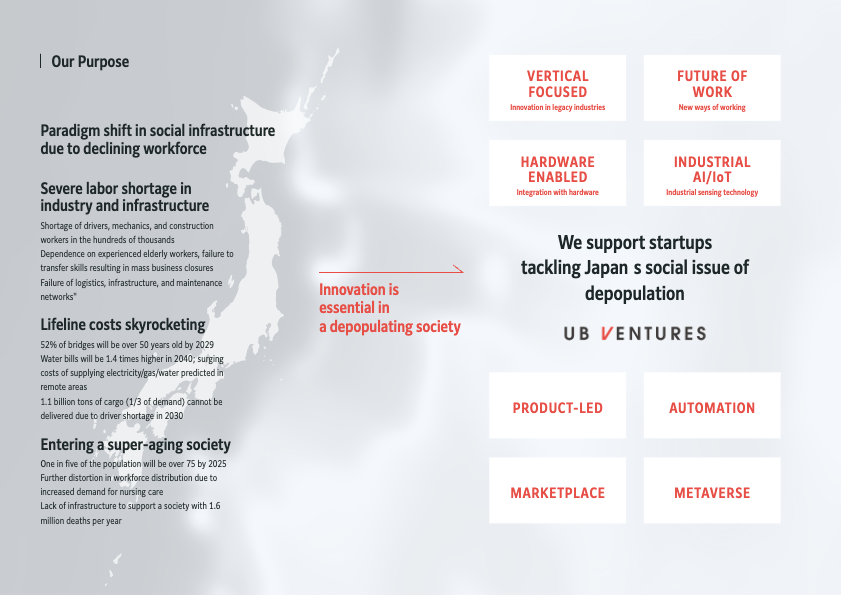
Paradigm Shift in Social Infrastructure
- Declining Workforce
- Severe labor shortages in key sectors such as drivers, mechanics, and construction.
- Heavy reliance on experienced elderly workers, risking skill gaps and business closures.
- Insight: As the workforce ages, transferring skills effectively is critical to sustaining industries.
Lifeline Costs Skyrocketing
- Aging Infrastructure
- By 2029, 52% of bridges will be over 50 years old.
- Water bills are expected to increase by 1.4 times in 2040.
- Costs for essential services like electricity, gas, and water will rise significantly, challenging remote areas.
- Insight: Investing in infrastructure renewal can mitigate skyrocketing costs and ensure service continuity.
Entering a Super-Aging Society
- Demographic Changes
- By 2025, one in five individuals will be over 75.
- Workforce distribution will skew toward nursing care due to increased demand.
- Infrastructure must evolve to handle 1.6 million deaths annually.
- Insight: Supporting advancements in healthcare and eldercare is vital.
Innovation Areas
-
Vertical Focused
- Innovating within legacy industries to modernize practices.
- Insight: Longstanding industries can benefit from integrating new technologies to remain competitive.
-
Future of Work
- Embracing new work methodologies and environments.
- Insight: Flexible work environments can attract younger talent and improve efficiency.
-
Hardware Enabled
- Integration with cutting-edge hardware technologies.
- Insight: Enhancing productivity and precision through hardware innovations.
-
Industrial AI/IoT
- Leveraging industrial sensing technology to optimize operations.
- Insight: Data-driven approaches can significantly boost operational efficiency.
-
Product-Led
- Focus on creating products that drive growth and innovation.
- Insight: Product innovation is key to maintaining market relevance.
-
Automation
- Utilizing automation to handle routine tasks and mitigate labor shortages.
- Insight: Automation can fill gaps in the workforce and reduce manual errors.
-
Marketplace
- Developing platforms that connect supply and demand efficiently.
- Insight: Digital marketplaces can streamline transactions and expand reach.
-
Metaverse
- Exploring the potential of virtual spaces for collaboration and business.
- Insight: The metaverse offers new avenues for engagement and interaction.
Supporting Startups
- Objective
- UB Ventures is committed to supporting startups that tackle the challenge of depopulation in Japan.
- Insight: Startups are poised to drive innovative solutions that address societal challenges effectively.
Extended readings:
UB Ventures SaaS Annual Report 2023-2024
Overview
Direction and Management
-
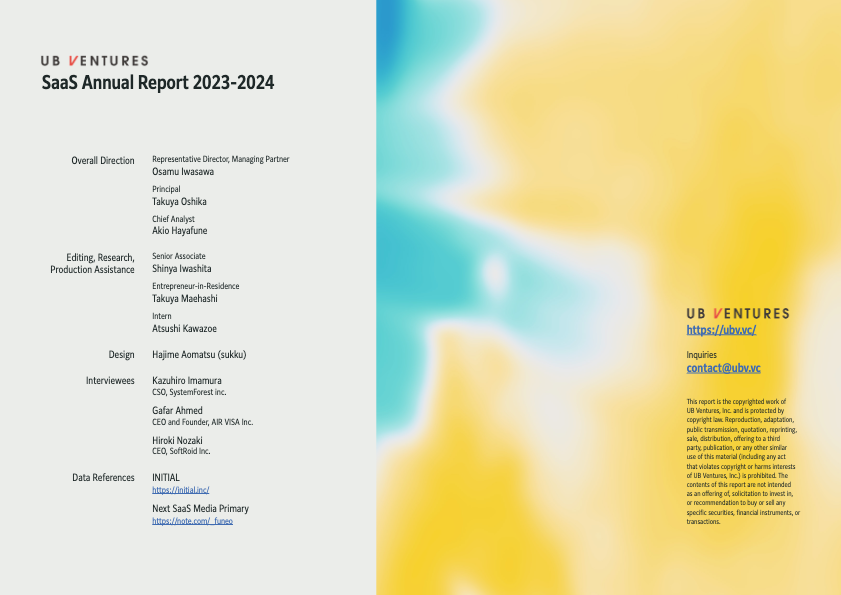
Overall Direction:
- Representative Director, Managing Partner: Osamu Iwasawa
- Principal: Takuya Oshika
- Chief Analyst: Akio Hayafune
Insight: Leadership plays a crucial role in guiding the direction and strategic decisions of the company. Osamu Iwasawa, as the managing partner, largely influences the vision and goals of UB Ventures.
Team Roles
-
Editing, Research, Production Assistance:
- Senior Associate: Shinya Iwashita
- Entrepreneur-in-Residence: Takuya Maehashi
- Intern: Atsushi Kawazoe
Insight: A diverse team in terms of roles ensures a holistic approach to research and production, allowing for innovative thinking, especially with the inclusion of an Entrepreneur-in-Residence.
Design
-
Designer: Hajime Aomatsu (sukku)
Insight: Design in reports is essential for clarity and engagement, facilitating better understanding through visual aids.
Interviews
-
Kazuhiro Imamura: CSO, SystemForest Inc.
-
Gafar Ahmed: CEO and Founder, AIR VISA Inc.
-
Hiroki Nozaki: CEO, SoftRoid Inc.
Insight: Interviews with industry leaders provide invaluable insights into the SaaS sector and help identify emerging trends and challenges.
Data References
-
INITIAL: https://initial.inc/
-
Next SaaS Media Primary: https://note.com/_funeo
Insight: Access to reliable data sources is vital for accurate analysis and reporting, allowing companies to make informed decisions.
Contact and Inquiries
-
Website: UB Ventures
-
Email: contact@ubv.vc
Insight: Clear communication channels are important for engagement with stakeholders and ensuring transparency.
Copyright Note
-
Protection: The report is copyrighted by UB Ventures, Inc. Any form of reproduction, adaptation, or distribution without permission is prohibited.
Insight: Copyright laws protect the interests of the company and ensure the integrity and originality of their work.
These notes capture the key elements of UB Ventures' SaaS Annual Report, highlighting the organizational structure, collaborative efforts, and compliance measures in place.
Extended readings: