**Title: Academic Writing: Structure, Clarity, and Style**
Language Style Guidelines
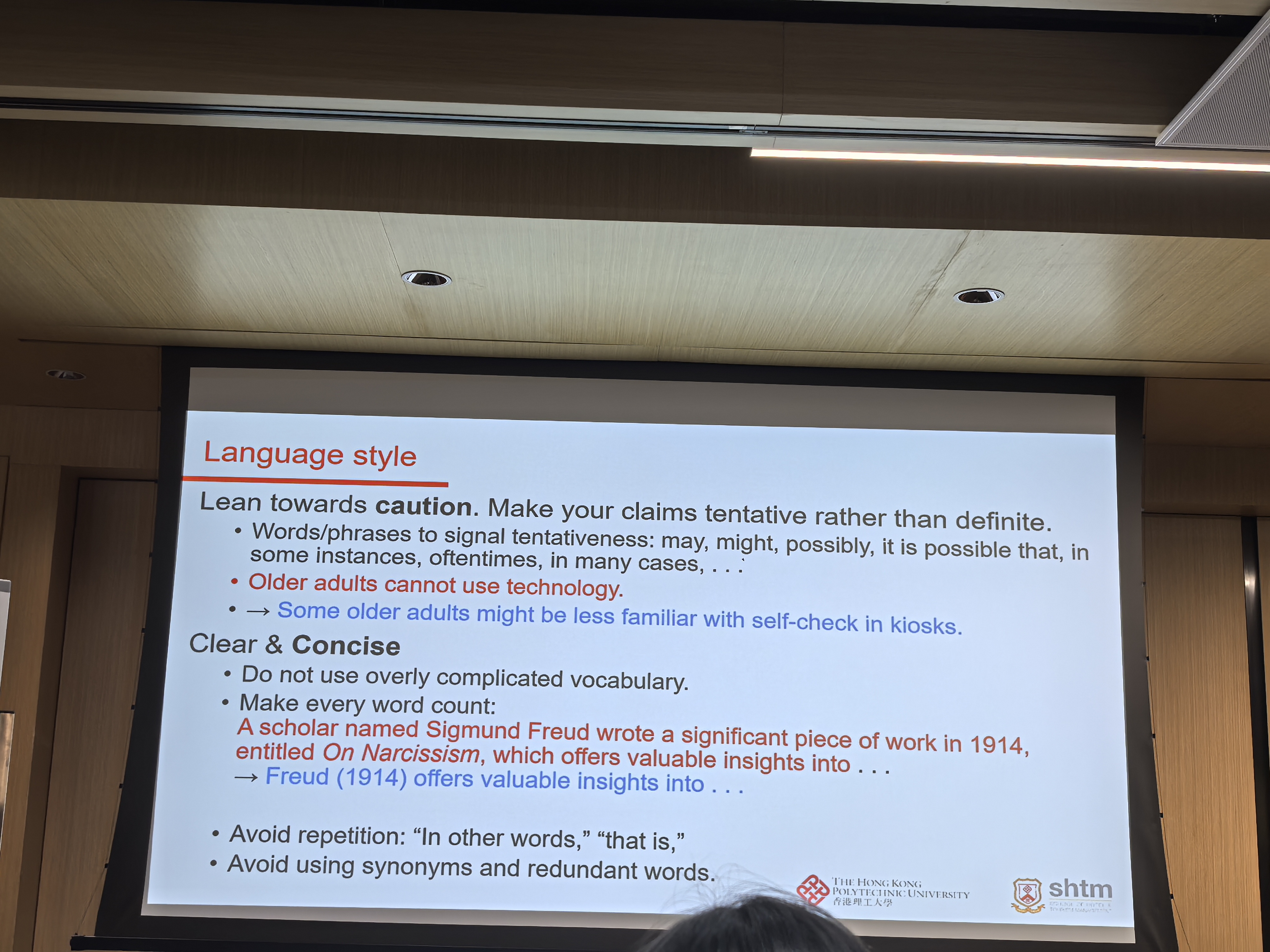
Lean Towards Caution
-
Make Your Claims Tentative Rather Than Definite:
- Using cautious language is crucial in academic writing. Words and phrases like "may," "might," and "possibly" help avoid over-generalizations or strong assertions that cannot be supported by evidence. This approach aligns with the concept of maintaining academic integrity and encouraging critical thinking.
-
Older Adults and Technology:
- Original statement: "Older adults cannot use technology."
- Revised suggestion: "Some older adults might be less familiar with self-check in kiosks."
- This revision highlights the variation in technological proficiency among older adults without stereotyping or making absolute statements.
Clear & Concise
-
Avoid Complicated Vocabulary:
- Using simple and clear language ensures that the message is accessible to a wider audience. Overly complex vocabulary can alienate readers and obscure the intended meaning.
-
Make Every Word Count:
- Original example: "A scholar named Sigmund Freud wrote a significant piece of work in 1914, entitled On Narcissism, which offers valuable insights into ..."
- Revised suggestion: "Freud (1914) offers valuable insights into ..."
- This revision illustrates the importance of brevity and clarity, emphasizing the significance of being concise in academic writing.
Avoid Redundancy
-
Avoid Repetition:
- Using phrases like "In other words," and "that is," can lead to redundancy. Instead, strive for a more seamless integration of ideas without unnecessary repetition or filler phrases.
-
Avoid Synonyms and Redundant Words:
- This reminder emphasizes the importance of precision in language. Using varied but far-reaching synonyms can dilute the main argument or point, so it's crucial to choose words that convey the intended meaning effectively.
By adhering to these guidelines, writers can enhance the clarity and professionalism of their academic writing, making their arguments more compelling and easier to understand.
Reference:
libguides.usc.edu
Academic Writing Style - Organizing Your Social Sciences Research ...
lpsonline.sas.upenn.edu
The difference between academic and professional writing
edis.ifas.ufl.edu
Guidelines for Effective Professional and Academic Writing - Ask IFAS
Sentences and Paragraphs
Key Points Before Writing
-
Think and Plan
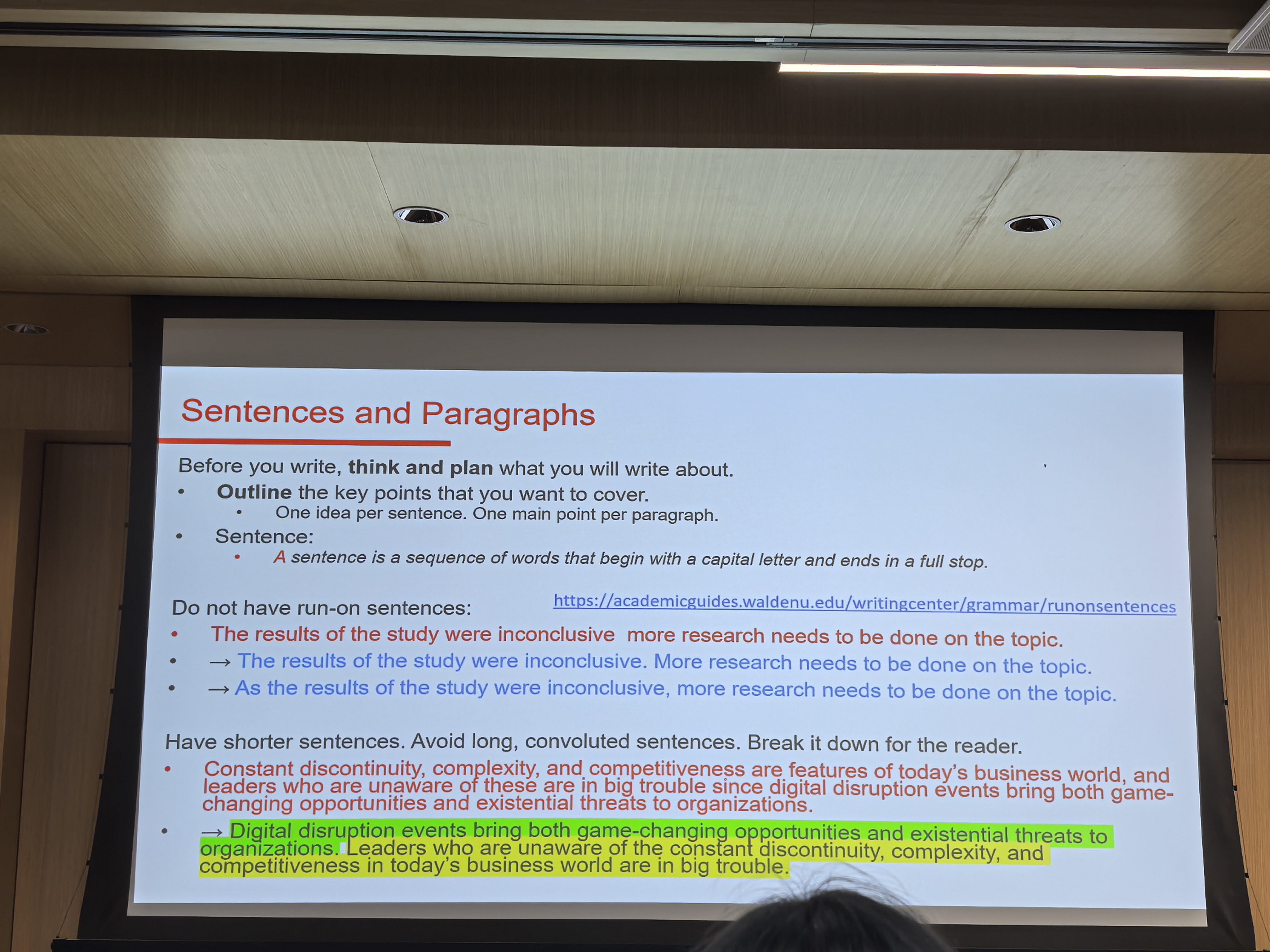
- It is crucial to have a clear idea of what you want to express in your writing before starting.
- This can prevent writer's block and ensures structured communication.
-
Outline Key Points
- Creating an outline helps organize thoughts and highlights the main points.
- One idea per sentence and one main point per paragraph encourages clarity.
Definition of a Sentence
- Sentence Structure
- A sentence is defined as a group of words starting with a capital letter and concluding with a full stop.
- This basic structure is essential for coherent writing.
Avoiding Run-On Sentences
- Clarity in Research Statements
- Example of a run-on sentence: "The results of the study were inconclusive..."
- This can be rewritten for clarity as:
- "The results of the study were inconclusive. More research needs to be done on the topic."
- Maintaining clear, separate statements improves comprehension.
Importance of Shorter Sentences
- Simplicity Over Complexity
- Short, clear sentences are preferable to long, convoluted ones. They aid readability and comprehension.
- For example:
- Original: "Constant discontinuity, complexity, and competitiveness are features of today’s business world..."
- Suggestion: Break down into simpler statements for better understanding.
Digital Disruption Context
- Impact on Organizations
- Digital disruption presents both opportunities and threats to organizations.
- Leaders need to be aware of these factors to navigate challenges and leverage opportunities effectively.
Summary
Understanding sentence structure, clarity in communication, and the importance of short sentences can significantly enhance writing quality, especially in academic contexts. Outlining and revising statements can lead to clearer and more impactful writing.
Reference:
academicguides.waldenu.edu
Run-On Sentences and Sentence Fragments - Grammar
www.quora.com
What is a run-on sentence, and how can you avoid writing one?
www.quora.com
Why do people use run-on sentences? - Quora