Tax Bureau Reorganization and Decentralization Overview
Tax Bureau Reorganization and Decentralization
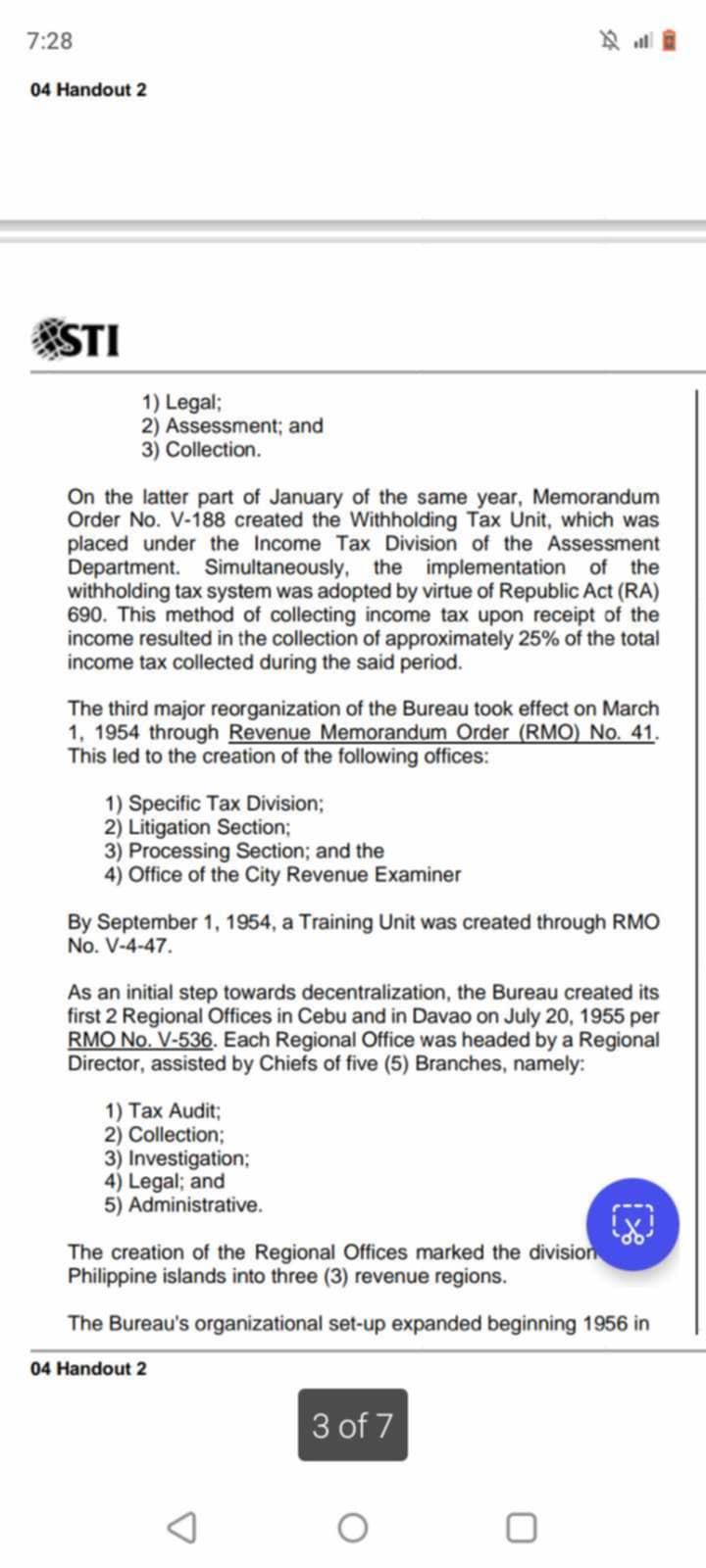
Key Functions of the Bureau
-
Legal
- Involves the interpretation and application of tax laws.
- Ensures compliance with legal standards and regulations.
-
Assessment
- Evaluates tax liabilities and ensures accurate tax collection.
- Important for maintaining fiscal accountability.
-
Collection
- Focuses on the efficient collection of taxes.
- Essential for funding government operations and services.
Withholding Tax Unit Creation
- Memorandum Order No. V-188: Established the Withholding Tax Unit in January.
- Placed under the Income Tax Division of the Assessment Department.
- Implemented via Republic Act (RA) 690.
- Resulted in collecting approximately 25% of total income tax during the period.
Major Reorganization (March 1, 1954)
- Revenue Memorandum Order (RMO) No. 41: Led to the creation of new offices:
- Specific Tax Division
- Litigation Section
- Processing Section
- Office of the City Revenue Examiner
Training Unit Establishment
- September 1, 1954: Training Unit created through RMO No. V-4-47.
- Aimed at enhancing the skills and knowledge of tax personnel.
Decentralization and Regional Offices
-
July 20, 1955: Establishment of Regional Offices in Cebu and Davao per RMO No. V-536.
- Each office led by a Regional Director with five branch chiefs:
- Tax Audit
- Collection
- Investigation
- Legal
- Administrative
- Each office led by a Regional Director with five branch chiefs:
-
Impact: Division of the Philippine islands into three revenue regions.
- Facilitated more localized and efficient tax administration.
Expansion of Organizational Set-up
- Beginning 1956: Continued expansion of the Bureau's organizational structure.
- Aimed at improving tax administration and service delivery across regions.
Bureau of Internal Revenue (BIR) Developments
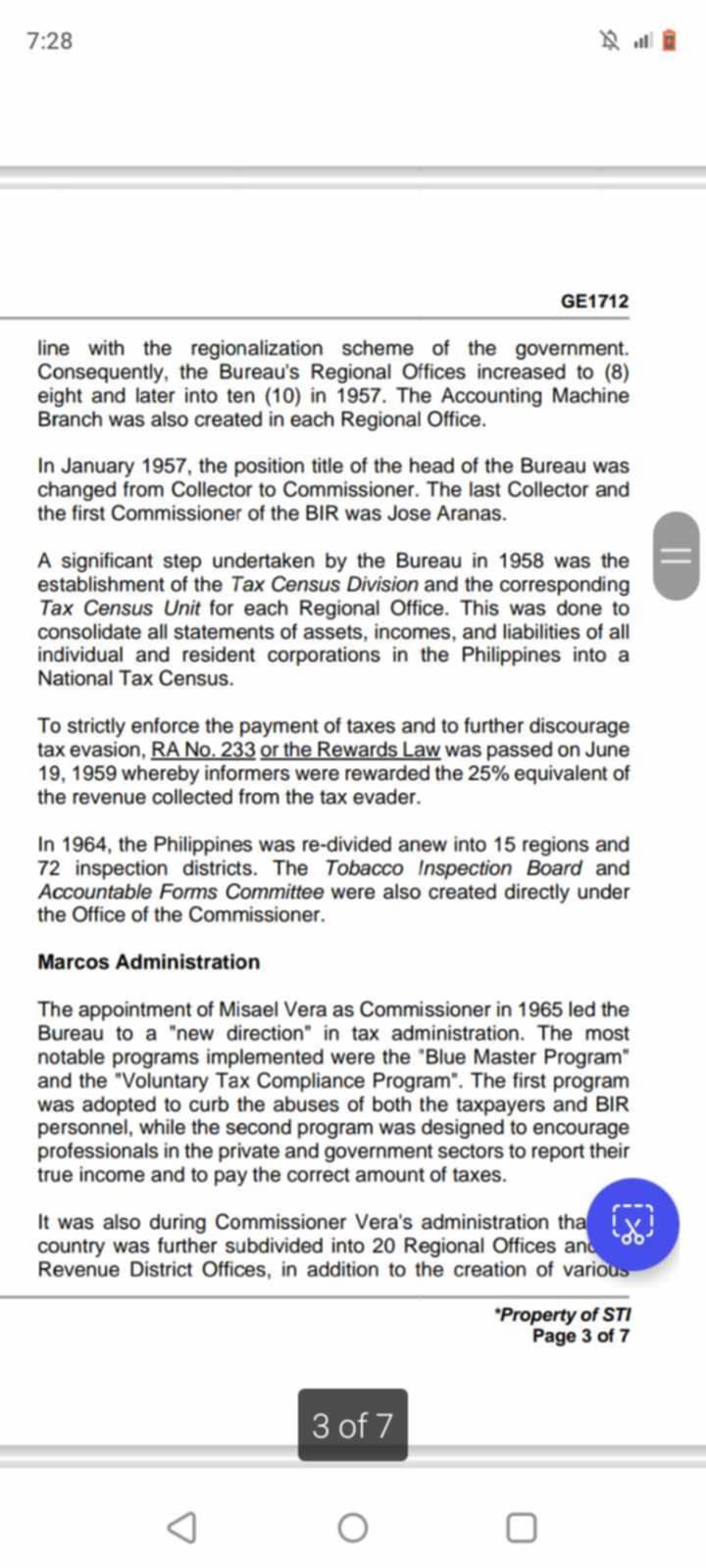
Regionalization and Structural Changes
-
Expansion of Regional Offices (1957)
- The number of Regional Offices increased from 8 to 10.
- An Accounting Machine Branch was established in each office.
- Insight: This expansion likely aimed to improve tax administration efficiency and coverage.
-
Change in Leadership Title (January 1957)
- The head of the Bureau's title changed from Collector to Commissioner.
- Jose Aranas was the last Collector and the first Commissioner.
- Insight: This change reflects a shift towards a more formalized and structured leadership approach.
Tax Census and Enforcement
-
Establishment of Tax Census Division (1958)
- Created to consolidate financial statements of individuals and corporations.
- Aimed to form a National Tax Census.
- Insight: This initiative was crucial for accurate tax data collection and analysis.
-
Rewards Law (RA No. 233) (1959)
- Introduced to enforce tax payments and discourage evasion.
- Informers received 25% of the revenue collected from tax evaders.
- Insight: This law incentivized public participation in tax enforcement.
Administrative Reorganization
- Re-division of the Philippines (1964)
- Divided into 15 regions and 72 inspection districts.
- Creation of the Tobacco Inspection Board and Accountable Forms Committee.
- Insight: These changes aimed to streamline operations and improve regulatory oversight.
Marcos Administration Initiatives
-
Appointment of Misael Vera as Commissioner (1965)
- Led to a "new direction" in tax administration.
- Introduction of the "Blue Master Program" and "Voluntary Tax Compliance Program."
- Insight: These programs targeted both taxpayer compliance and internal abuses.
-
Further Subdivision and Office Creation
- Country subdivided into 20 Regional Offices and Revenue District Offices.
- Insight: This further subdivision likely aimed to enhance local tax administration and service delivery.
These developments reflect a period of significant transformation in the BIR, focusing on improving efficiency, compliance, and administrative structure.
Tax Bureau Developments and Reforms
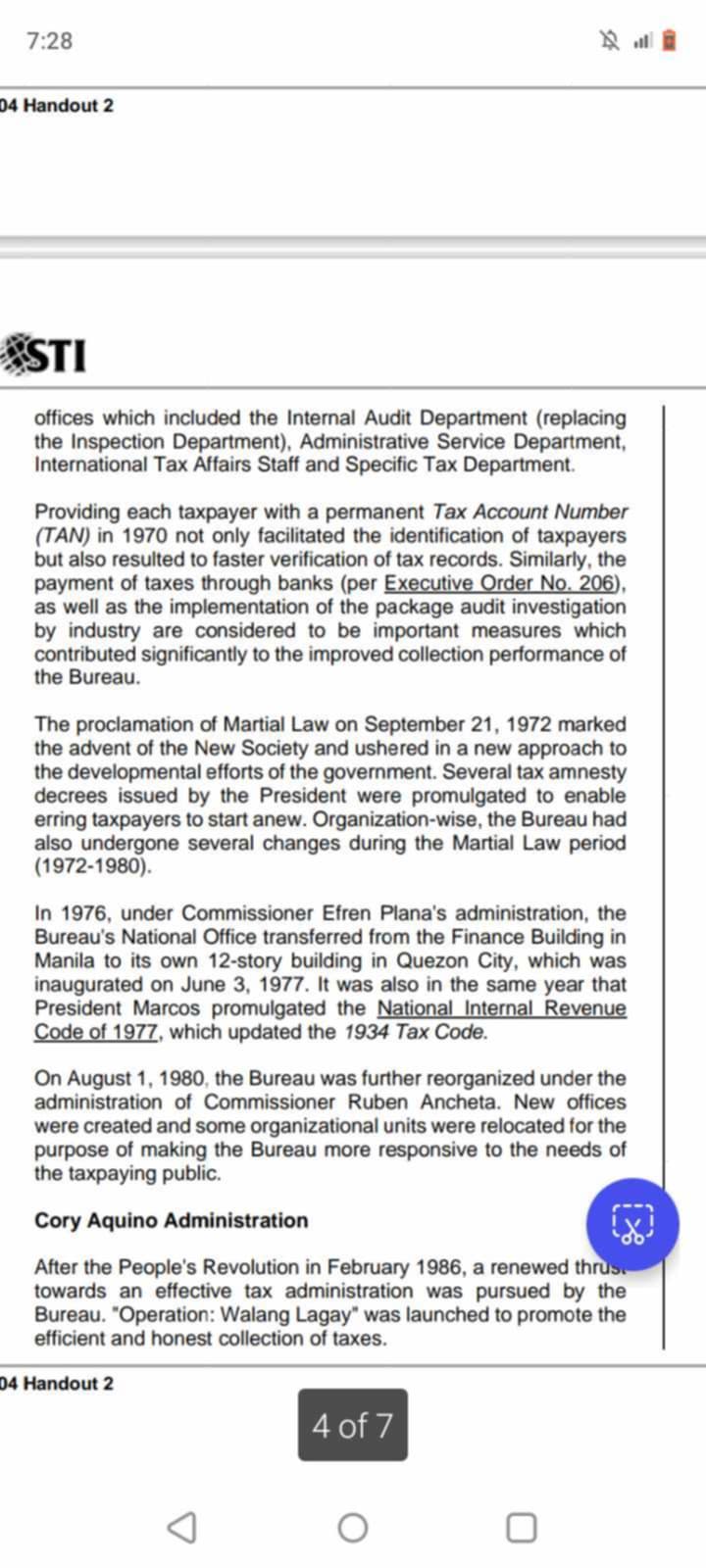
Internal Reorganization
-
New Departments:
- Internal Audit Department: Replaced the Inspection Department.
- Administrative Service Department: Focused on internal operations.
- International Tax Affairs Staff: Managed international tax issues.
- Specific Tax Department: Handled specific tax categories.
Insight: These changes aimed to streamline operations and improve efficiency in tax administration.
Tax Account Number (TAN)
-
Introduction in 1970:
- Facilitated taxpayer identification.
- Enabled faster verification of tax records.
- Supported tax payments through banks (Executive Order No. 206).
Insight: TAN was crucial for modernizing tax processes and enhancing compliance.
Martial Law Period (1972-1980)
-
Impact:
- New societal approach to government development.
- Tax amnesty decrees allowed erring taxpayers to start anew.
- Organizational changes to adapt to new policies.
Insight: This period marked significant shifts in tax policy and administration, reflecting broader governmental changes.
Relocation and Code Update
-
1976-1977 Developments:
- National Office moved to a new building in Quezon City.
- Introduction of the National Internal Revenue Code of 1977, updating the 1934 Tax Code.
Insight: These changes were part of efforts to modernize and centralize tax administration.
Further Reorganization in 1980
-
Under Commissioner Ruben Ancheta:
- New offices and relocation of units to better serve taxpayers.
Insight: This reorganization aimed to make the Bureau more responsive and efficient.
Cory Aquino Administration
-
Post-1986 Reforms:
- Focus on effective tax administration.
- Launch of "Operation: Walang Lagay" to ensure honest tax collection.
Insight: These reforms were part of a broader push for transparency and efficiency in government operations following the People's Revolution.