SaaS Resilience in Japan's Depopulating Landscape
Key Themes to Tackle Population Decline
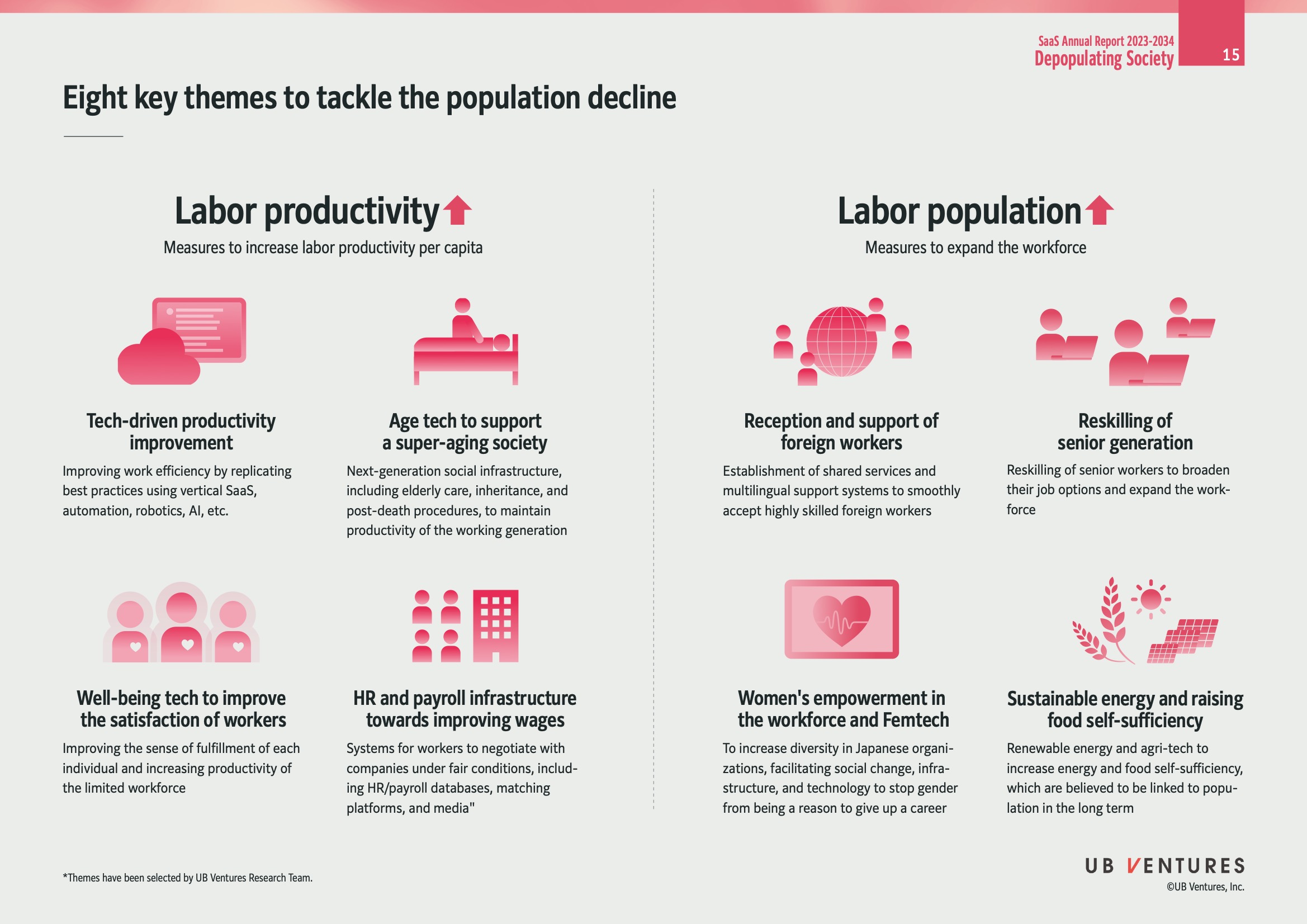
Labor Productivity
Measures to increase labor productivity per capita.
Tech-Driven Productivity Improvement
- Objective: Enhance work efficiency through technology.
- Methods: Utilize vertical SaaS, automation, robotics, and AI.
- Insight: Integrating these technologies can streamline processes and reduce manual labor, leading to cost savings and higher productivity.
Age Tech to Support a Super-Aging Society
- Objective: Maintain productivity in an aging population.
- Services: Focus on elderly care, inheritance, and post-death procedures.
- Insight: Investing in technology that supports elder care can free up the working-age population, reducing caregiver burnout and maintaining economic stability.
Well-being Tech to Improve Worker Satisfaction
- Objective: Increase fulfillment and productivity among workers.
- Methods: Enhance quality of life through tech solutions.
- Insight: Employee satisfaction is directly linked to productivity. Providing tools that enhance well-being can lead to more engaged and efficient workers.
HR and Payroll Infrastructure Toward Improving Wages
- Objective: Enable fair wage negotiations.
- Systems: Use of HR/payroll databases and matching platforms.
- Insight: Transparent and accessible systems ensure fair labor practices, reducing conflicts and improving morale.
Labor Population
Measures to expand the workforce.
Reception and Support of Foreign Workers
- Objective: Expand workforce with skilled foreign labor.
- Strategies: Implement shared services and multilingual support.
- Insight: A diverse workforce can drive innovation and fill labor gaps, especially in industries facing skill shortages.
Reskilling of Senior Generation
- Objective: Broaden workload capabilities of older workers.
- Methods: Training programs for new job options.
- Insight: Providing opportunities for the senior generation to acquire new skills can keep them economically active longer, combating workforce shrinkage.
Women's Empowerment in the Workforce and Femtech
- Objective: Increase workplace diversity and gender inclusion.
- Focus: Support social change and technology to prevent career sacrifices due to gender.
- Insight: Gender diversity leads to broader perspectives and drives organizational success. Supporting women through Femtech can remove barriers to career progression.
Sustainable Energy and Raising Food Self-Sufficiency
- Objective: Enhance energy and food security sustainably.
- Methods: Employ renewable energy and agri-tech.
- Insight: Sustainable practices contribute to long-term stability and can alleviate pressures related to population decline by creating self-sufficient communities.
Summary
Addressing population decline involves enhancing productivity through technology and infrastructure, expanding the labor pool through worker diversity and re-skilling, and investing in sustainable practices to ensure long-term societal resilience.
Extended readings:
Vertical SaaS Growth Potential in Regional Economies
Overview
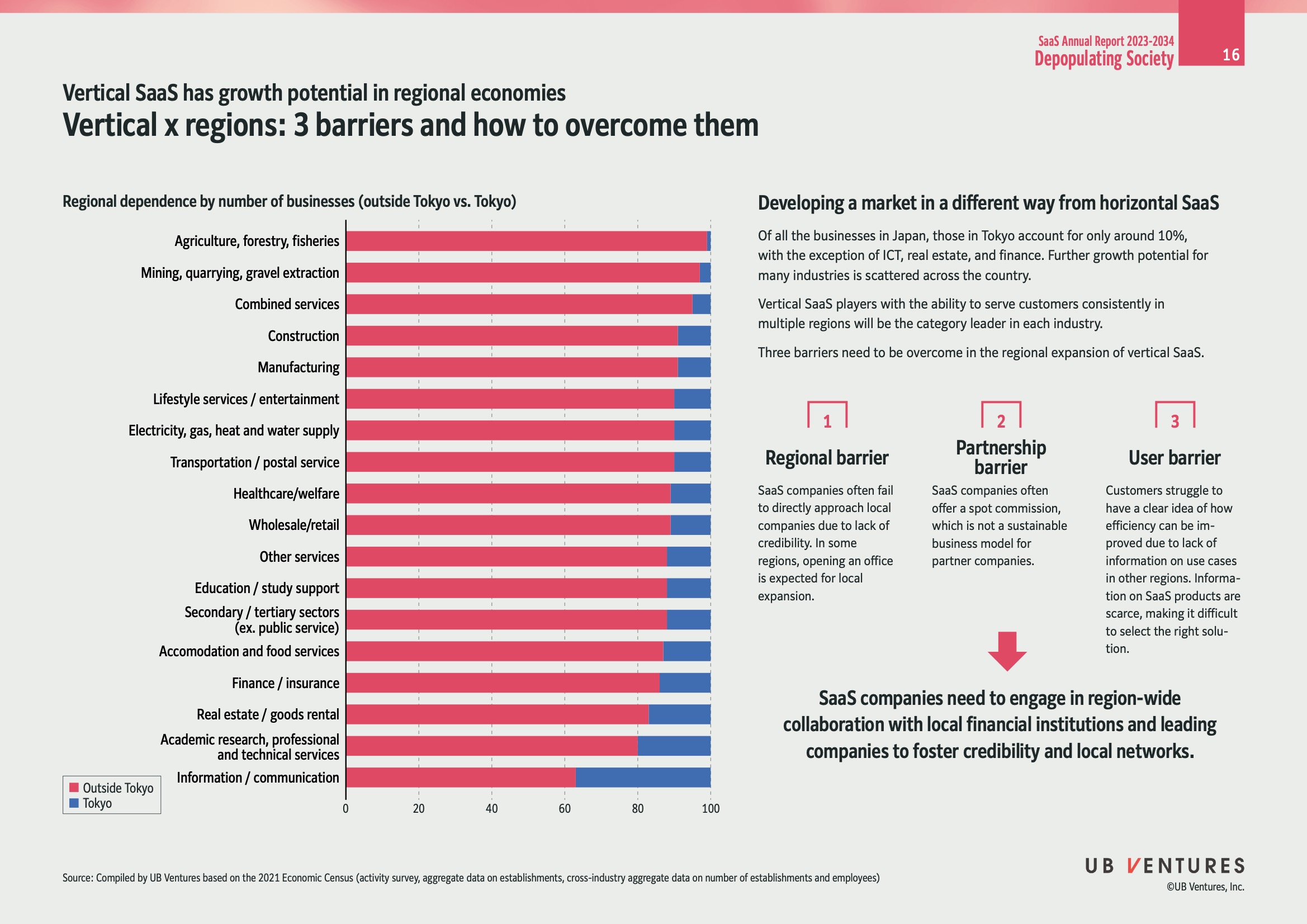
Vertical SaaS (Software as a Service) has significant growth potential in regional economies across Japan. Unlike horizontal SaaS, which offers a broad range of services, vertical SaaS targets specific industry needs, making it crucial in serving diverse markets outside of Tokyo.
Regional Dependence by Industry
A comparison by the number of businesses outside Tokyo versus within Tokyo. This highlights market dispersion and potential opportunities for Vertical SaaS:
| Industry | Outside Tokyo | Tokyo |
|---|---|---|
| Agriculture, Forestry, Fisheries | High | Low |
| Mining, Quarrying, Gravel Extraction | High | Low |
| Combined Services | High | Low |
| Construction | High | Low |
| Manufacturing | High | Low |
| Lifestyle Services/Entertainment | High | Low |
| Electricity, Gas, Heat and Water Supply | High | Low |
| Transportation/Postal Service | High | Low |
| Healthcare/Welfare | High | Low |
| Wholesale/Retail | High | Low |
| Other Services | High | Low |
| Education/Study Support | High | Low |
| Secondary/Tertiary Sectors (Ex. Public Service) | High | Low |
| Accommodation and Food Services | High | Low |
| Finance/Insurance | High | Low |
| Real Estate/Goods Rental | High | Low |
| Academic Research, Professional and Technical Services | High | Low |
| Information/Communication | Low | High |
Market Development Insights
-
Unique Approach: Unlike horizontal SaaS, developing a market for vertical SaaS often requires addressing specialized needs within specific industries.
-
Region-Specific Opportunities: With only roughly 10% of businesses located in Tokyo (excluding some fields), there's immense potential for regional expansion.
Key Barriers to Overcome
1. Regional Barrier
- Challenge: Establishing credibility and accessing local companies.
- Insight: Opening local offices can foster trust and facilitate easier market entry.
- Additional Info: Having a local presence may reassure clients about service quality and support.
2. Partnership Barrier
- Challenge: Offering unsustainable business models like spot commissions.
- Insight: Establishing solid, sustainable partnerships is crucial for long-term success.
- Additional Info: Long-term partnerships can provide ongoing support and market stability.
3. User Barrier
- Challenge: Limited information on SaaS product efficiency hinders adoption.
- Insight: Clear communication and demonstrations of product capabilities can enhance user acceptance.
- Additional Info: Producing case studies and testimonials may aid in illustrating product viability.
Strategy for Growth
- Collaboration: Engage in region-wide collaboration with local financial institutions and leading companies.
- Goal: Foster credibility and robust local networks, ensuring consistent and widespread SaaS integration.
Source
Information is compiled by UB Ventures based on the 2021 Economic Census, providing valuable insights into establishment activities and regional business dynamics.
Good and Bad Mindsets for SaaS Expansion
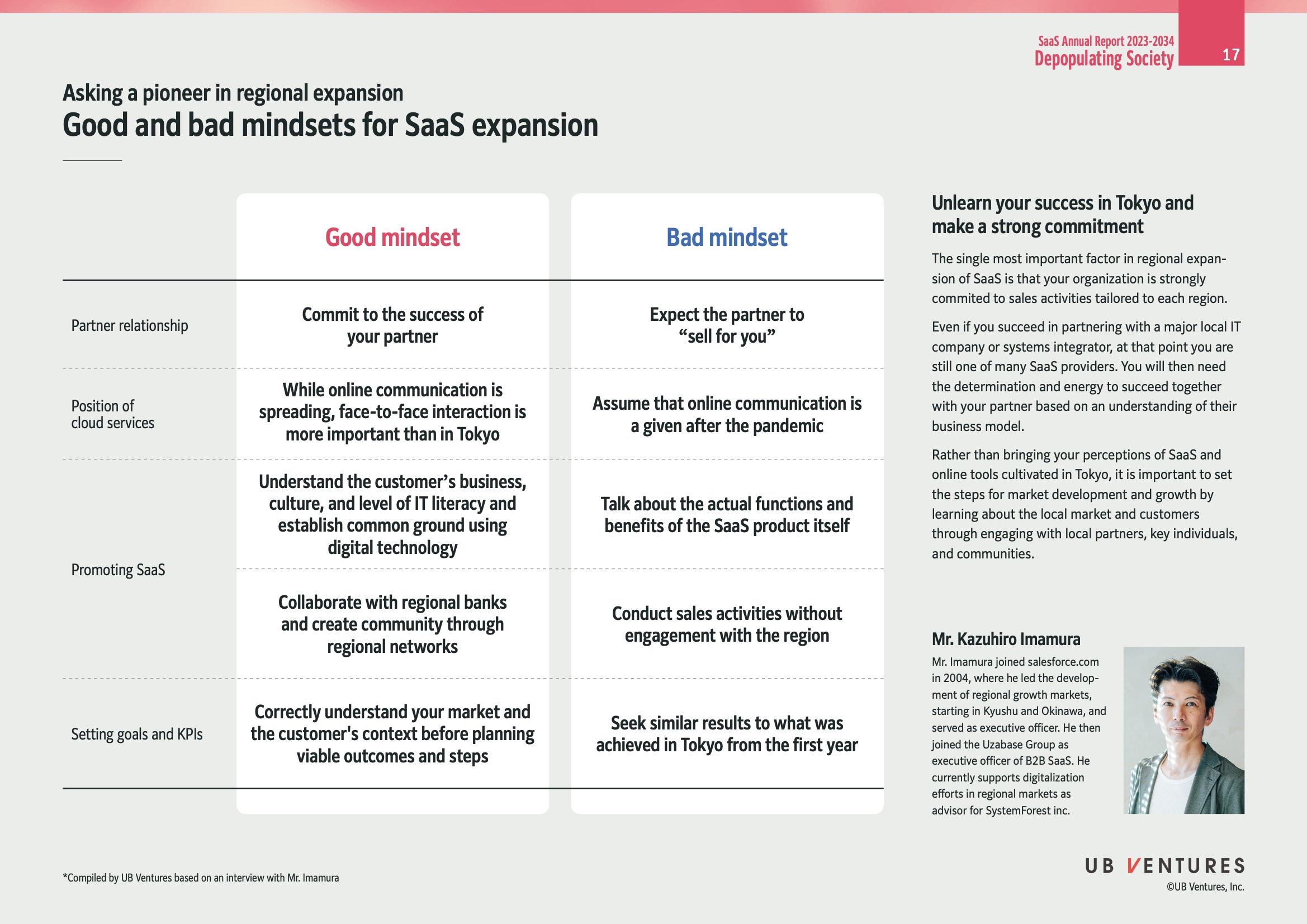
Partner Relationship
Good Mindset
- Commit to the success of your partner
- Building a strong partnership involves mutual commitment and sharing goals.
- Long-term success relies on collaboration and joint efforts.
Bad Mindset
- Expect the partner to "sell for you"
- Over-reliance on partners can lead to lack of engagement and understanding of the target market.
- Selling should be a joint effort.
Position of Cloud Services
Good Mindset
- Face-to-face interaction is crucial
- While online communication is convenient, personal interactions help build trust and better relationships, especially outside major tech hubs like Tokyo.
Bad Mindset
- Assume online communication is sufficient
- Relying solely on digital communication can overlook cultural nuances and personal connections important in business development.
Promoting SaaS
Good Mindset
-
Understand the customer’s business
- Knowledge of the customer’s needs, culture, and IT literacy is essential for effective promotion.
- Use digital technologies to find common ground.
-
Collaborate with regional banks
- Regional networks can offer valuable market insights and support.
- Building local communities strengthens brand presence and reliability.
Bad Mindset
-
Focus only on product features
- Mere emphasis on product benefits without contextual understanding may not resonate with potential clients.
-
Conducting sales without regional engagement
- Ignoring local networks and cultural context can lead to missed opportunities and weaker market position.
Setting Goals and KPIs
Good Mindset
- Understand market and customer context
- Successful planning requires in-depth market research and clear goals aligned with customer needs.
Bad Mindset
- Seek results similar to Tokyo immediately
- Each market has unique traits, and expecting similar outcomes without adaptation can lead to disappointment.
Additional Insights
-
Unlearn Success in Tokyo
- Expanding SaaS requires adapting to the regional nuances and not relying solely on past successful strategies from metropolitan cities like Tokyo.
-
Commitment and Adaptation
- It's crucial for organizations to commit to tailored sales activities and fully integrate into the local business model and market dynamics.
Expert Insight
- Mr. Kazuhiro Imamura
- Background: Key role in regional market development for Salesforce and other SaaS platforms.
- Current Work: Supports digitalization in regional markets, advising on strategic market growth and engagement.
Conclusion
- Effective SaaS expansion requires a deep understanding and commitment to local markets.
- Balancing digital communication with personal interactions and fostering regional partnerships are key strategies for success.
24 Startups Tackling the Challenges of a Depopulating Society
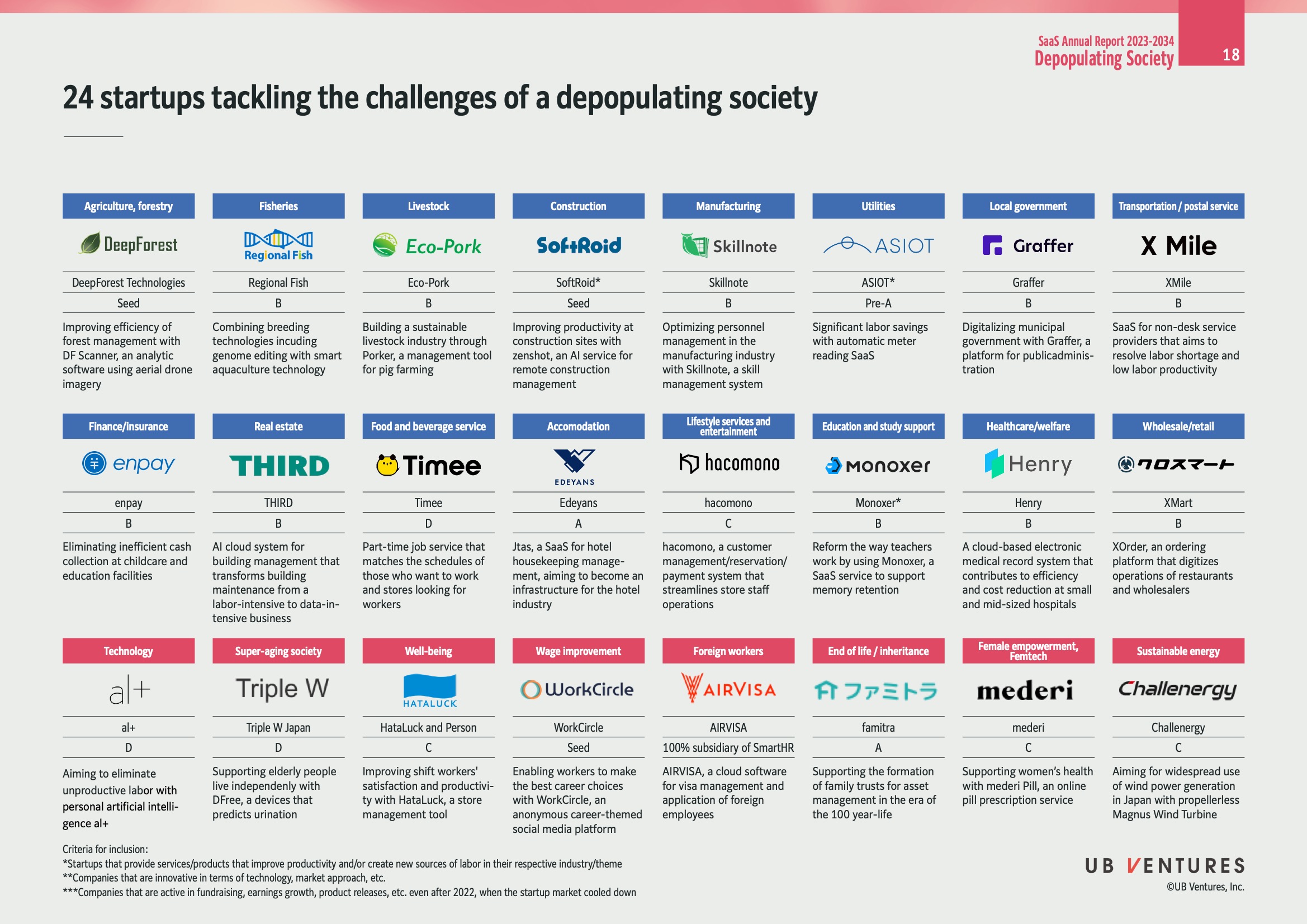
The image showcases various startups addressing issues arising from societal depopulation across different sectors. Each startup provides innovative solutions for enhancing productivity and tackling specific challenges within their respective industries. Here's a detailed breakdown:
Agriculture, Forestry
- DeepForest Technologies
- Stage: Seed
- Focus: Enhances the efficiency of forest management using "DF Scanner," an analytic software employing aerial drone imagery.
- Insight: Leveraging drones can significantly increase data accuracy and reduce labor costs in forestry.
Fisheries
- Regional Fish
- Stage: B
- Focus: Uses breeding technologies, combining genome editing with smart aquaculture.
- Insight: This modernizes the aquaculture industry, promising sustainability and increased yields.
Livestock
- Eco-Pork
- Stage: B
- Focus: Builds a sustainable livestock industry with "Porker," a management tool for pig farming.
- Insight: Such tools can optimize livestock management, potentially leading to better animal care and resource efficiency.
Construction
- SoftRoid
- Stage: Seed
- Focus: Boosts productivity at construction sites using "zenshot," an AI-based remote construction management service.
- Insight: This could minimize human error and streamline project management, crucial for large-scale constructions.
Manufacturing
- Skillnote
- Stage: B
- Focus: Optimizes personnel management in manufacturing through "Skillnote," a skill management system.
- Insight: Tracking skill development can enhance workforce productivity and reduce skill gaps.
Utilities
- ASIOT
- Stage: Pre-A
- Focus: Offers significant labor savings with an automatic meter reading SaaS.
- Insight: Automation in utilities can lead to both cost savings and enhanced operational efficiencies.
Local Government
- Graffer
- Stage: B
- Focus: A digital platform for government administration, aimed at enhancing public service efficiency.
- Insight: Streamlining government operations can significantly improve public service delivery.
Transportation/Postal Service
- XMile
- Stage: B
- Focus: Provides SaaS for operations aiding labor shortage resolution and boosting productivity.
- Insight: Technology can bridge gaps in labor-intensive industries, making them more efficient.
Finance/Insurance
- enpay
- Stage: B
- Focus: Facilitates efficient cash collection in childcare and educational facilities.
- Insight: This can lead to significant time and resource savings for institutions.
Real Estate
- THIRD
- Stage: B
- Focus: AI-based system transforming building maintenance from labor-intensive to data-intensive.
- Insight: AI can automate and predict maintenance needs, reducing downtime and cost.
Food and Beverage Service
- Timee
- Stage: D
- Focus: Matches work schedules with job seekers in stores and other locations.
- Insight: Flexible job matching can cater to non-standard work hours, improving employment rates.
Accommodation
- Edeyans
- Stage: A
- Focus: A SaaS for hotel housekeeping management, evolving the industry infrastructure.
- Insight: Automation in hospitality can enhance guest experience and reduce operational costs.
Lifestyle Services and Entertainment
- hacomo
- Stage: C
- Focus: A management system for customer relations and staff operations.
- Insight: Streamlining operations can improve service delivery and customer satisfaction.
Education and Study Support
- Monoxer
- Stage: C
- Focus: A SaaS tool enhancing teachers' work habits and supporting memory retention.
- Insight: EdTech can play a crucial role in improving educational standards and methodologies.
Healthcare/Welfare
- Henry
- Stage: B
- Focus: An electronic medical record system that aids efficiency in medical practices.
- Insight: Digitizing health records leads to better patient data management and care.
Wholesale/Retail
- XMart
- Stage: B
- Focus: Ordering platform digitizing restaurant and wholesale operations.
- Insight: E-commerce solutions can streamline supply chains and enhance B2B transactions.
Technology
- aI+
- Stage: D
- Focus: Personal artificial intelligence aimed at eliminating unproductive labor.
- Insight: AI deployment in task automation could vastly increase productivity across industries.
Super-Aging Society
- Triple W Japan
- Stage: D
- Focus: Devices aiding elderly independence, predicting urination needs.
- Insight: Innovative health tech can improve quality of life in aging populations.
Well-being
- HataLuck and Person
- Stage: C
- Focus: Enhancing shift workers' satisfaction and productivity with management tools.
- Insight: Addressing worker satisfaction can lower turnover rates and increase morale.
Wage Improvement
- WorkCircle
- Stage: Seed
- Focus: Career enhancement through a social media platform for job opportunities.
- Insight: Networking can open up pathways to better career prospects and wage improvements.
Foreign Workers
- AIRVISA
- Stage: 100% subsidiary of SmartHR
- Focus: Facilitates visa management and foreign employee application processing.
- Insight: Streamlining these processes can ease transitions for international workers.
End of Life/Inheritance
- famitra
- Stage: A
- Focus: Supports family trust formation for asset management over long-term life spans.
- Insight: Estate planning tools can provide peace of mind and financial security.
Female Empowerment, Femtech
- mederi
- Stage: C
- Focus: Digital solutions for women's health, like online pill prescriptions.
- Insight: Femtech is pivotal in addressing specific women's health issues efficiently.
Sustainable Energy
- Challenergy
- Stage: C
- Focus: Promotes wind power generation using "Magnus Wind Turbine."
- Insight: Renewable energy technologies are essential for sustainable development and reducing carbon footprints.
These startups highlight how technological innovations can address demographic challenges by increasing efficiency, reducing labor reliance, and enhancing overall quality of life.
Extended readings:
Issues and Solutions in the Construction Industry
Facts
-
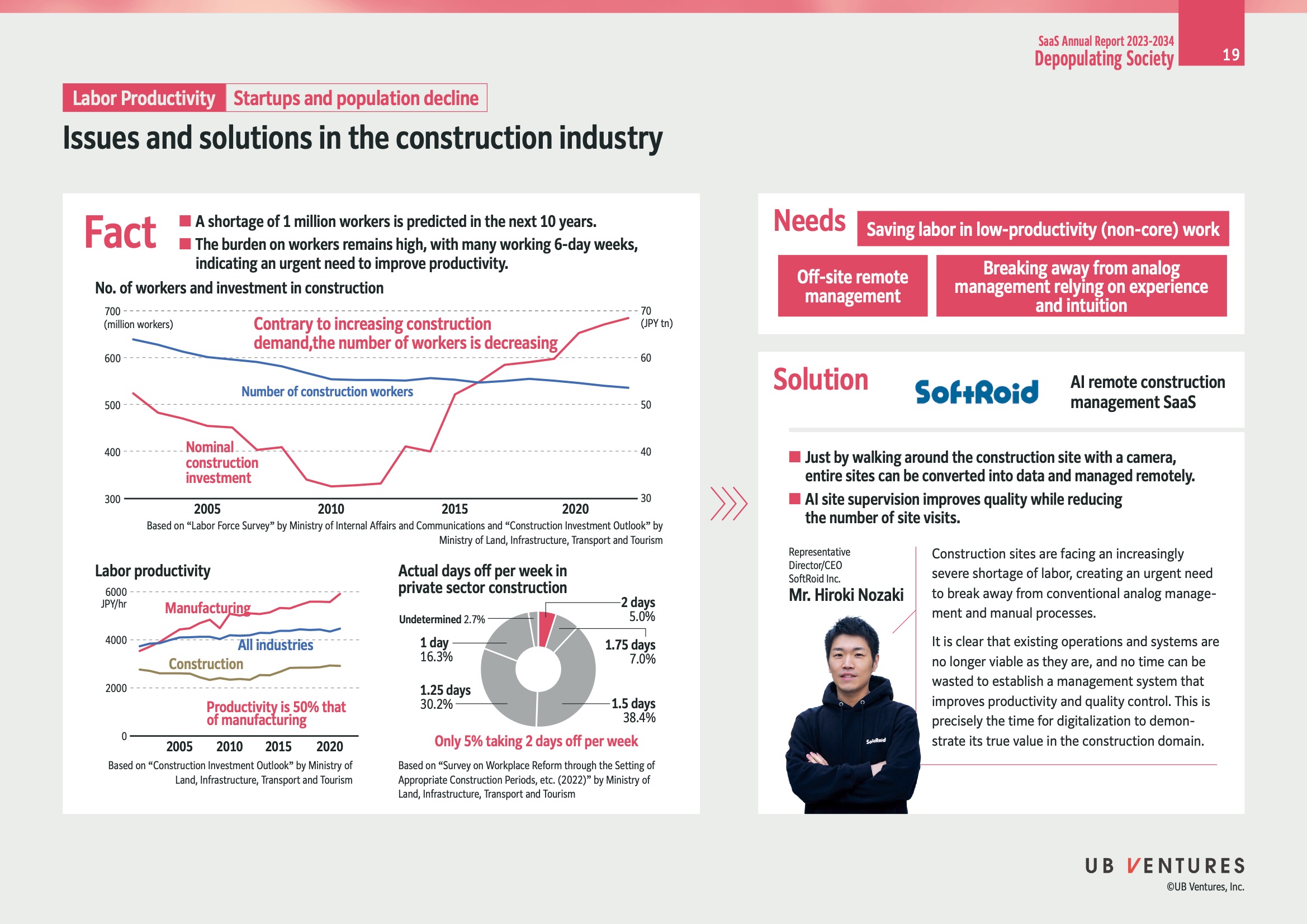
Worker Shortage Prediction:
- A shortage of 1 million workers is anticipated in the next 10 years.
- Implication: There's a critical need to improve productivity to manage the decreasing workforce.
-
Burden on Workers:
- Many are working 6-day weeks, highlighting the necessity to enhance efficiency.
- Insight: Productivity improvements can help balance work-life dynamics and reduce burnout.
Data Insights
-
Number of Workers and Investment in Construction:
- Increasing demand for construction, but the workforce is declining.
- Chart Details:
- Workers (in million): Dropped from around 600 in 2005 to below 500 in 2015, slightly recovering by 2020.
- Nominal construction investment (in JPY trillion): Showing a rising trend after 2015.
- Importance: Balancing investment vs. workforce can optimize resource allocation.
-
Labor Productivity:
- Construction productivity is 50% that of manufacturing.
-
Actual Days Off per Week:
- Only 5% take 2 days off per week.
- Breakdown:
- 1 day: 16.3%
- 1.25 days: 30.2%
- 1.5 days: 38.4%
- 1.75 days: 7.0%
- 2 days: 5.0%
- Undetermined: 2.7%
- Insight: More balanced time-off policies may improve morale and retention.
Needs
- Labor Saving in Non-Core Work:
- Importance: Automating or outsourcing non-core tasks can allow workers to focus on critical activities.
- Off-Site Remote Management:
- Relevance: Enables flexibility and reduces the necessity of being physically present.
- Breaking from Analog Management:
- Transition from experience/intuition to data-driven management.
Solution: SoftRoid - AI Remote Construction Management SaaS
- Features:
- Site data conversion and management via camera walkthrough.
- AI supervision for quality and site visit reduction.
- Benefits:
- Addressing labor shortages by optimizing existing resources.
- Accelerating transition to digital management techniques.
- Strategic Ideas:
- Emphasizing digital innovation to demonstrate value in construction.
- Immediate restructuring of management systems for productivity boosts.
Representative
- Mr. Hiroki Nozaki:
- Position: Representative Director/CEO of SoftRoid Inc.
- Perspective: Urgency in adopting digital tools for improving construction management.
Issues and Solutions in Employment of Foreign Workers
Overview
Japan is facing a shortage in its workforce, making it a major destination for immigration. Foreign workers play a crucial role, especially in essential sectors.
Key Facts
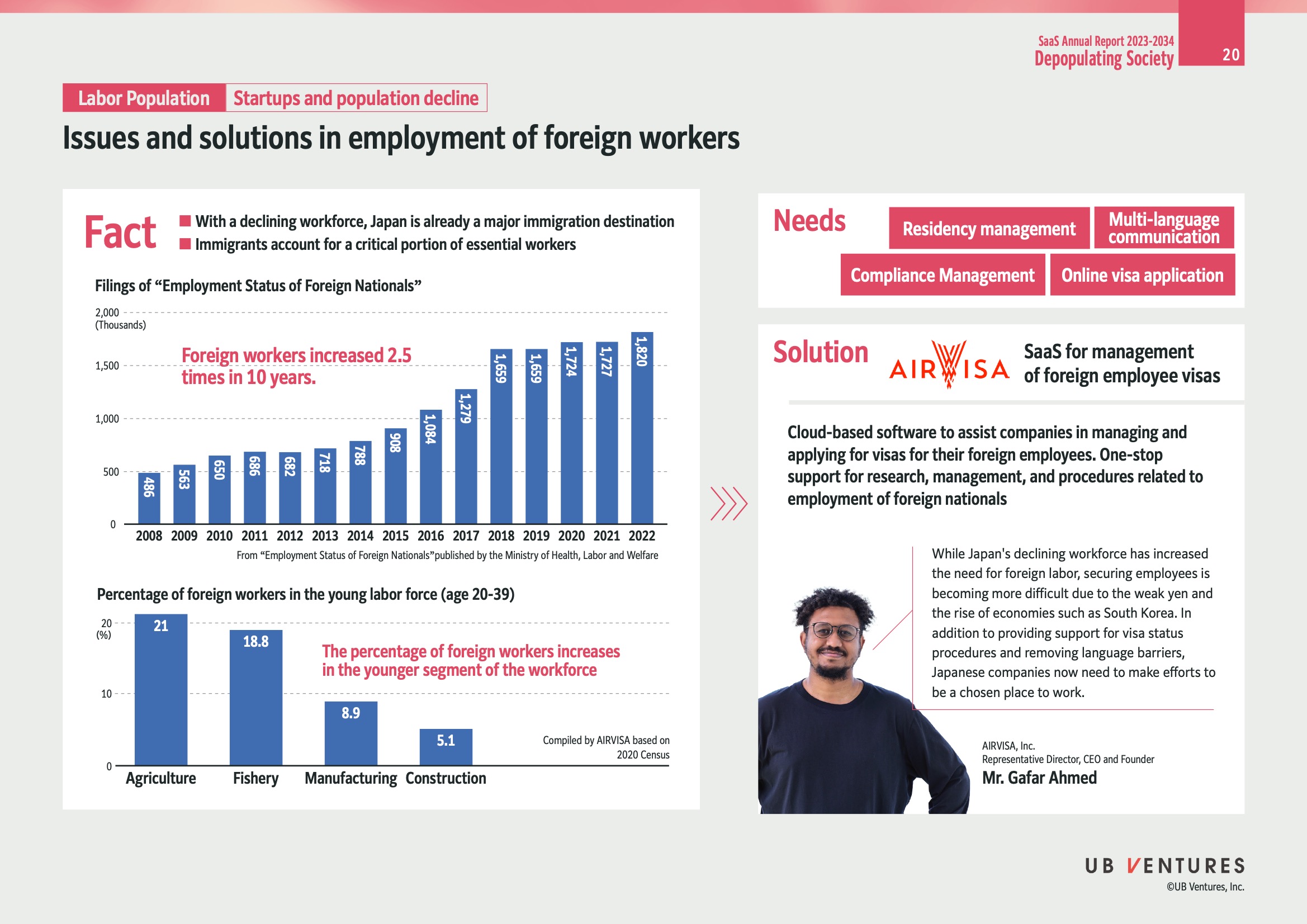
- Workforce Increase: Foreign workers have increased 2.5 times over the past decade.
- Essential Workers: Immigrants are vital in sectors like agriculture, fishery, manufacturing, and construction.
Chart Data
Filings of “Employment Status of Foreign Nationals”
| Year | Filings (Thousands) |
|---|---|
| 2008 | 486 |
| 2009 | 565 |
| 2010 | 650 |
| 2011 | 686 |
| 2012 | 682 |
| 2013 | 717 |
| 2014 | 788 |
| 2015 | 908 |
| 2016 | 1,083 |
| 2017 | 1,279 |
| 2018 | 1,460 |
| 2019 | 1,662 |
| 2020 | 1,724 |
| 2021 | 1,727 |
| 2022 | 1,820 |
Percentage of Foreign Workers (Age 20-39) in Young Labor Force
| Sector | Percentage (%) |
|---|---|
| Agriculture | 21 |
| Fishery | 18.8 |
| Manufacturing | 8.9 |
| Construction | 5.1 |
- Trend: The percentage of foreign workers is increasing, especially in younger segments of the workforce.
Needs Identified
Companies in Japan require effective management in the following areas:
- Residency Management
- Multi-language Communication
- Compliance Management
- Online Visa Application
Solution by AirVisa
Description
AirVisa offers cloud-based software to assist companies with:
- Managing and applying for visas for foreign employees.
- Providing a one-stop solution for research, management, and procedures related to employing foreign nationals.
Benefits
- Streamlined Process: Simplifies visa applications and compliance.
- Communication Support: Breaks down language barriers, making the workplace more inclusive.
Challenges
- Economic Competition: The declining workforce necessitates foreign labor, yet competition from rising economies like South Korea impacts recruitment.
- Workplace Choice: Japanese companies must distinguish themselves to attract talent.
Representative
- Company: AirVisa, Inc.
- Founder & CEO: Mr. Gafar Ahmed
Insight
With ongoing demographic challenges, integrating foreign workers efficiently is essential for sustaining economic growth in Japan. Solutions like AirVisa can address logistical barriers, but cultural and competitive factors remain significant obstacles.
Extended readings: