**Title: Understanding Electric Vehicles and Basic Electrical Concepts**
Kirchhoff's Voltage Law
-
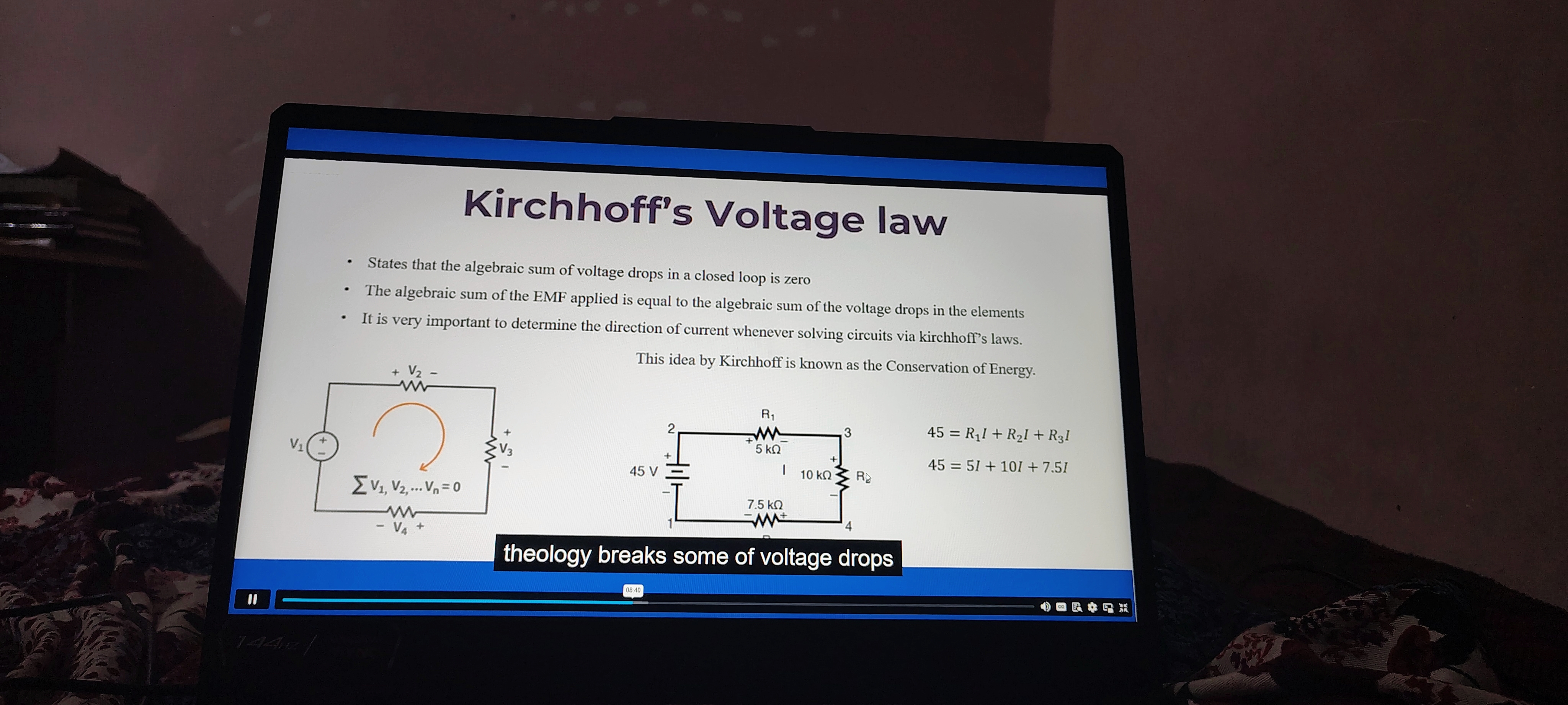
Definition: Kirchhoff's Voltage Law (KVL) states that the algebraic sum of voltage drops in a closed loop is zero.
- Thoughts: This principle is fundamental in circuit analysis, as it helps in understanding how voltages behave in electrical circuits. It's a direct consequence of the conservation of energy, emphasizing that energy supplied in a loop must equal the energy used.
-
Application: The algebraic sum of the EMF (Electromotive Force) applied is equal to the algebraic sum of the voltage drops in the elements of the circuit.
- Additional Information: EMF can be thought of as the total voltage provided by a power source like a battery. Each component in a circuit, such as resistors, creates a voltage drop that must be accounted for when applying KVL.
-
Importance of Direction: It's crucial to determine the direction of current when solving circuits using Kirchhoff’s laws.
- Thoughts: The current direction significantly affects voltage drops across components. Correctly understanding current flow helps in accurately applying KVL and obtaining the correct values.
-
Conservation of Energy: This idea is intrinsic to KVL, reflecting the conservation of energy within electrical systems.
- Additional Information: Like energy cannot be created or destroyed, in a closed electrical circuit, the total energy supplied must be equal to the total energy consumed.
Example Circuit Analysis
| Component | Resistance (R) | Voltage (V) |
|---|---|---|
| R1 | 5 kΩ | - |
| R2 | 10 kΩ | - |
| R3 | 7.5 kΩ | - |
| Total | - | 45 V |
- Equation Breakdown:
- This equation illustrates how the sum of voltage drops across all resistors equals the supplied voltage, reinforcing KVL principles.
Key Takeaways
- KVL is essential for solving complex circuits.
- Correct understanding of voltage drops and currents leads to accurate circuit analysis.
- The principle underpins much of electronic design and troubleshooting.
Reference:
Circuit Analysis Example
Overview
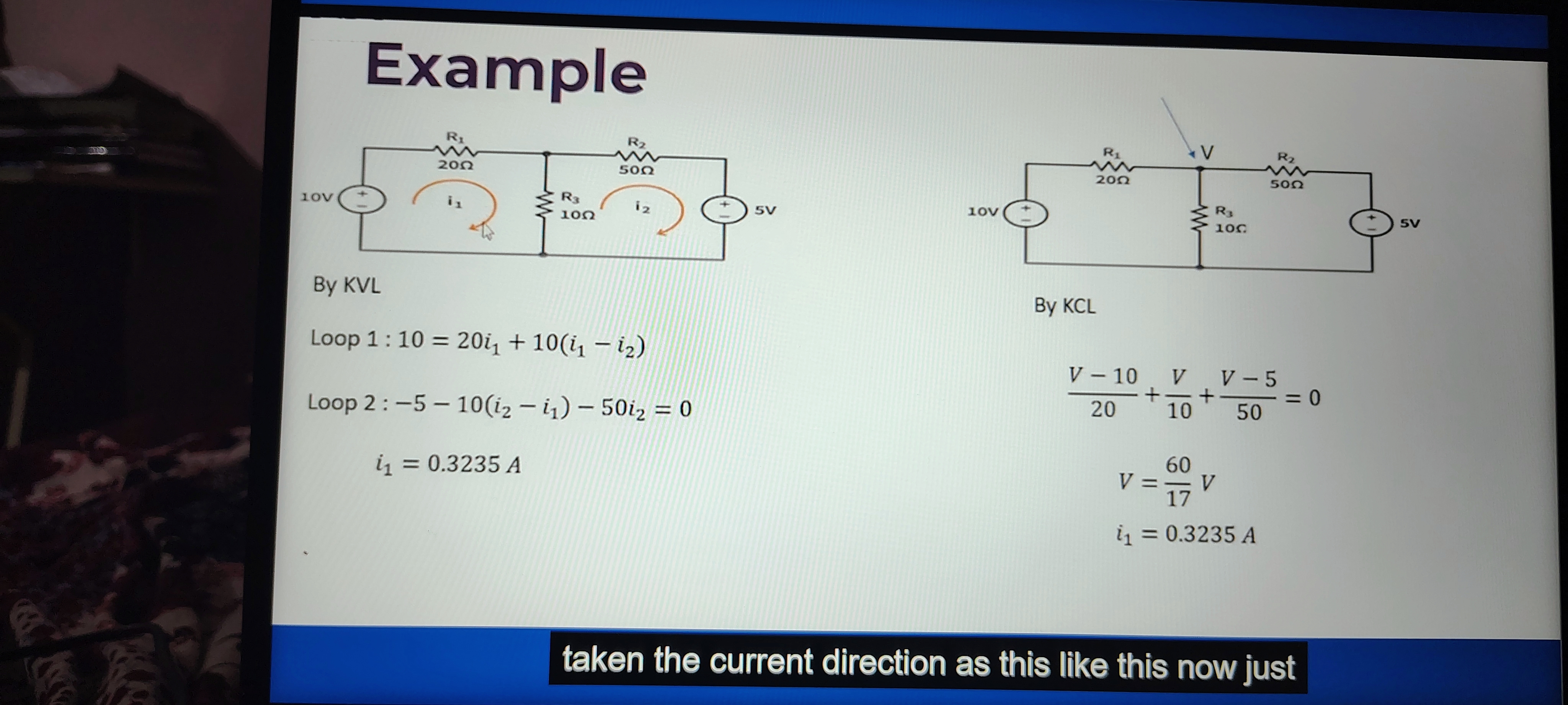
This image discusses the analysis of an electrical circuit using Kirchhoff's Voltage Law (KVL) and Kirchhoff's Current Law (KCL). The circuit consists of resistors and voltage sources, and it uses loop equations to find the current values.
Key Points
-
Kirchhoff's Voltage Law (KVL) :
- KVL states that the sum of all electrical potential differences (voltage) around any closed circuit loop must equal zero. This principle is fundamental in circuit analysis.
- In this example, two loops are analyzed:
- Loop 1 Equation:
- This equation represents the voltage drop around Loop 1, accounting for the voltage source and the resistive elements.
- Loop 2 Equation:
- This equation represents Loop 2, ensuring that the voltage drops equals the voltage rises.
- Loop 1 Equation:
-
Kirchhoff's Current Law (KCL) :
- KCL states that the sum of currents entering a junction must equal the sum of currents leaving that junction.
- The equation derived from KCL in this example helps in determining the voltage :
- This equation allows the calculation of based on the resistor values and voltage sources.
-
Current Values:
- The calculated current is .
- This indicates the amount of current flowing through the specified branch of the circuit.
Tables
| Component | Values |
|---|---|
| Resistor R1 | 20 Ω |
| Resistor R2 | 50 Ω |
| Resistor R3 | 10 Ω |
| Voltage Source 1 | 10 V |
| Voltage Source 2 | 5 V |
| Calculated | 0.3235 A |
Additional Thoughts
Understanding KVL and KCL is crucial for analyzing electrical circuits effectively. These laws are not just theoretical; they form the basis for many practical applications, including circuit design and troubleshooting. It is beneficial for students to practice various circuit configurations using these laws to solidify their comprehension.
Reference: