New Notebook
The Federal Budget
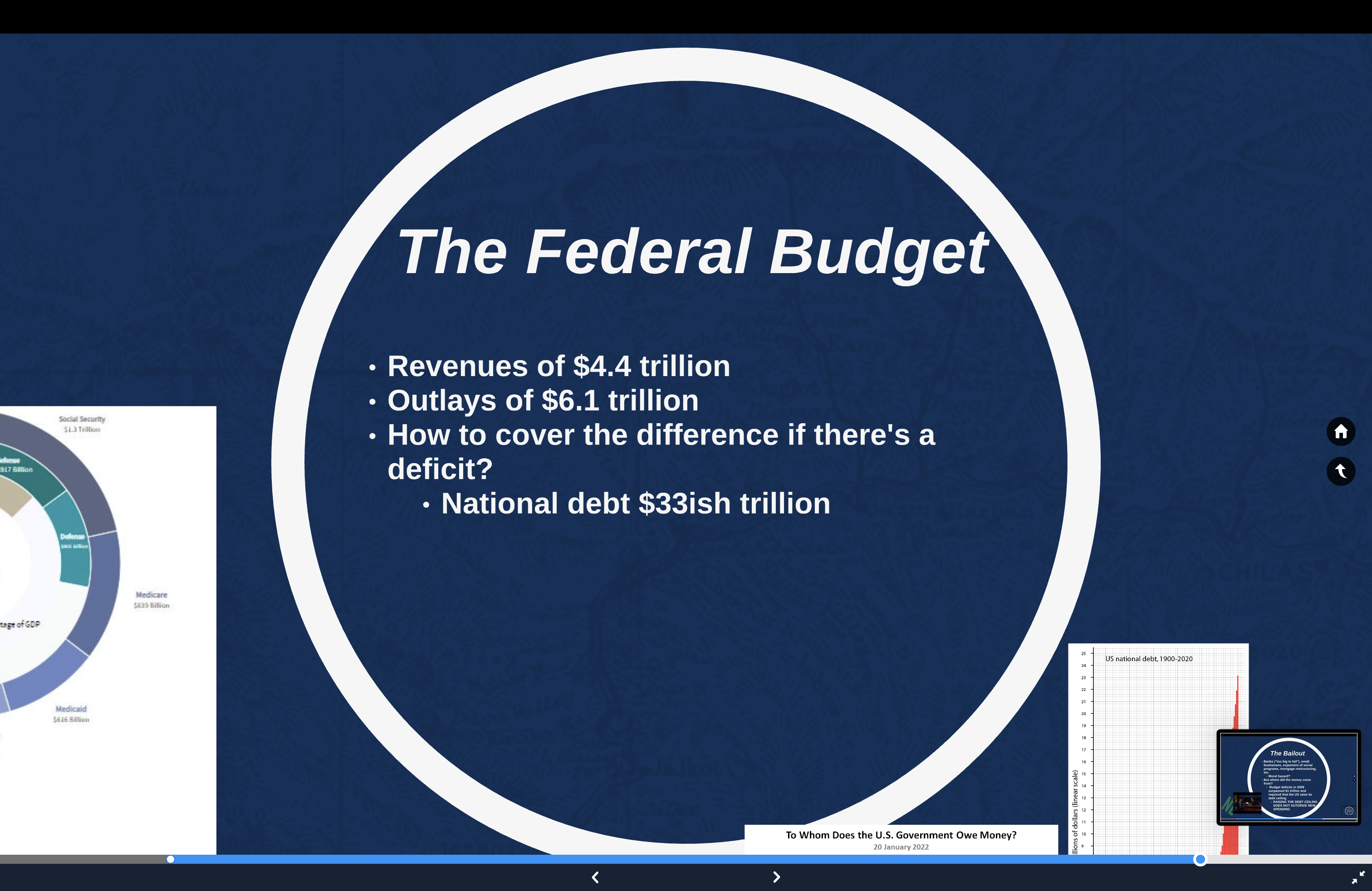
-
Revenues of $4.4 trillion
- This figure represents the total income the federal government anticipates receiving from various sources, including taxes, fees, and other income. Understanding revenue is crucial, as it forms the foundation for budget planning and determines how much can be spent on federal programs.
-
Outlays of $6.1 trillion
- Outlays refer to the total amount of money the government plans to spend, which includes mandatory spending (like Social Security and Medicare) and discretionary spending (like defense and education). The difference between outlays and revenues indicates if there will be a budget deficit.
-
How to cover the difference if there's a deficit?
- When outlays exceed revenues, a deficit occurs, which means the government needs to find ways to cover this shortfall. Strategies may include borrowing money (issuing bonds), increasing taxes, or cutting spending in certain areas.
-
National debt $33ish trillion
- The national debt reflects the total amount of money the federal government owes. It accumulates over time due to deficits, and understanding its impact is vital for assessing the country's financial health. High national debt can lead to increased interest rates and decreased governmental flexibility in financial policy.
Table of Spending Categories
| Category | Amount |
|---|---|
| Social Security | $1.1 Trillion |
| Medicare | $843 Billion |
| Medicaid | $646 Billion |
| Other Defense | Not specified |
| Non-defense discretionary | Not specified |
- This table illustrates some major components of federal spending, highlighting the significant allocation towards social programs, which are essential for supporting various demographics of the population. Understanding these allocations helps in debates over budget priorities and fiscal policy.
Extended readings:
Brexit
-
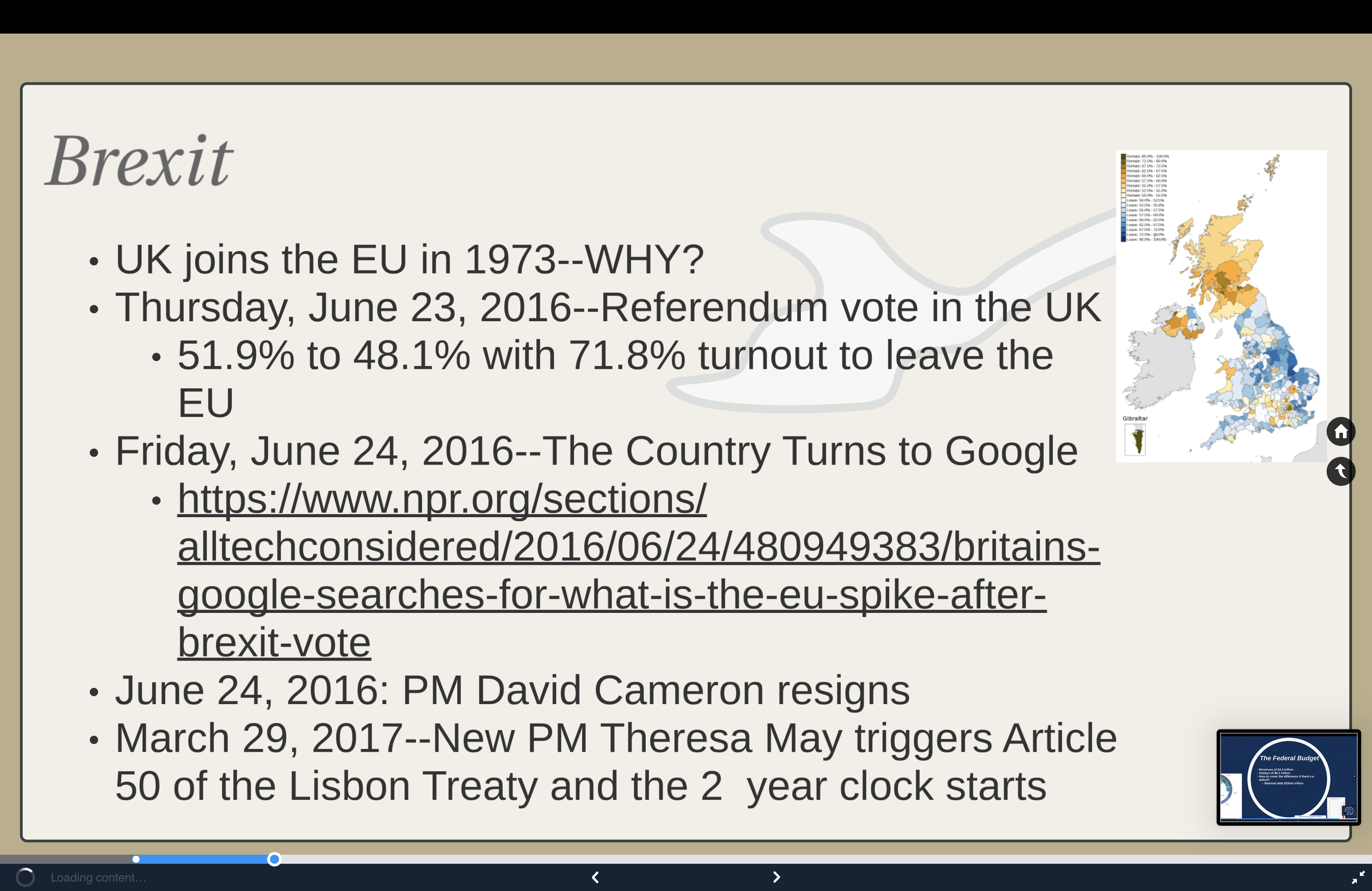
UK joins the EU in 1973
- This marked a significant step in the UK's relationship with Europe, emphasizing economic integration and cooperative policies. Understanding the factors that led to this decision helps clarify Britain's evolving stance on EU membership over the decades.
-
Referendum vote in the UK: June 23, 2016
- Result: 51.9% to 48.1% with a turnout of 71.8%
- The close result highlighted a deeply divided public opinion on EU membership, indicating strong regional differences within the UK regarding their relationship with Europe.
- Result: 51.9% to 48.1% with a turnout of 71.8%
-
The Country Turns to Google: June 24, 2016
- Following the referendum, there was a spike in Google searches related to the EU, particularly queries like "What is the EU?"
- This reflects a general public confusion and a desire for understanding after the significant decision was made. This moment marked a shift in public engagement with political and economic issues in the UK.
- Following the referendum, there was a spike in Google searches related to the EU, particularly queries like "What is the EU?"
-
David Cameron resigns: June 24, 2016
- The Prime Minister's resignation signaled a major political upheaval in the UK and a response to the results of the referendum.
- His leadership was closely tied to the campaign for Remaining in the EU, and his resignation opened the door for a new government approach toward Brexit.
- The Prime Minister's resignation signaled a major political upheaval in the UK and a response to the results of the referendum.
-
Theresa May triggers Article 50: March 29, 2017
- This action officially started the two-year countdown for the UK to leave the EU, as stipulated by the Lisbon Treaty.
- Triggering Article 50 marked the formal beginning of the negotiation process for the UK's exit, bringing practical implications to the debate that had been largely theoretical before.
- This action officially started the two-year countdown for the UK to leave the EU, as stipulated by the Lisbon Treaty.
Additional Thoughts
- The Brexit referendum and its aftermath remain pivotal in shaping the current political landscape in the UK and its relationship with Europe and the world at large.
- The events surrounding Brexit illustrate the complexities of national identity, sovereignty, and global interdependence in contemporary governance.
Extended readings:
Brexit Vote (2016) Notes
-
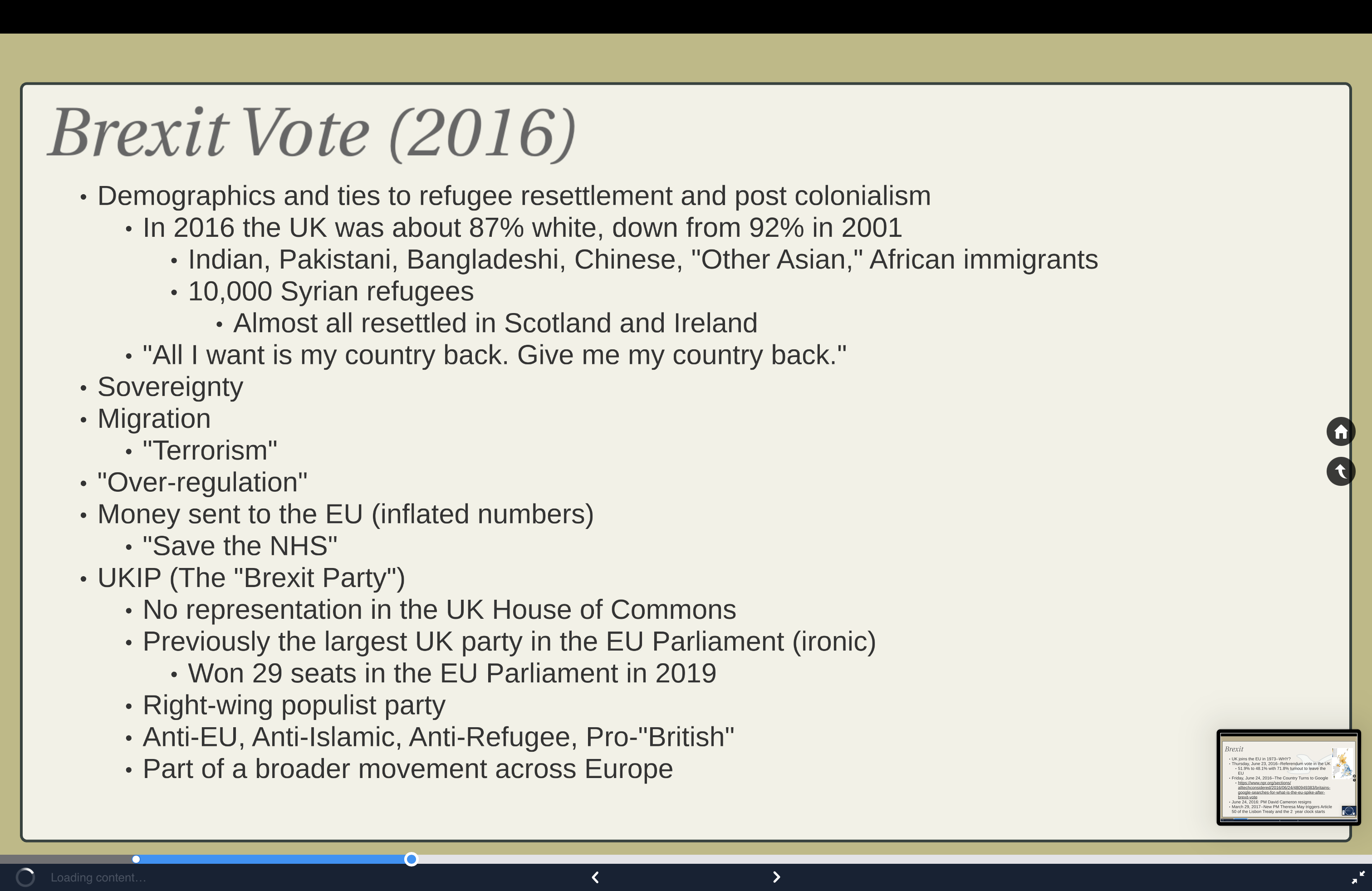
Demographics and Refugee Resettlement
- In 2016, the UK's population was approximately 87% white, a decrease from 92% in 2001.
- This shift highlights the evolving demographics due to immigration and resettlement policies.
- Notable immigrant groups include Indians, Pakistanis, Bangladeshis, Chinese, "Other Asian," and African immigrants.
- Recognizing these groups is crucial to understanding the multicultural landscape of modern Britain.
- Around 10,000 Syrian refugees were resettled, primarily in Scotland and Ireland.
- This influx reflects the UK's response to the humanitarian crisis resulting from the Syrian civil war.
- Quote: "All I want is my country back. Give me my country back."
- This sentiment encapsulates the desire for national sovereignty felt by many voters.
- In 2016, the UK's population was approximately 87% white, a decrease from 92% in 2001.
-
Key Issues in the Brexit Debate
- Sovereignty: A central theme, emphasizing the desire for the UK to reclaim legislative power from the EU.
- Migration: Concerns over immigration were prominent, often linked to fears of "terrorism."
- Over-regulation: Voters expressed frustration with what they perceived as excessive EU regulations affecting daily life.
- Financial Contributions to the EU: Claims about inflated numbers regarding money sent to the EU were used to stir public sentiment.
- Phrase: "Save the NHS" was a rallying cry, indicating a belief that funds could be better spent domestically.
-
UKIP (The "Brexit Party")
- At the time, UKIP had no representation in the UK House of Commons but was influential in the EU Parliament.
- Previously the largest UK party in the EU Parliament, UKIP won 29 seats in 2019.
- Their performance indicated strong support for Brexit among the electorate.
- Identified as a right-wing populist party, they campaigned on anti-EU, anti-Islamic, and anti-refugee platforms.
- Their platform also emphasized a pro-"British" identity, appealing to nationalist sentiments.
- UKIP was part of a broader populist movement across Europe, aligning with other right-wing parties advocating for similar platforms.
Extended readings:
The Common Market
-
UK Access to EU Markets
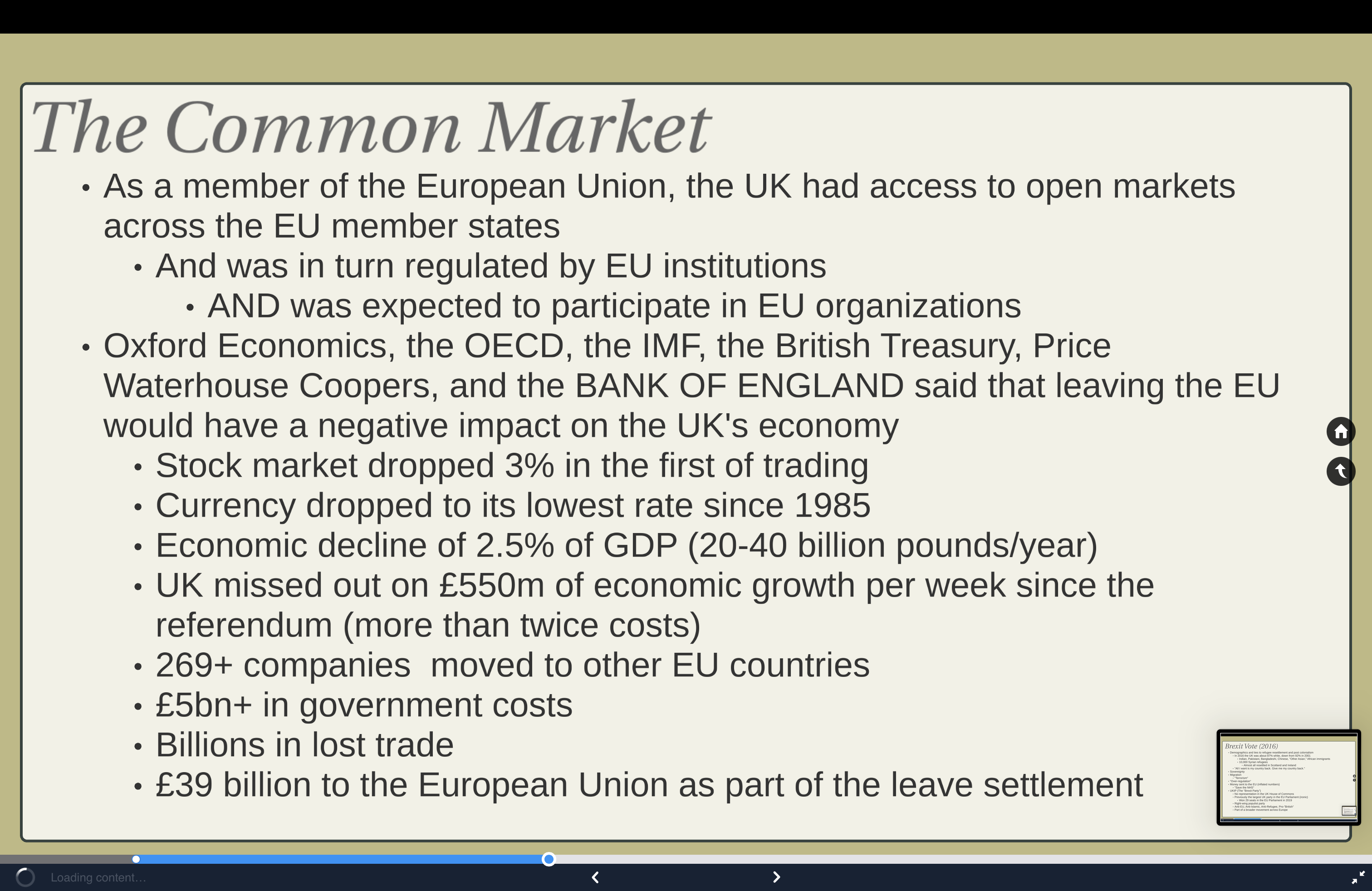
- As a member of the EU, the UK had significant access to open markets across EU member states.
- This access facilitated trade and economic cooperation but also came with regulations imposed by EU institutions.
-
Economic Impact of Leaving the EU
- Various economic organizations warned that leaving the EU would negatively impact the UK's economy.
- This reflects the interconnected nature of modern economies, where changes in trade relationships can have quick and severe consequences.
-
Market Reactions
- Stock market dropped 3% in the first trading session following the referendum.
- This showcases immediate investor uncertainty and market volatility in response to political changes.
- Stock market dropped 3% in the first trading session following the referendum.
-
Currency Depreciation
- The pound dropped to its lowest rate since 1985, indicating a loss of confidence among investors.
- A weak currency can make imports more expensive, affecting inflation and consumer prices.
- The pound dropped to its lowest rate since 1985, indicating a loss of confidence among investors.
-
Economic Decline
- An estimated economic decline of 2.5% of GDP, translating to 20-40 billion pounds annually.
- This decline illustrates the potential long-term economic costs of reduced market access and investor confidence.
- An estimated economic decline of 2.5% of GDP, translating to 20-40 billion pounds annually.
-
Loss of Economic Growth
- The UK missed out on £550 million of economic growth per week since the referendum.
- Such figures highlight the immediate economic toll of businesses relocating or scaling back operations.
- The UK missed out on £550 million of economic growth per week since the referendum.
-
Business Relocation
- Over 269 companies moved to other EU countries post-referendum.
- This shift indicates the impact of uncertainty on business decisions, as companies seek stability in the EU.
- Over 269 companies moved to other EU countries post-referendum.
-
Government Costs
- Estimated costs exceeding £5 billion in government expenditures related to the transition.
- This emphasizes the financial burden placed on the government to navigate the separation process.
- Estimated costs exceeding £5 billion in government expenditures related to the transition.
-
Trade Losses
- Significant losses measured in billions due to reduced trade relationships.
- These trade losses can lead to a decline in available jobs and economic activities in the UK.
- Significant losses measured in billions due to reduced trade relationships.
-
Settlement Payments
- The UK agreed to pay £39 billion to the EU as part of the leave settlement.
- This payment reflects the financial obligations tied to the exit agreement and underscores the complexity of negotiating such settlements.
- The UK agreed to pay £39 billion to the EU as part of the leave settlement.
Summary Table of Economic Impacts
| Impact | Value |
|---|---|
| Stock Market Drop | 3% in initial trading |
| Currency Drop | Lowest since 1985 |
| Economic Decline | 2.5% of GDP (20-40 billion pounds/year) |
| Missed Economic Growth | £550m per week |
| Companies Moved to Other EU Countries | 269+ |
| Government Costs | £5bn+ |
| Lost Trade | Billions |
| Payment to EU | £39 billion |
Extended readings:
Political Impacts of Brexit
-
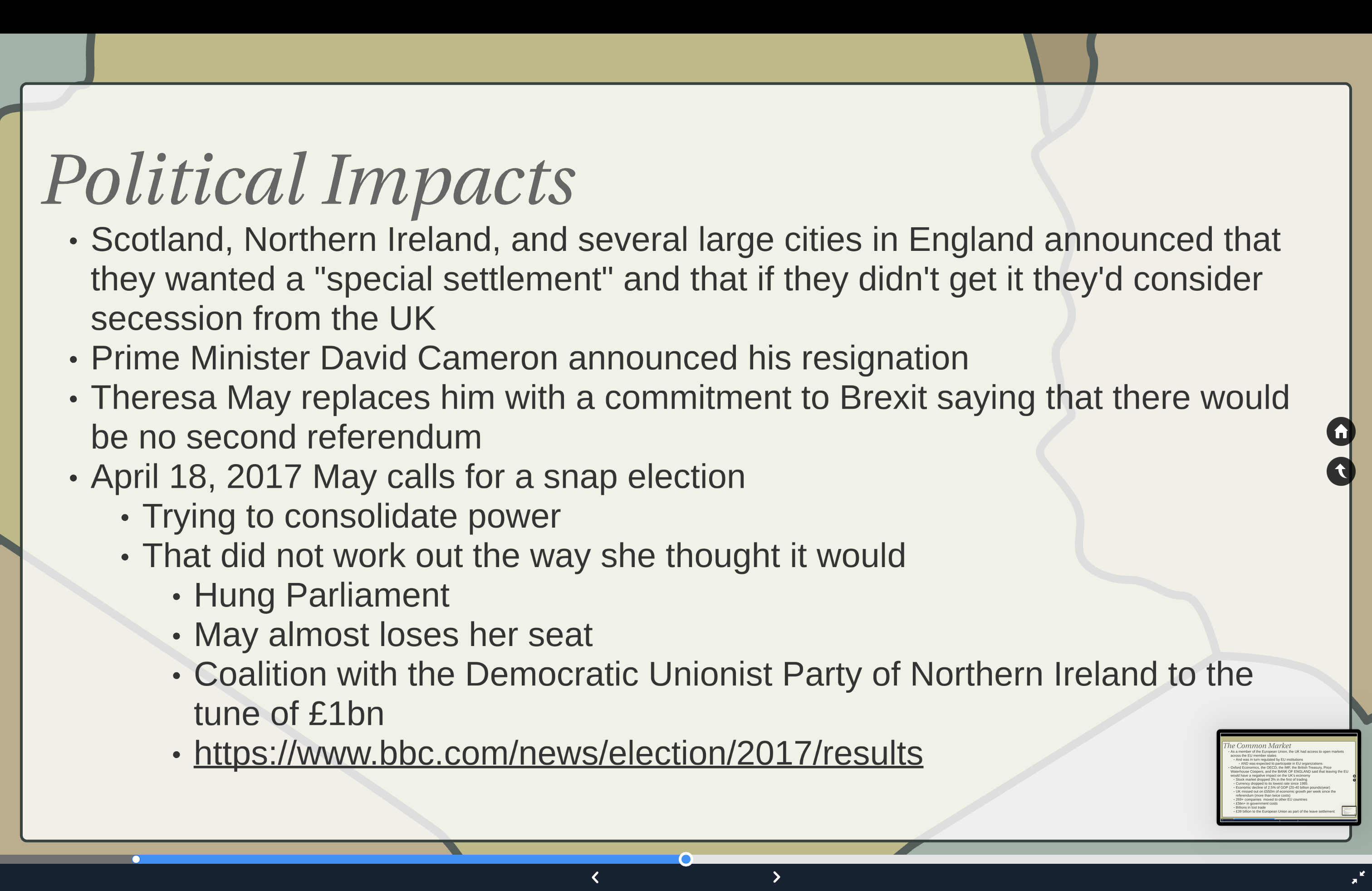
Desire for Special Settlements
Scotland, Northern Ireland, and several large cities in England expressed a need for a "special settlement" post-Brexit. This indicates significant regional dissatisfaction and challenges to UK unity. If desires weren't met, there was a threat of secession, demonstrating how Brexit polarized regional politics. -
David Cameron's Resignation
Prime Minister David Cameron announced his resignation following the Brexit referendum results. His resignation was a direct consequence of leading the campaign to remain in the EU, reflecting the political instability and leadership challenges faced within the Conservative Party at that time. -
Theresa May's Leadership
Theresa May succeeded Cameron with a commitment to execute Brexit, asserting there would be no second referendum. This decision highlights the deep divisions within the UK regarding Brexit and May's attempts to consolidate authority amidst tremendous political pressure. -
Snap Election Call (April 18, 2017)
May called for a snap election to strengthen her position. The rationale was to consolidate power and gain a stronger mandate for her Brexit strategy. This move suggests a tactical approach to gaining support in Parliament during an uncertain period.- Outcome: The election resulted in a hung parliament. This outcome meant that no single party gained a governing majority, complicating the political landscape further.
- Personal Risk: There were significant concerns that May could lose her seat, suggesting lack of confidence in her leadership.
- Coalition with the Democratic Unionist Party (DUP) : May formed a coalition with the DUP from Northern Ireland that came at a cost of £1bn. This highlights the complexities and compromises made in UK politics post-Brexit, as smaller parties gained increased influence and negotiation power.
-
Source Reference
The provided link directs to BBC's coverage of the 2017 election results, serving as a resource for more detailed election data and analysis.
Overall, these notes encapsulate the political turmoil generated by Brexit in the UK, including intra-party conflicts, regional divisions, and the shifting power dynamics in Parliament.
Extended readings:
Brexit Timeline and Key Events
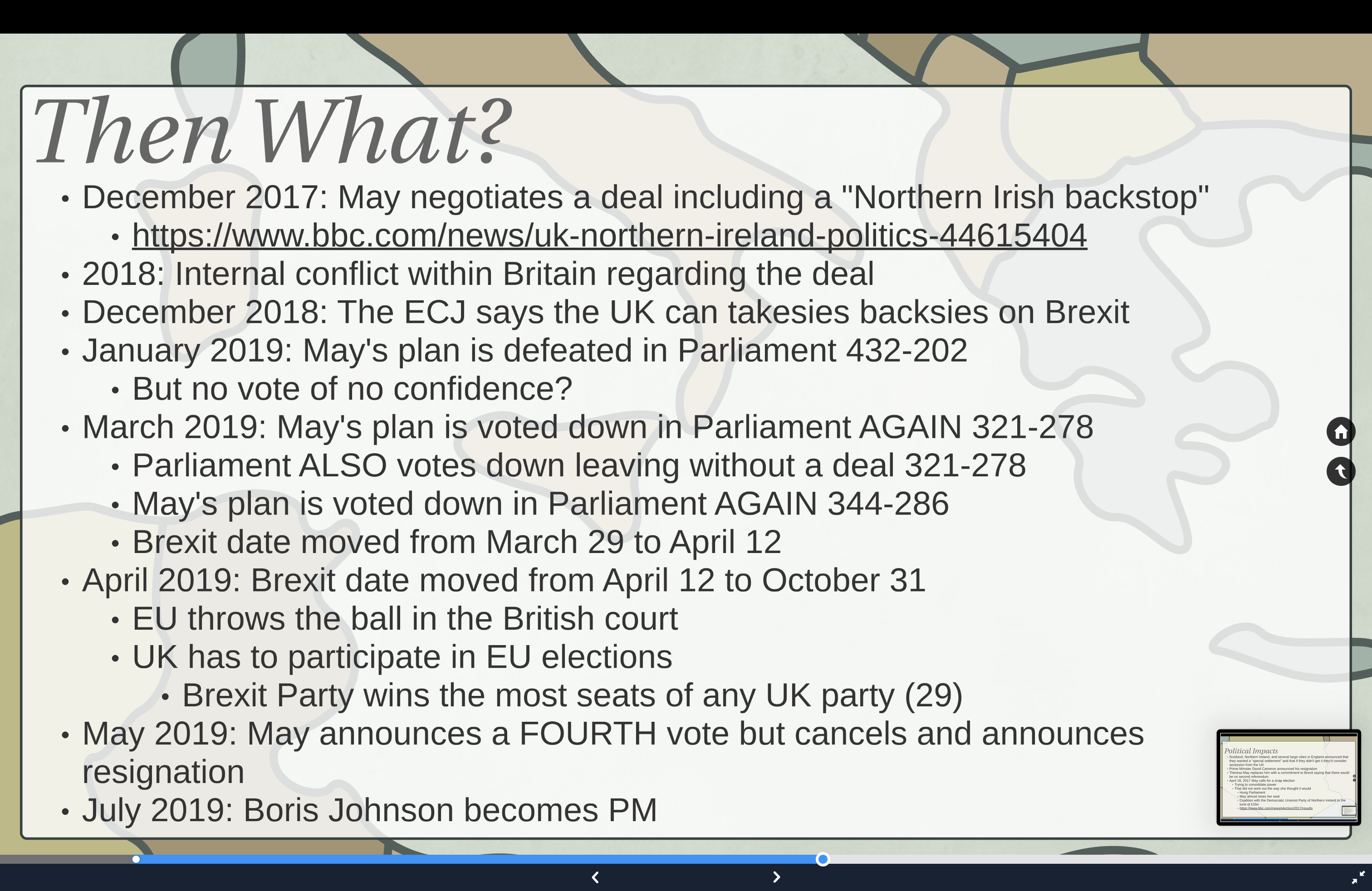
December 2017
- May negotiates a deal including a "Northern Irish backstop"
- This deal aimed to prevent a hard border between Northern Ireland and the Republic of Ireland, addressing one of the key issues of Brexit.
2018
- Internal conflict within Britain regarding the deal
- Different factions within the UK government and Parliament had opposing views on how Brexit should be handled, leading to significant political turmoil.
December 2018
- The ECJ says the UK can reverse Brexit (takesies backsies)
- The European Court of Justice ruling clarified that the UK could revoke its Article 50 notification, potentially allowing for a reversal of Brexit.
January 2019
- May's plan is defeated in Parliament (432-202)
- The substantial defeat indicated major opposition to her proposed deal, reflecting deep divisions in the UK government and Parliament.
- But no vote of no confidence?
- Despite the defeat, there was no immediate call for a vote of no confidence against May.
March 2019
- May's plan is voted down in Parliament AGAIN (321-278)
- Another significant defeat, emphasizing continued lack of consensus on the deal.
- Parliament ALSO votes down leaving without a deal (321-278)
- This highlighted lawmakers' reluctance to exit without an agreement, raising fears about the implications of a no-deal Brexit.
- Brexit date moved from March 29 to April 12
- Delays reflect the ongoing negotiations and struggle to agree on a deal.
April 2019
- Brexit date moved from April 12 to October 31
- Further extensions indicated continued deadlock and the complexities of reaching an acceptable agreement.
- EU throws the ball in the British court
- The EU has made it clear that the UK needs to make the next move, highlighting the pressure on UK lawmakers.
- UK has to participate in EU elections
- This was a consequence of the extended timeline, leading to the necessity of electing MEPs.
- Brexit Party wins the most seats of any UK party (29)
- This indicated significant public support for a hard Brexit stance.
May 2019
- May announces a FOURTH vote but cancels and announces resignation
- Reflects the failures of her administration to push through a cohesive Brexit strategy, ultimately leading to her stepping down.
July 2019
- Boris Johnson becomes PM
- Johnson's leadership marked a new phase in the Brexit negotiations, with promises of a firmer approach to leaving the EU.
Extended readings:
Brexit Timeline and Key Events
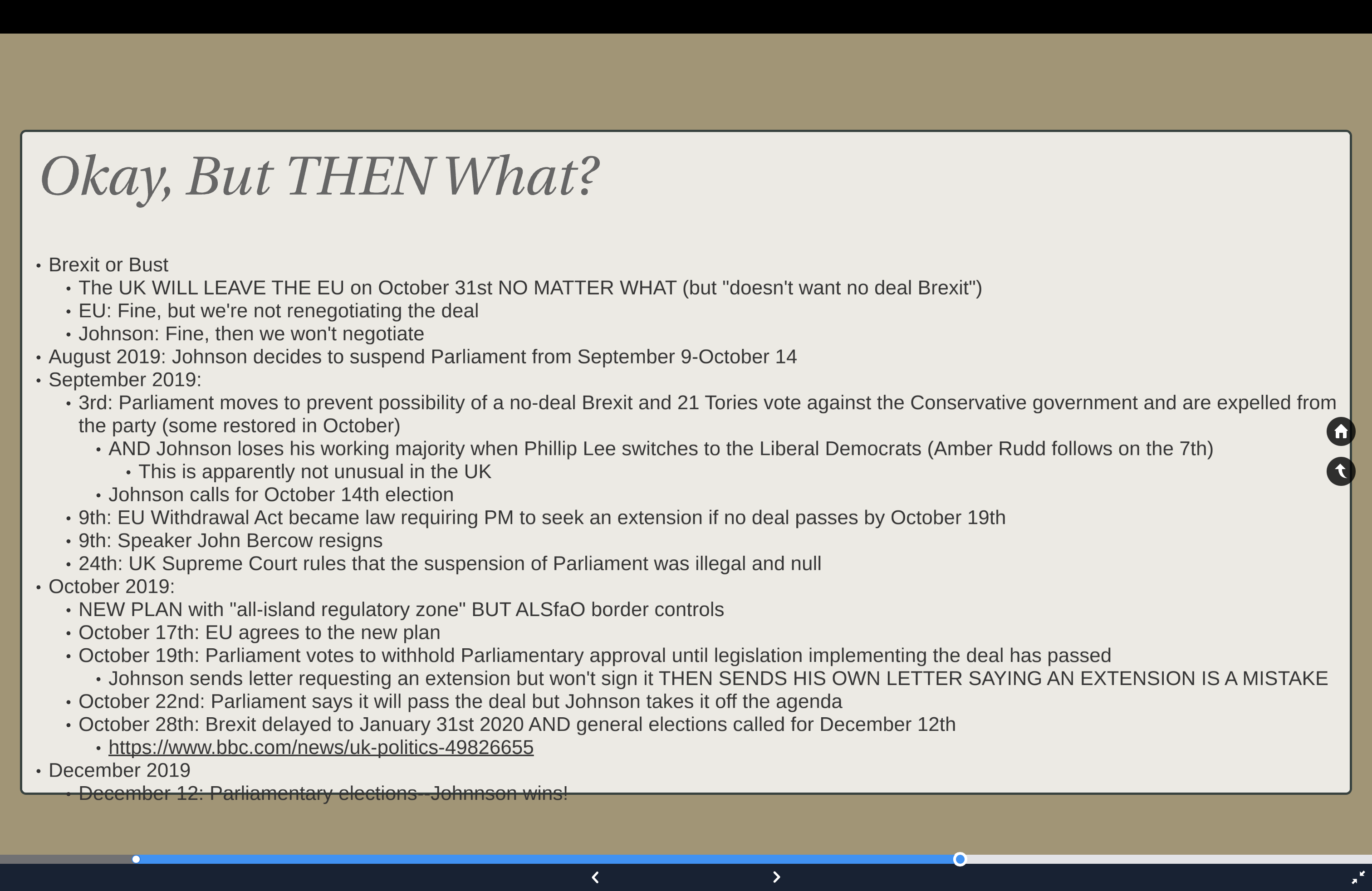
Brexit or Bust
- The UK is set to leave the EU on October 31st, regardless of the circumstances, emphasizing a hard stance.
- Thoughts: This reflects a commitment to a decisive Brexit, even if it results in a no-deal scenario that could have widespread ramifications for both the UK and EU.
August 2019
- Johnson suspends Parliament from September 9 to October 14.
- Explanation: This move raised concerns about transparency and parliamentary democracy during a critical time in the Brexit process.
September 2019
- 3rd: Parliament takes actions to prevent a no-deal Brexit; several Tory MPs voted against the government and faced expulsion.
- Thoughts: This indicates significant dissent within the ruling party about Brexit strategy.
- 9th: The EU Withdrawal Act is established, mandating the PM to seek an extension if no deal is reached by October 19.
- 24th: UK Supreme Court rules the suspension of Parliament was illegal and null.
- Implications: This ruling upheld the principle of parliamentary sovereignty and accountability.
October 2019
- New proposal includes an "all-island regulatory zone" but introduces complexities regarding border controls.
- Additional Info: The mention of "ALSfa" border controls is critical given the sensitive nature of the Northern Ireland border.
- 17th: The EU agrees to the new plan.
- 19th: Parliament withholds legislative approval until the new deal is fully legislated.
- 22nd: Parliament votes to bypass the deal but Johnson removes it from the agenda.
- 28th: Brexit postponed to January 31, 2020, with general elections called for December 12.
- Context: This extension again highlights the challenges in reaching a consensus on Brexit terms.
December 2019
- 12th: Parliamentary elections are held, and Johnson's party wins.
- Thoughts: The election result reflects public sentiment regarding Johnson's Brexit strategy, providing him a mandate to proceed with his plans.
Summary
This timeline outlines the significant events surrounding the Brexit process from Johnson’s tenure as Prime Minister. Key actions taken by Parliament and the judicial rulings emphasize the ongoing debates and complexities faced in achieving a cohesive Brexit strategy.
Best Brexit Analogy Ever
-
Context of Analogy:
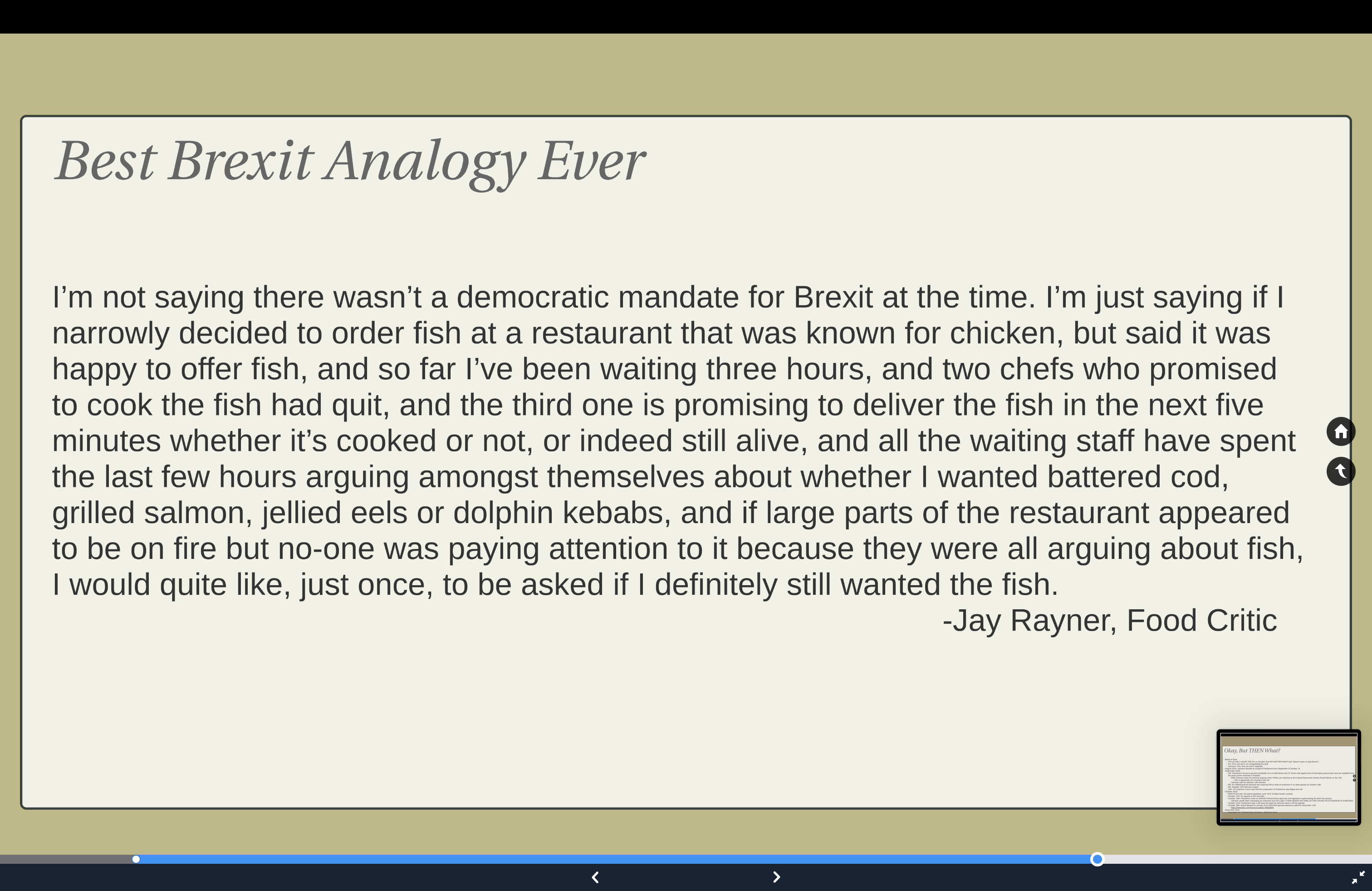
- The analogy is a humorous critique of the Brexit process, where the speaker compares the complex situation to ordering fish in a restaurant known for chicken. This reflects frustration with the convoluted and prolonged nature of Brexit negotiations.
-
Democratic Mandate:
- The speaker acknowledges that there was a democratic decision for Brexit, highlighting the legitimacy of the process while expressing dissatisfaction with its execution. This points to the tension between democratic choice and practical implementation.
-
Delay and Uncertainty:
- There's a notable delay (waiting three hours) that symbolizes the lengthy process of Brexit negotiations. This emphasizes the theme of uncertainty and indecision that has characterized the situation.
-
Staff Confusion:
- The various chefs and waiting staff struggling to agree on how to prepare the fish reflects the political disarray and disagreements among leaders regarding Brexit. This illustrates the chaos and inconsistency in planning and strategy.
-
Desired Attention:
- The speaker's wish to be asked if they still want the fish expresses a desire for simple communication and clarity, which is often lacking in complicated political discussions. It suggests that the people's needs and questions should be prioritized in policymaking.
-
Food Choices as Symbolism:
- The different types of fish (battered cod, grilled salmon, jellied eels, dolphin kebabs) represent the varied opinions and options available during the Brexit discussions. This highlights the complexity of the choices being made and their implications.
-
Imagery of Fire:
- The mention of parts of the restaurant being on fire serves as a powerful metaphor for the crises that arose during the Brexit process, indicating that important issues were being neglected amid the confusion.
Extended readings:
Brexit Timeline and Implications
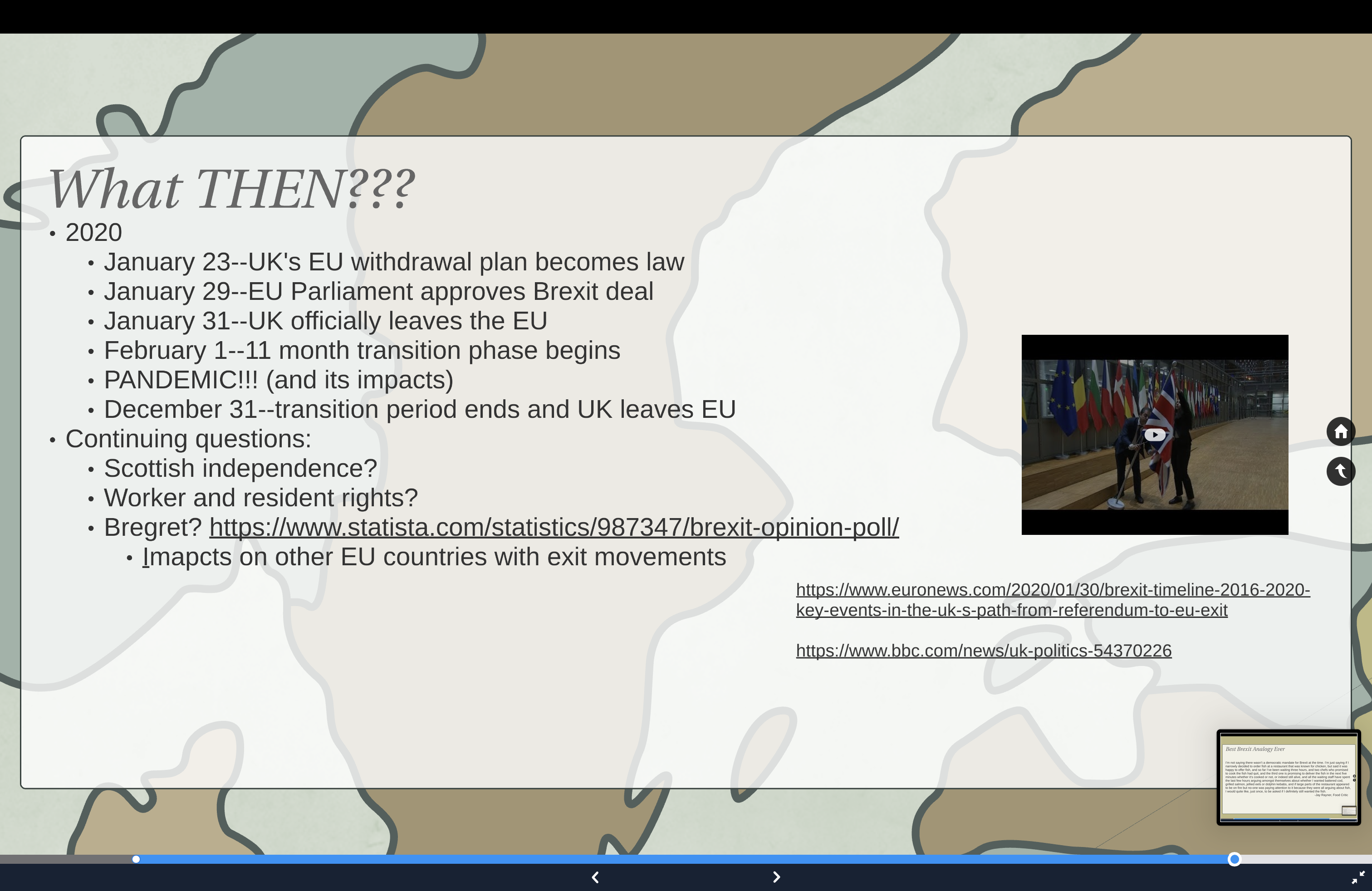
Key Events in 2020
-
January 23: UK's EU withdrawal plan becomes law
This marks a significant legal framework for the Brexit process, ensuring that the UK's departure from the EU is formalized. -
January 29: EU Parliament approves Brexit deal
The approval by the EU Parliament signifies the agreement between the UK and EU, leading to the UK’s official departure. -
January 31: UK officially leaves the EU
This date is pivotal as it ends over 40 years of UK membership in the EU, impacting trade, travel, and various agreements. -
February 1: 11-month transition phase begins
During this period, existing EU laws continue to apply, allowing time for negotiations on future relations between the UK and the EU. -
Pandemic: COVID-19 impacts
The pandemic has introduced new challenges for the UK, affecting the economy, public health, and Brexit negotiations. -
December 31: Transition period ends, UK leaves EU
This marks the end of the transitional phase, which raises questions about the future relationship, trade agreements, and the rights of citizens.
Continuing Questions
-
Scottish Independence?
Post-Brexit, discussions around Scotland's potential independence have intensified, reflecting differing views on EU membership among UK nations. -
Worker and Resident Rights?
Concerns arise regarding the rights of EU citizens living in the UK and UK citizens living in the EU, especially concerning residency and employment. -
Bregret?
The term "Bregret" refers to the regret expressed by some voters post-Brexit, with polling indicating fluctuating opinions on the decision to leave the EU.- Statista on Brexit Opinion Poll
Surveys highlight changing public sentiments towards Brexit and its aftermath.
- Statista on Brexit Opinion Poll
-
Impacts on Other EU Countries with Exit Movements
Other EU nations, like Italy and France, may face rise in calls for similar referendums on EU membership, warranting observation of political trends.
Sources
Background of the Opioid Crisis
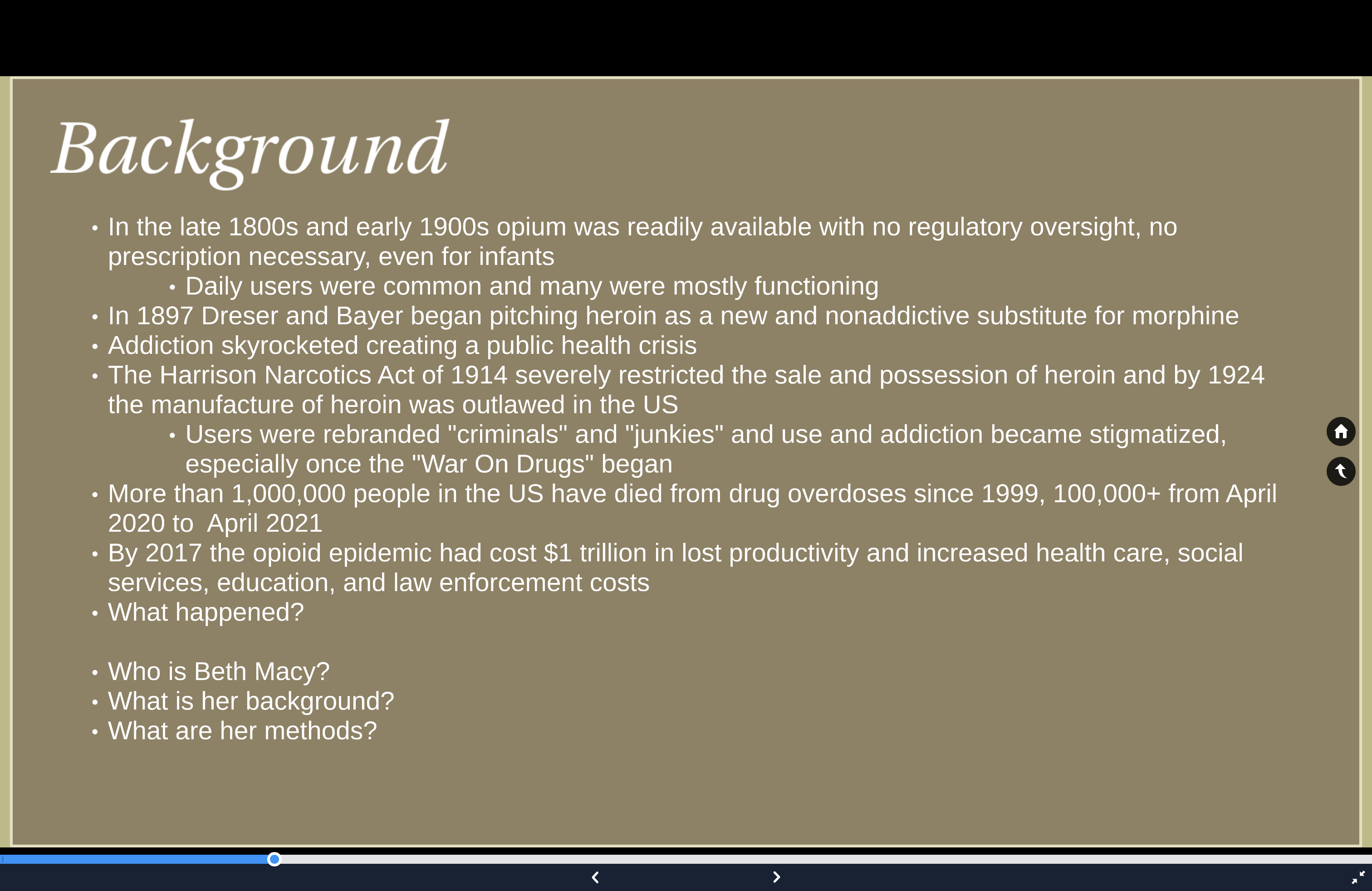
-
Historical Availability of Opium
- In the late 1800s and early 1900s, opium was widely available without regulations, even prescribed for infants.
- This lack of oversight contributed to higher rates of addiction as it was easily accessible to the general public.
-
Introduction of Heroin
- In 1897, developers like Dreser and Bayer marketed heroin as a nonaddictive alternative to morphine.
- This led to a surge in addiction rates, escalating into a significant public health crisis as more people became dependent on the substance.
-
Regulatory Changes: Harrison Narcotics Act of 1914
- The Harrison Narcotics Act of 1914 significantly restricted the sale and possession of heroin, making it illegal by 1924.
- This shift in regulation led to a societal stigma around users, labeling them as "criminals" and "junkies," particularly amplified during the "War On Drugs."
-
Current Statistics and Impact
- More than 1,000,000 people in the U.S. have died from drug overdoses since 1999, with over 100,000 fatalities between April 2020 and April 2021 alone.
- The opioid epidemic has incurred a staggering economic cost of $1 trillion by 2017, affecting productivity, healthcare, social services, and law enforcement.
-
Questions Raised
- What happened?
- This part invites an exploration of the crisis' evolution and contributing factors over time, indicating a need for deeper analysis and understanding.
- What happened?
-
Profile of Beth Macy
- Who is Beth Macy?
- Initial question aiming to detail her identity and contributions related to the opioid crisis.
- What is her background?
- This question seeks to understand her expertise, experience, and perspective in tackling the issues of addiction and public health.
- What are her methods?
- This prompts a discussion on her approaches to raising awareness, advocating for change, or addressing the problem effectively.
- Who is Beth Macy?
Overall, this presentation provides a timeline of the opioid crisis, highlighting historical trends and societal implications while prompting inquiries into individuals who have engaged with these issues critically, such as Beth Macy.
Extended readings:
Where are the Chagos?
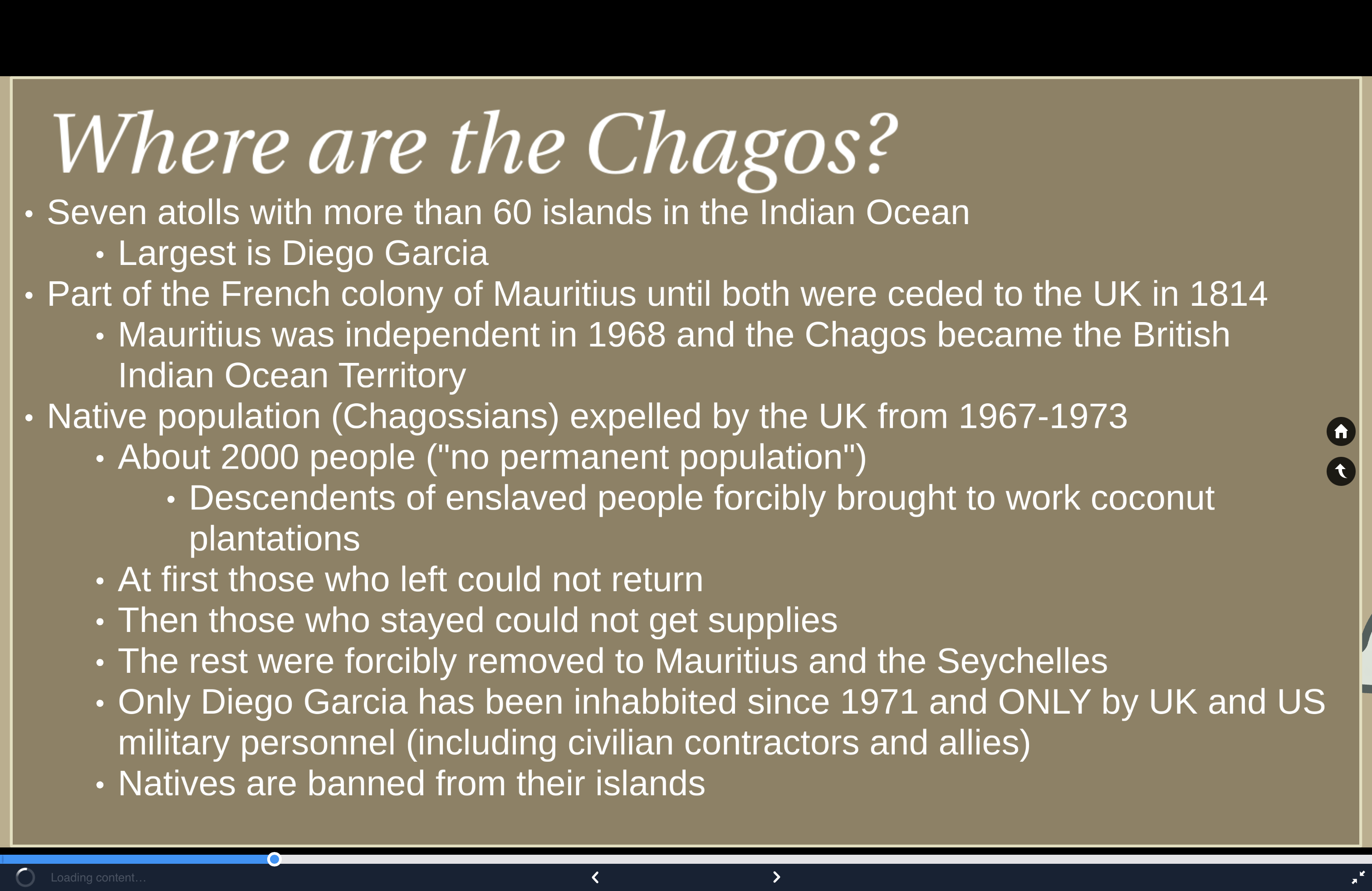
-
Geographical Overview:
- The Chagos archipelago consists of seven atolls with over 60 islands in the Indian Ocean.
- The largest island is Diego Garcia, which is strategically significant for military purposes.
-
Colonial History:
- The islands were part of the French colony of Mauritius until 1814, when they were ceded to the UK.
- Mauritius gained independence in 1968, after which the Chagos became known as the British Indian Ocean Territory.
-
Native Population:
- The native inhabitants, known as the Chagossians, were expelled by the UK between 1967 and 1973.
- There are about 2000 Chagossians, but they are often described as having "no permanent population" due to forced relocations.
- The Chagossians are descendants of enslaved individuals who were brought to work on coconut plantations.
-
Displacement and Consequences:
- Initially, those who left the islands were unable to return.
- Those who remained faced difficulties in obtaining supplies.
- Many were forcibly relocated to Mauritius and the Seychelles.
- Since 1971, only Diego Garcia has been inhabited and is occupied exclusively by UK and US military personnel, including contractors and allies.
- The native population is still banned from returning to their ancestral lands.
The situation highlights issues of colonialism, displacement, and the ongoing struggles for the rights of indigenous populations. The Chagos Islanders have sought recognition and restitution for their lost homeland and rights across international forums.
Extended readings:
Notes on Diego Garcia
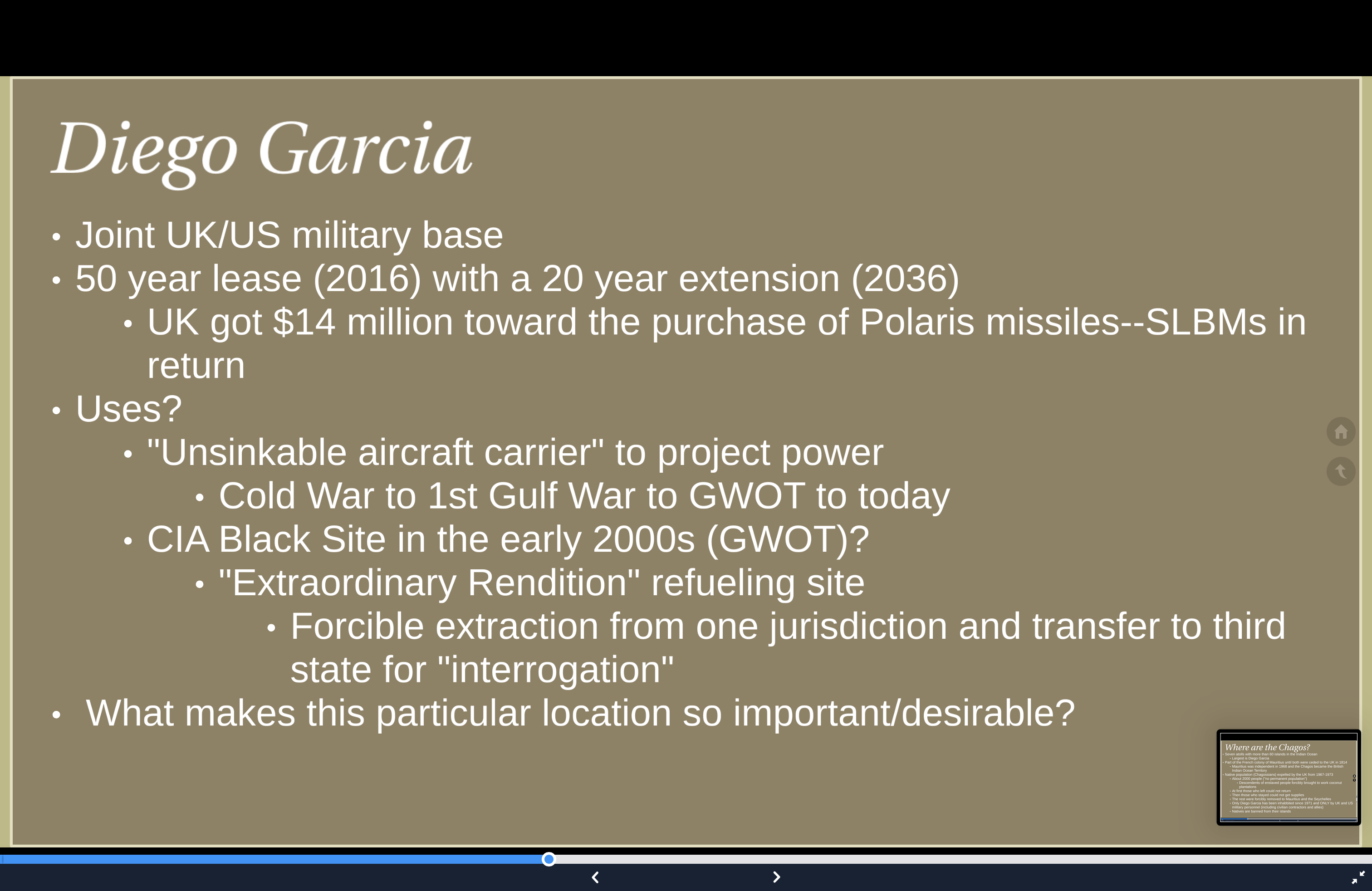
-
Joint UK/US military base
- Diego Garcia serves as a strategic military asset for both the United Kingdom and the United States, allowing for shared resources and operational capabilities in the Indian Ocean region.
-
50 year lease (2016) with a 20 year extension (2036)
- The lease arrangement underscores the long-term military cooperation between the UK and US, facilitating sustained military presence and operations in the area.
- The UK received $14 million towards the purchase of Polaris missiles, indicating reciprocal benefits from the lease.
-
Uses?
-
"Unsinkable aircraft carrier" to project power
- The base acts as a pivotal location for projecting military force across the Indian Ocean and into conflict zones, making it strategically significant during periods of global tension (e.g., Cold War, Gulf Wars).
-
CIA Black Site in the early 2000s (GWOT)
- The base played a role in the "Global War on Terror," housing a CIA black site for detaining and interrogating suspected terrorists, showcasing its use in intelligence and covert operations.
-
"Extraordinary Rendition" refueling site
- Diego Garcia facilitated the controversial practice of extraordinary rendition, where individuals were forcibly transferred between jurisdictions for interrogation, raising ethical and legal concerns.
-
-
What makes this particular location so important/desirable?
- The strategic significance of Diego Garcia lies in its geographic location, allowing for rapid deployment of military assets in a pivotal region, serving both operational and logistical purposes for the US and UK military.
Extended readings: