New Notebook
ICJ Decision on Chagos Archipelago
-
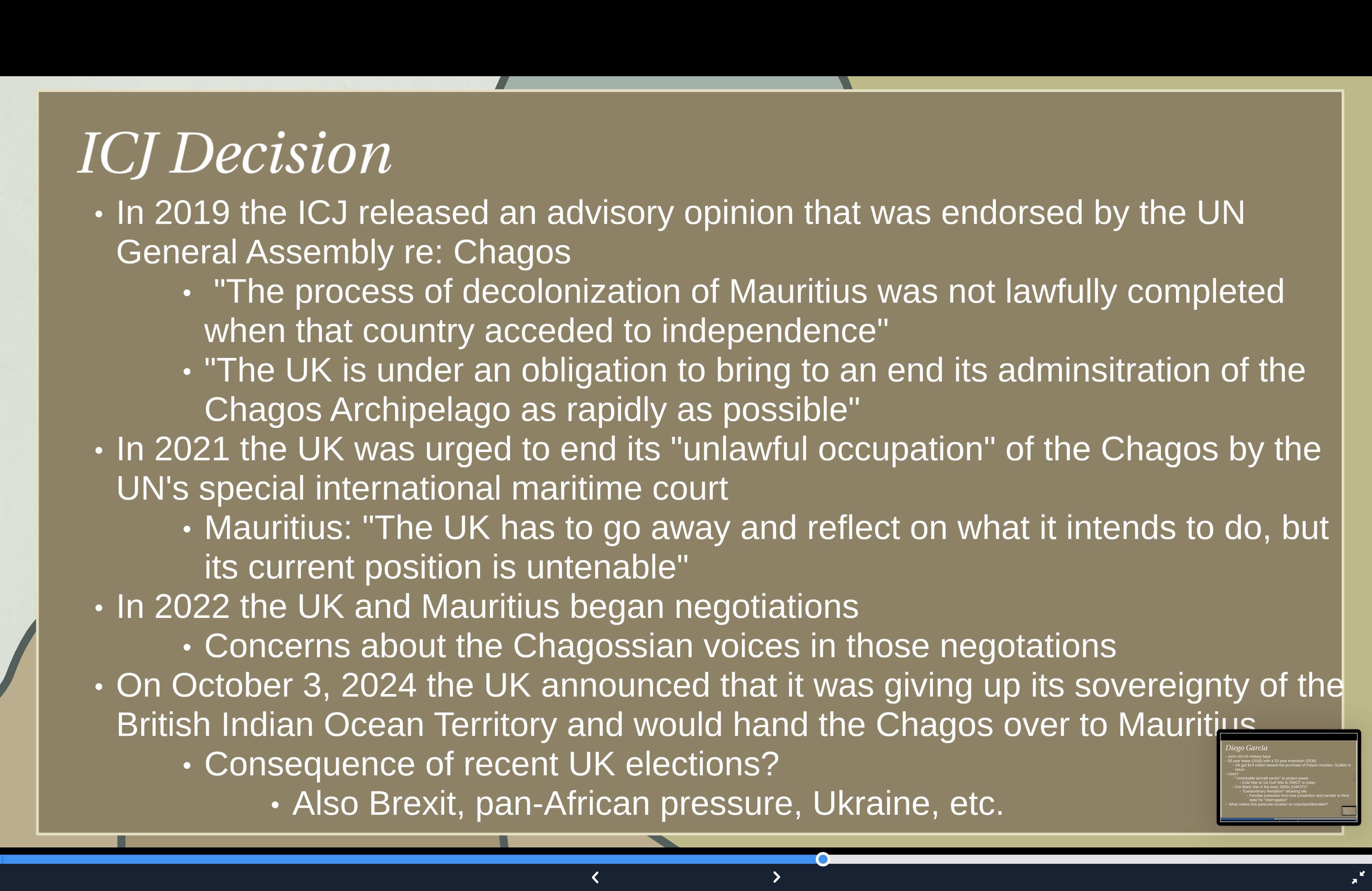
2019 ICJ Advisory Opinion
- The International Court of Justice (ICJ) issued an advisory opinion regarding the Chagos Archipelago, which was endorsed by the UN General Assembly.
- The opinion stated that the decolonization process of Mauritius was not completed lawfully at the time it gained independence. This highlights the issues surrounding colonial legacies and the rights of formerly colonized nations.
- The International Court of Justice (ICJ) issued an advisory opinion regarding the Chagos Archipelago, which was endorsed by the UN General Assembly.
-
UK's Obligations
- The UK was deemed to have an obligation to end its administration of the Chagos Archipelago as quickly as possible.
- This reflects international expectations for former colonial powers to resolve outstanding issues related to colonial territories.
- The UK was deemed to have an obligation to end its administration of the Chagos Archipelago as quickly as possible.
-
2021 Urging from the UN
- The UK was urged to terminate its "unlawful occupation" of the Chagos by the UN's special international maritime court.
- The language used emphasizes the international community's view of the UK's stance as not just controversial, but legally indefensible.
- The UK was urged to terminate its "unlawful occupation" of the Chagos by the UN's special international maritime court.
-
Mauritius's Position
- Mauritius stated, "The UK has to go away and reflect on what it intends to do, but its current position is untenable."
- This sentiment indicates Mauritius’s frustration with prolonged negotiations and the need for a resolution that acknowledges its sovereignty.
- Mauritius stated, "The UK has to go away and reflect on what it intends to do, but its current position is untenable."
-
2022 Negotiations
- In 2022, discussions began between the UK and Mauritius, indicating a potential shift in the dynamic and a willingness to engage in dialogue.
- However, there were concerns over the inclusion of Chagossian voices in these negotiations, suggesting that the affected populations have a critical role in discussions about their homeland.
- In 2022, discussions began between the UK and Mauritius, indicating a potential shift in the dynamic and a willingness to engage in dialogue.
-
2024 Announcement
- On October 3, 2024, the UK announced its intent to relinquish sovereignty over the British Indian Ocean Territory and transfer control of the Chagos to Mauritius.
- This decision may have been influenced by various factors, including recent political developments in the UK, such as Brexit and pressures from pan-African movements, as well as ongoing global conflicts affecting international relations.
- On October 3, 2024, the UK announced its intent to relinquish sovereignty over the British Indian Ocean Territory and transfer control of the Chagos to Mauritius.
-
Implications of Recent Events
- The decision can be seen as a consequence of recent UK elections and broader geopolitical pressures, illustrating how domestic politics can intersect with international legal obligations and colonial legacies.
Extended readings:
What Now?
-
UK and US Operations on Diego Garcia
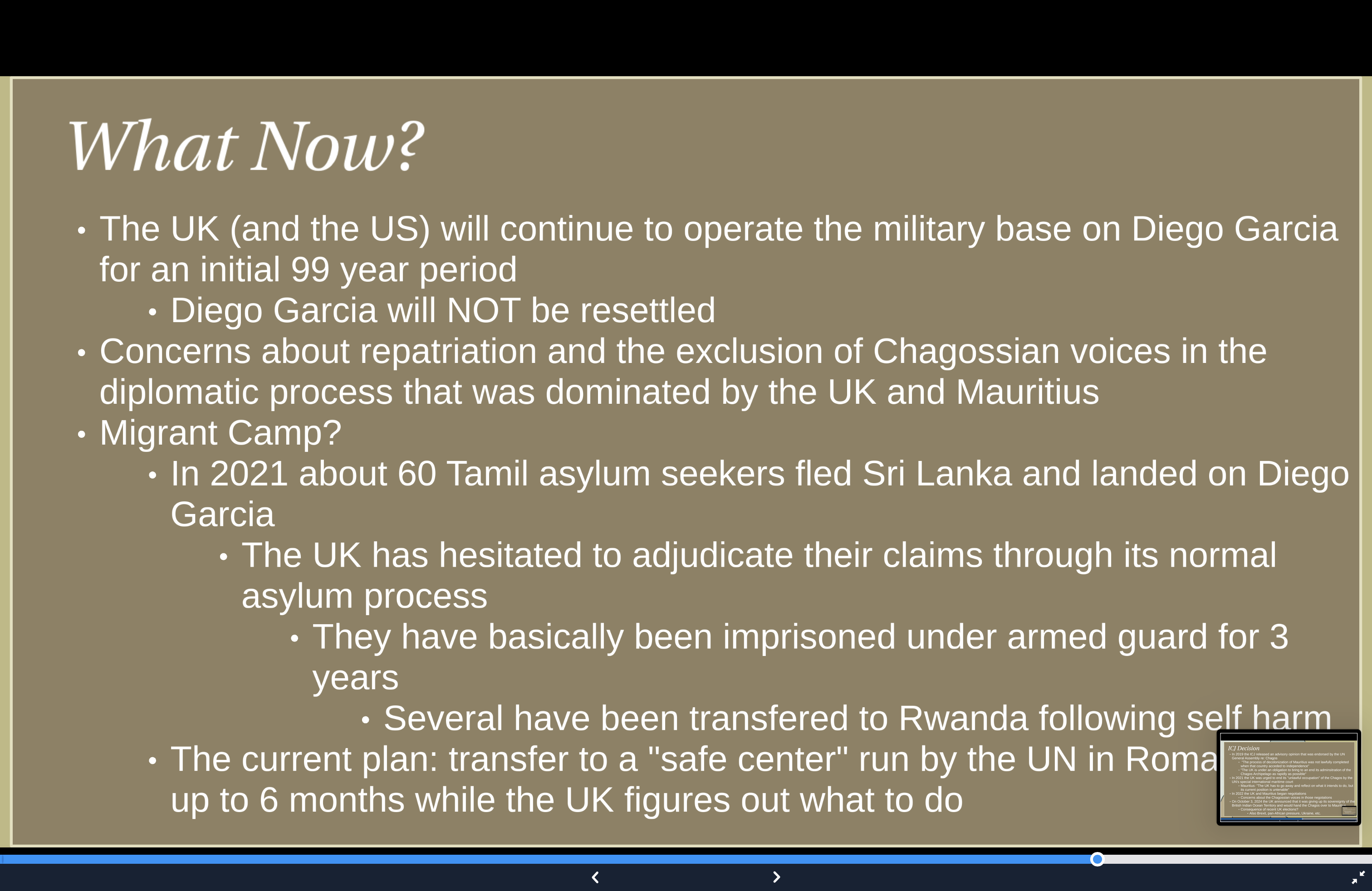
- The UK and the US will operate the military base on Diego Garcia for a period of 99 years.
- Thoughts: This lengthy operational duration indicates ongoing strategic military interests in the region. It raises questions about the long-term implications for local populations and geopolitical stability.
- The UK and the US will operate the military base on Diego Garcia for a period of 99 years.
-
Resettlement of Diego Garcia
- Diego Garcia will NOT be resettled.
- Ideas: This decision reflects a lack of consideration for potential rehousing of displaced populations, particularly the Chagossians, whose voices are often overlooked in these discussions.
- Diego Garcia will NOT be resettled.
-
Concerns About Repatriation
- There are concerns regarding the repatriation process and the exclusion of Chagossian voices from discussions primarily controlled by the UK and Mauritius.
- Explanation: The Chagossians, forcibly removed from their homeland, continue to seek justice and recognition. Their exclusion from diplomatic talks exacerbates feelings of disenfranchisement.
- There are concerns regarding the repatriation process and the exclusion of Chagossian voices from discussions primarily controlled by the UK and Mauritius.
-
Migrant Camp Situation
- In 2021, approximately 60 Tamil asylum seekers from Sri Lanka arrived in Diego Garcia.
- Context: This raises humanitarian concerns about the treatment of refugees and asylum seekers who face legal and social hurdles.
- In 2021, approximately 60 Tamil asylum seekers from Sri Lanka arrived in Diego Garcia.
-
UK Asylum Process Hesitation
- The UK has hesitated to adjudicate the asylum claims of these individuals, effectively limiting their legal status and rights.
- Ideas: Delays in the asylum process can lead to increased psychological stress for migrants who are often fleeing persecution. This can be viewed as a failure of the UK to uphold its legal and moral obligations.
- The UK has hesitated to adjudicate the asylum claims of these individuals, effectively limiting their legal status and rights.
-
Imprisonment Under Armed Guard
- Many have been effectively imprisoned under armed guard for three years.
- Thoughts: This situation reflects significant human rights concerns, as it may violate international norms regarding the treatment of asylum seekers and refugees.
- Many have been effectively imprisoned under armed guard for three years.
-
Transfer to Rwanda
- Several individuals have been transferred to Rwanda following incidents of self-harm.
- Ideas: This transfer raises ethical questions about the care and treatment of vulnerable populations. Rwanda’s capacity to adequately support these individuals may be questioned.
- Several individuals have been transferred to Rwanda following incidents of self-harm.
-
Temporary "Safe Center" Plan
- The current plan involves transferring the migrants to a "safe center" run by the UN in Romania, with an uncertain time frame of up to six months.
- Explanation: This temporary solution appears to be a stopgap measure while the UK assesses how to handle the situation. It reflects a lack of a long-term strategic plan for dealing with migrant issues.
- The current plan involves transferring the migrants to a "safe center" run by the UN in Romania, with an uncertain time frame of up to six months.
Goals
Early Post-Soviet Russian Imperatives
-
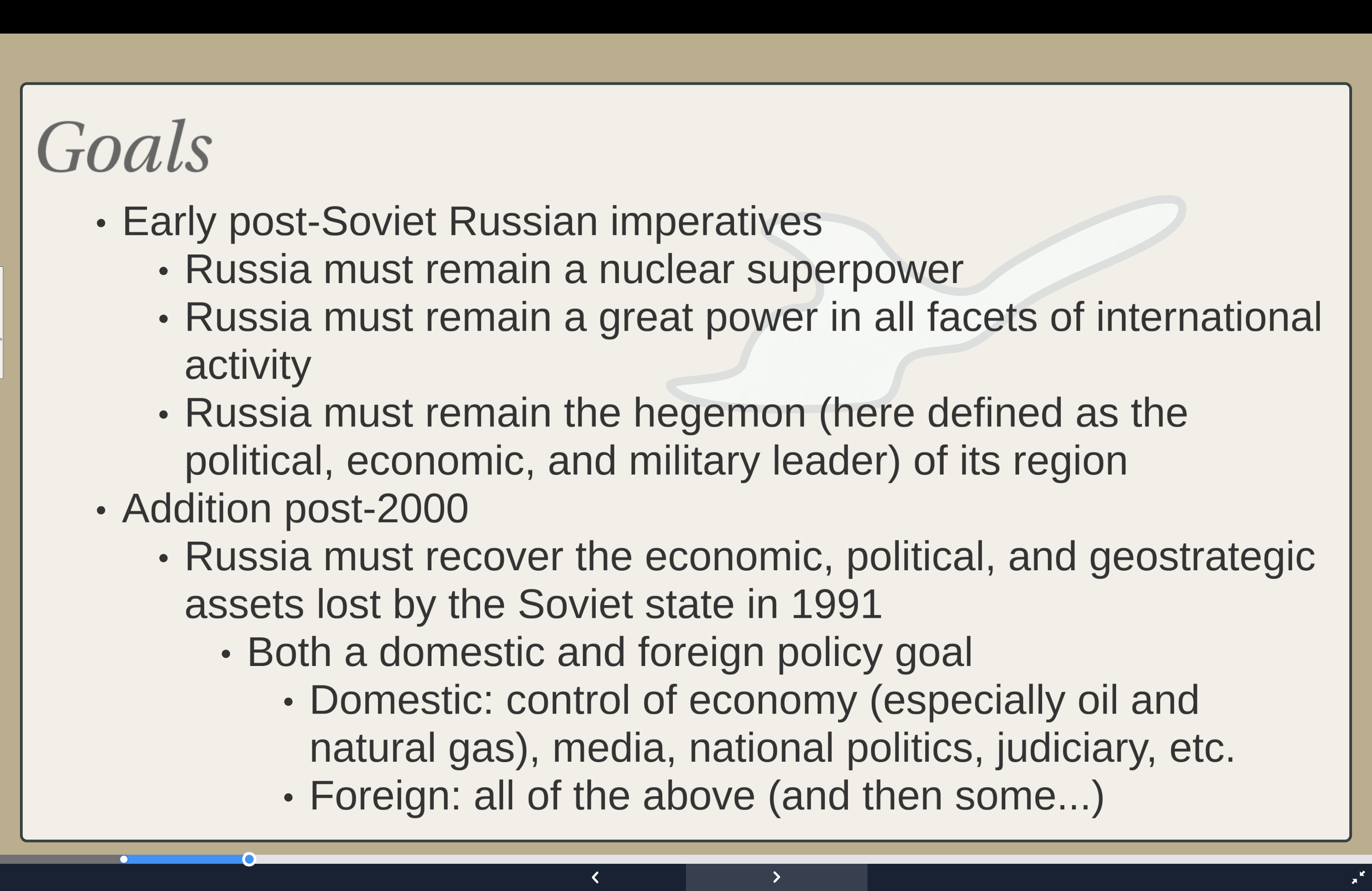
Russia must remain a nuclear superpower
- The nuclear capability is crucial for Russia's security and status on the global stage, ensuring it retains influence over other nations.
-
Russia must remain a great power in all facets of international activity
- This goal emphasizes the importance of being active in international politics, economics, and cultural exchanges to maintain global relevance.
-
Russia must remain the hegemon of its region
- Here, "hegemon" refers to Russia's aim to lead politically, economically, and militarily within its sphere of influence, which includes former Soviet states.
Addition Post-2000
-
Russia must recover the economic, political, political, and geostrategic assets lost by the Soviet state in 1991
- Following the collapse of the Soviet Union, Russia lost significant influence and resources. This recovery is essential to reestablish its position.
-
Both a domestic and foreign policy goal
-
This dual focus indicates that Russia's internal policies directly impact its external relations and power projection.
-
Domestic: control of economy (especially oil and natural gas), media, national politics, judiciary, etc.
- Control over vital resources like oil and gas reinforces economic stability and political power. The media and judiciary are critical for maintaining governmental authority and suppressing dissent.
-
Foreign: all of the above (and then some...)
- This illustrates the interconnectedness of domestic and foreign policy, where internal control strengthens Russia's international standing and negotiation power.
-
Extended readings:
Putin's Rise to and Concentration of Power
-
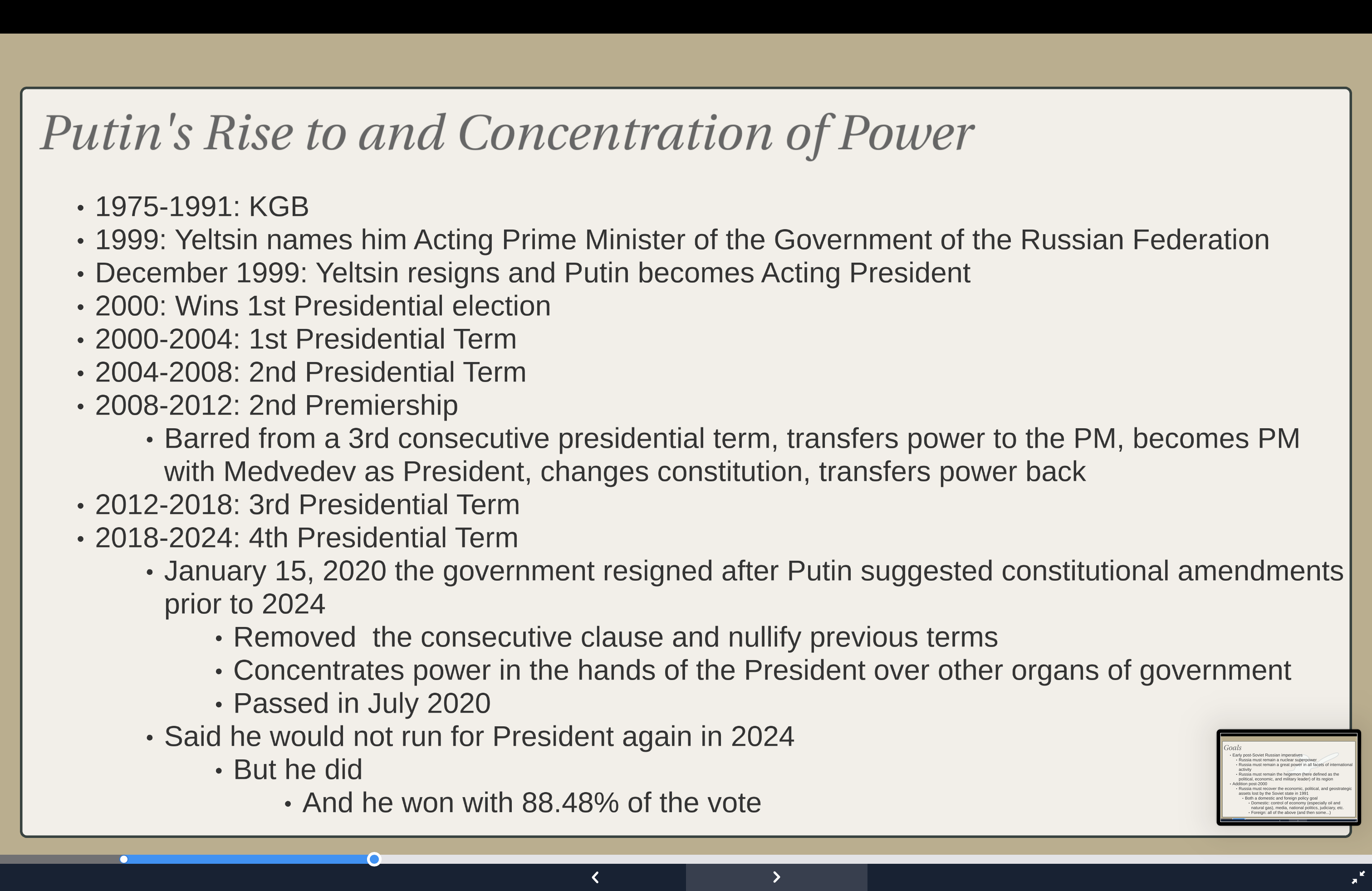
1975-1991: KGB
- Background in the KGB, the main security agency for the Soviet Union, which provided him with networks and experience in governance and intelligence.
-
1999: Yeltsin names him Acting Prime Minister
- Boris Yeltsin appointed him as a strategic move, perhaps due to Putin's loyalty and effectiveness seen in his KGB career.
-
December 1999: Yeltsin resigns and Putin becomes Acting President
- Significant transition in leadership, marking the emergence of Putin as a key figure in Russian politics.
-
2000: Wins 1st Presidential election
- Demonstrated significant electoral support, paving the way for future consolidations of power.
-
2000-2004: 1st Presidential Term
- Early years focused on stabilizing the country and consolidating power after the chaotic post-Soviet era.
-
2004-2008: 2nd Presidential Term
- Continued focus on economic recovery and strengthening political control, amidst rising tensions with the West.
-
2008-2012: 2nd Premiership
-
Due to constitutional limits, Putin acted as Prime Minister while Medvedev assumed presidency. This period highlighted the flexibility of Russian political structures to maintain Putin's influence.
-
Barred from a 3rd consecutive presidential term:
- Indicated the challenges of sustaining power amid constitutional limits, yet he maneuvered effectively.
-
Transfers power to the PM, becomes PM with Medvedev as President, changes constitution, transfers power back:
- This maneuvering illustrates a strategic approach to political power dynamics.
-
-
2012-2018: 3rd Presidential Term
- A return to the presidency amid political protests and a renewed assertiveness on the global stage.
-
2018-2024: 4th Presidential Term
-
January 15, 2020: Government resignation after Putin suggested constitutional amendments prior to 2024:
- Indicated preparedness to adapt governance structures for longevity in power.
-
Removed the consecutive clause and nullify previous terms:
- Allowed him to reset his political timeline, reinforcing his hold over Russian leadership.
-
Concentrates power in the hands of the President over other organs of government:
- Indicates an increasing centralization of authority, limiting checks on presidential power.
-
Passed in July 2020:
- Significant move to strengthen his position anteing the upcoming elections.
-
Said he would not run for President again in 2024:
- Initial statements might have been seen as a political maneuver, emphasizing a transitional phase.
-
But he did and won with 88.48% of the vote:
- This reflects the significant control he maintains over electoral processes and public opinion, despite potential dissent.
-
These points illustrate the complex political maneuvering and strategic adaptations employed by Putin to consolidate and maintain power in Russia over more than two decades.
Nuclear Superpower
-
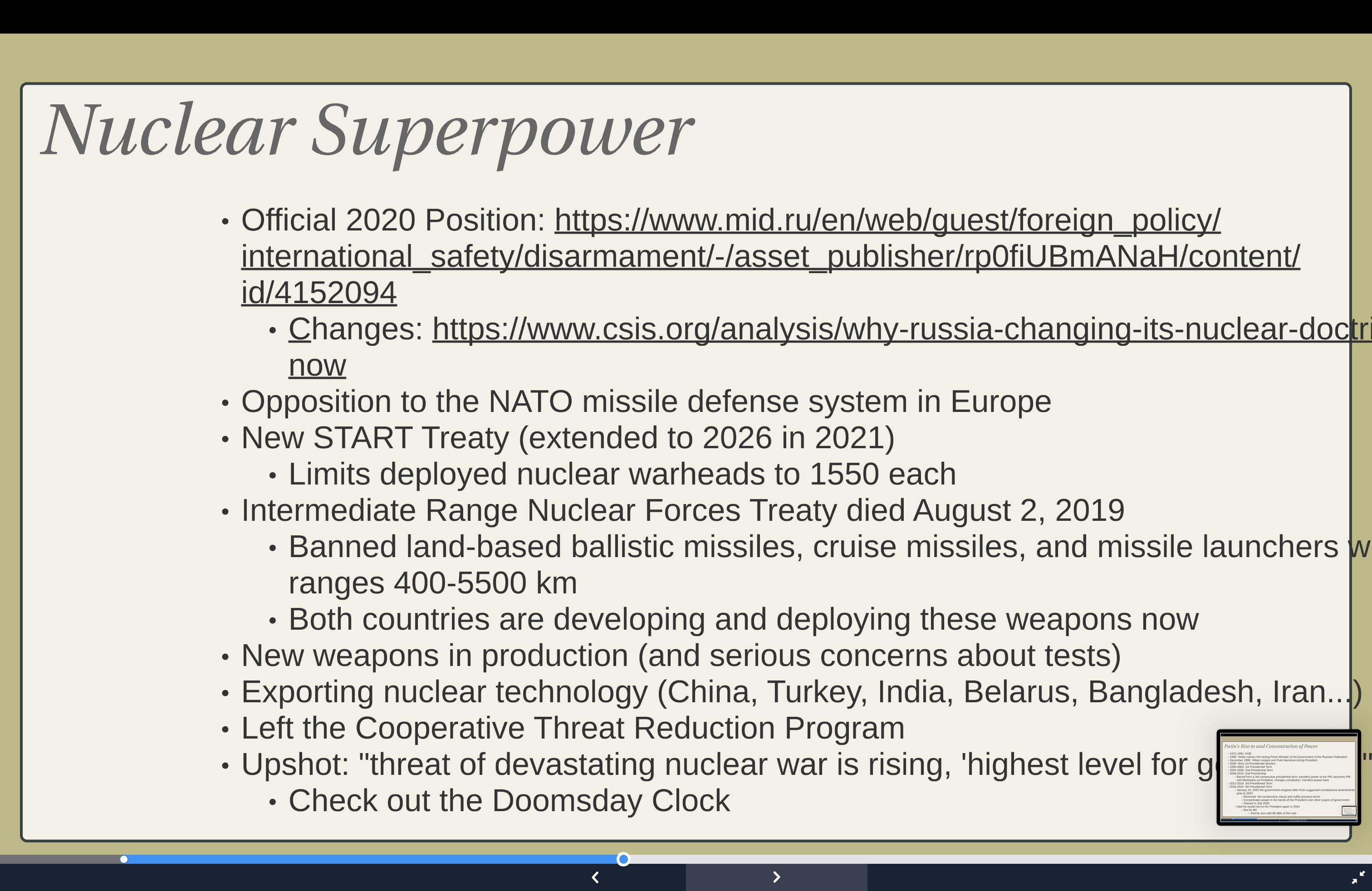
Official 2020 Position:
- Link: Official Position
- This document outlines the formal stance on nuclear disarmament and international safety, reflecting the country's strategic approach to nuclear weapons.
-
Changes:
- Link: Analysis on Changes
- This resource discusses the evolving nuclear strategy of Russia in response to international pressures and changes in global security dynamics.
-
Opposition to NATO Missile Defense:
- Russia has voiced strong opposition to NATO’s missile defense initiatives in Europe, viewing them as a threat to its national security.
- This highlights ongoing tensions between NATO member states and Russia regarding missile deployment and defense systems.
-
New START Treaty:
- Extended to 2026 in 2021, this treaty limits deployed nuclear warheads to 1550 each.
- The treaty plays a crucial role in arms control, aiming to promote strategic stability between the major nuclear powers.
-
Intermediate Range Nuclear Forces Treaty (INF Treaty) :
- The INF Treaty, which was designed to eliminate land-based ballistic missiles, died on August 2, 2019.
- This treaty's demise raises concerns over a renewed arms race, as both the U.S. and Russia may now expand their missile capabilities.
-
New Weapons Development:
- Both Russia and the United States are currently developing and deploying new nuclear weapons systems.
- This indicates a shift towards modernization of arsenals, which could escalate global tensions.
-
Exporting Nuclear Technology:
- Countries like China, Turkey, India, Belarus, Bangladesh, and Iran are receiving nuclear technology from Russia.
- This proliferation poses significant geopolitical risks as it may empower other nations with nuclear capabilities.
-
Cooperative Threat Reduction Program:
- Russia has left this program, which aimed to dismantle weapons of mass destruction in former Soviet states.
- The exit from this program raises concerns regarding the safety and management of nuclear materials.
-
Upshot:
- The perceived "threat of devastating nuclear war" is rising globally, noted as being at the "highest level for decades."
- Awareness of nuclear risks is encapsulated in the concept of the Doomsday Clock, which symbolizes the proximity of human civilization to catastrophic destruction.
Extended readings:
"Great Power" Status
-
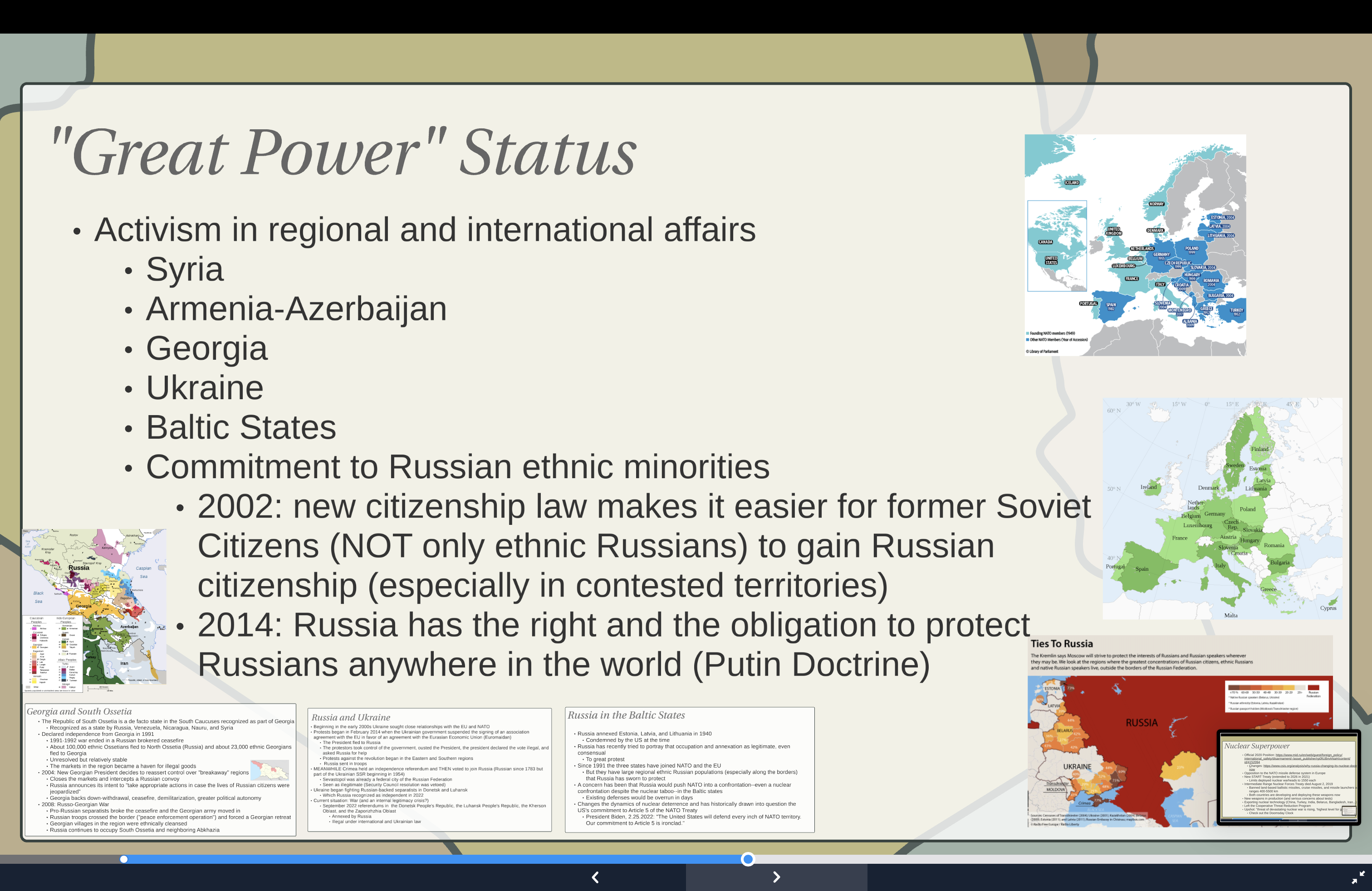
Activism in regional and international affairs
- Russia has been actively involved in several geopolitical issues reflecting its "Great Power" status. This activism includes:
- Syria: Russia's involvement supports the Assad regime and extends its influence in the Middle East.
- Armenia-Azerbaijan: Russia plays a mediating role in this conflict, asserting its influence over former Soviet republics.
- Georgia: The recognition of Abkhazia and South Ossetia as independent states by Russia demonstrates its willingness to challenge Western influence in the region.
- Ukraine: The annexation of Crimea in 2014 and ongoing conflict in Eastern Ukraine signify a significant assertion of power.
- Baltic States: Russia's military posturing and presence in Latvia, Lithuania, and Estonia raise security concerns among NATO allies.
- Russia has been actively involved in several geopolitical issues reflecting its "Great Power" status. This activism includes:
-
Commitment to Russian ethnic minorities
- 2002 Citizenship Law: This law simplifies the process for former Soviet citizens to acquire Russian citizenship, which is strategically significant, particularly in territories with Russian populations.
- Thought: The aim is to maintain a connection and influence over Russian-speaking populations outside of Russia, potentially acting as a pretext for intervention.
- 2014 Putin Doctrine: This doctrine asserts Russia’s responsibility to protect ethnic Russians globally, legitimizing military action under the guise of protection.
- Additional Information: This doctrine has been cited in justifications for actions in Crimea and Ukraine, indicating the extension of Russian influence based on ethnic ties.
- 2002 Citizenship Law: This law simplifies the process for former Soviet citizens to acquire Russian citizenship, which is strategically significant, particularly in territories with Russian populations.
Maps Included
- Maps: The presentation includes various maps showcasing regions affected by Russian policies and military activities, highlighting geopolitical tensions in Europe and surrounding areas. These visuals emphasize the strategic interests of Russia in maintaining influence over former Soviet territories.
Extended readings:
Georgia and South Ossetia
-
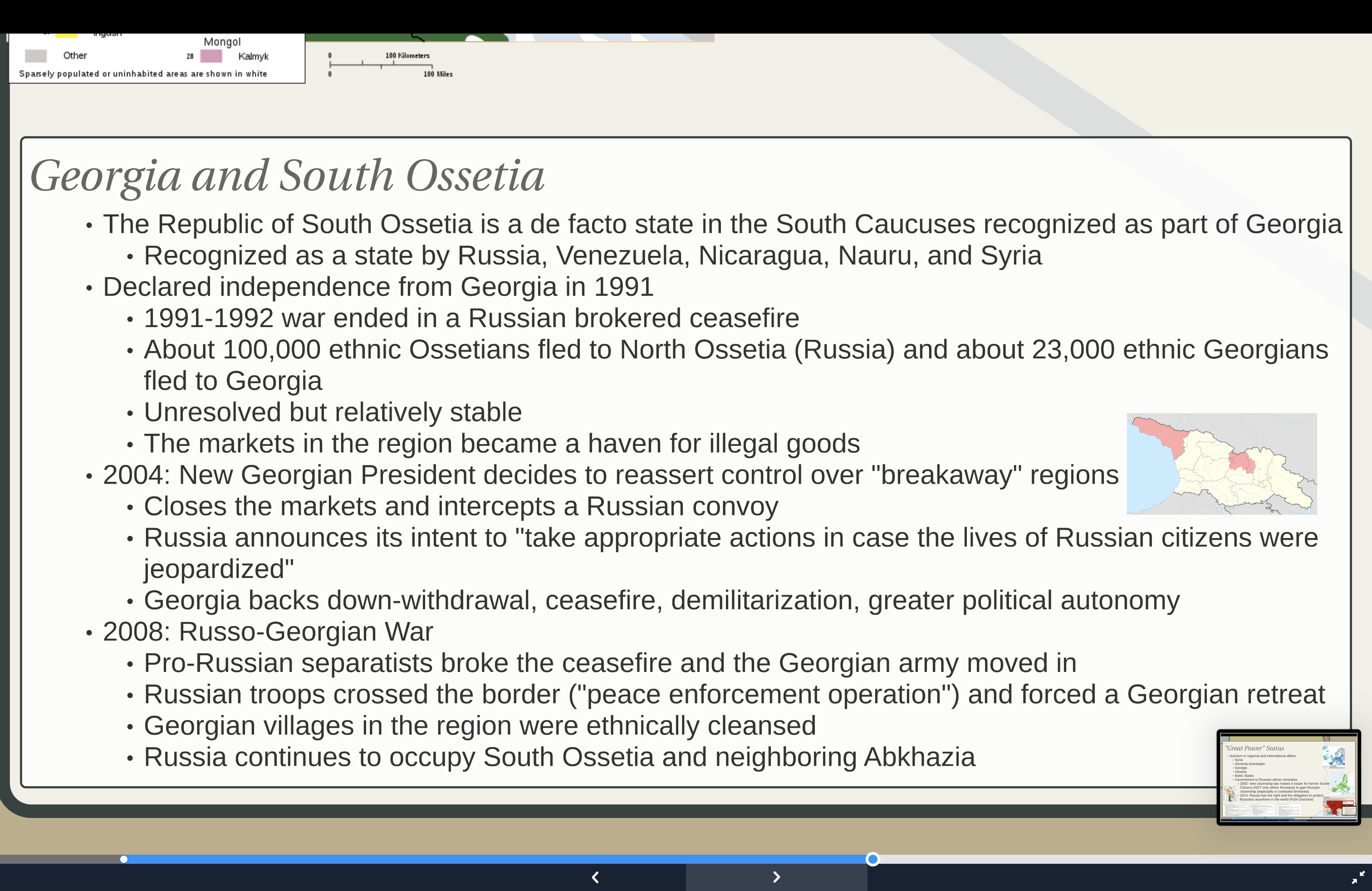
Republic of South Ossetia:
- A de facto state in the South Caucasus, recognized as part of Georgia.
- Recognized only by Russia, Venezuela, Nicaragua, Nauru, and Syria.
- This limited recognition highlights the geopolitical complexities and alignments in the region.
-
Independence from Georgia:
- Declared independence in 1991.
- A war occurred from 1991-1992, resulting in a Russian-brokered ceasefire.
- The conflict led to significant displacement, with about 100,000 ethnic Ossetians fleeing to North Ossetia (Russia), while around 23,000 ethnic Georgians moved to Georgia.
- The unresolved status of the conflict shows ongoing tensions and the fragile stability in the area.
-
Market Issues:
- Markets in the region turned into a hub for illegal goods, reflecting the economic instability and the presence of unregulated trade.
- Economic conditions may contribute to ongoing conflicts, as local economies struggle with legality and stability.
-
Georgian Political Resurgence (2004) :
- The new Georgian president sought to reassert control over self-proclaimed "breakaway" regions.
- Closed markets and intercepted a Russian convoy, indicating a change in domestic policy that could escalate tensions.
- Russia’s intent to protect Russian citizens suggests a proactive stance in the region, potentially justifying future military interventions.
-
Russo-Georgian War (2008) :
- Pro-Russian separatists broke the ceasefire, prompting the Georgian army to respond.
- The conflict escalated with Russia conducting a "peace enforcement operation," further intensifying the humanitarian crisis in the region, including ethnic cleansing of Georgian villages.
- Russia's ongoing occupation of South Ossetia and Abkhazia complicates peace efforts, as it undermines Georgian sovereignty and fosters prolonged instability.
This overview encapsulates key events and their implications on regional stability and international relations in the South Caucasus.
Extended readings:
Russia and Ukraine
-
Background of Ukraine's Political Shift
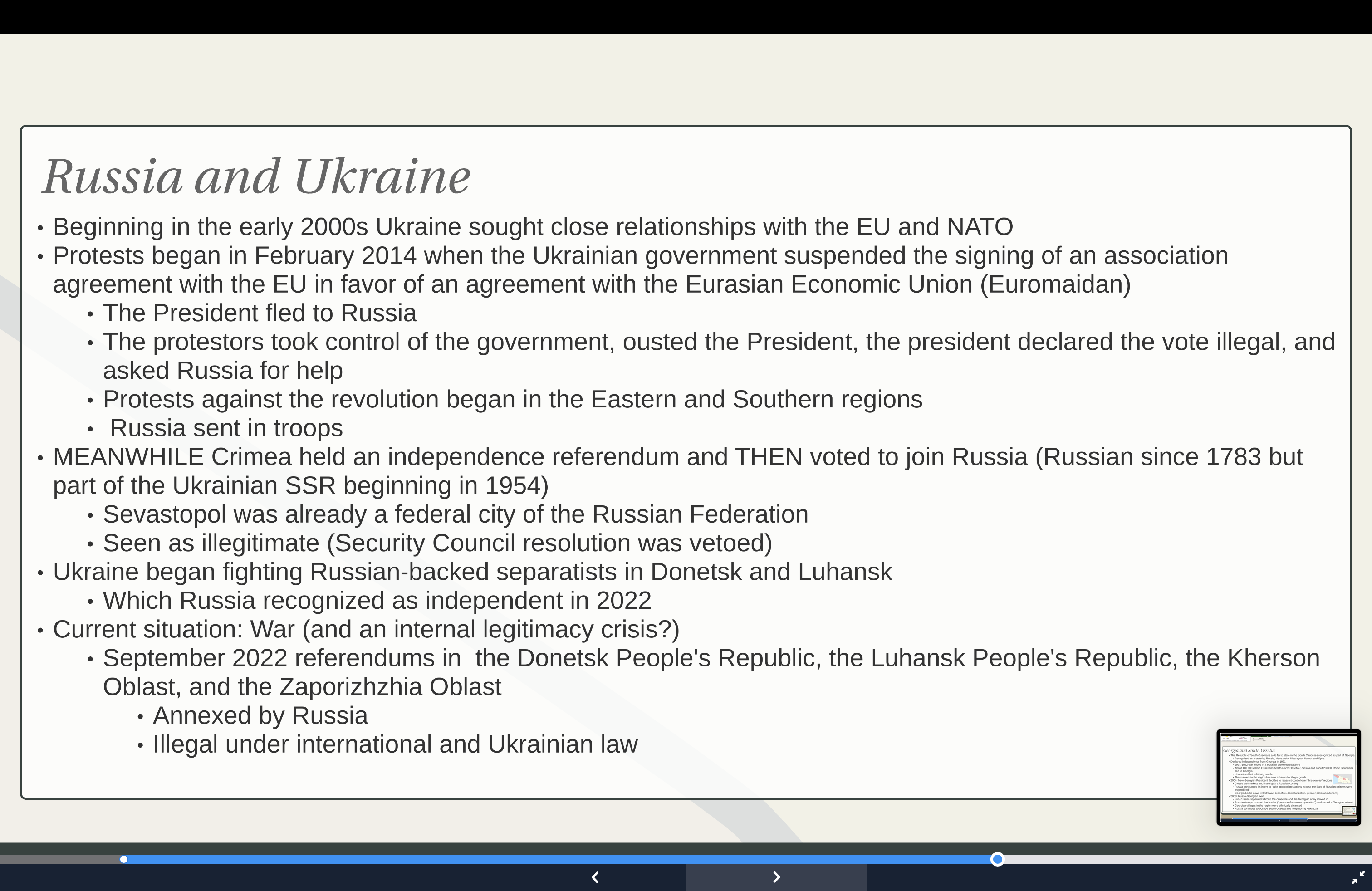
- Ukraine sought closer ties with the EU and NATO in the early 2000s.
- This reflects a broader trend in post-Soviet countries aiming for European integration and distancing from Russian influence.
- Ukraine sought closer ties with the EU and NATO in the early 2000s.
-
2014 Protests (Euromaidan)
-
Protests erupted in February 2014 when the Ukrainian government halted an EU association agreement in favor of the Eurasian Economic Union.
- The public's reaction was rooted in a desire for democratic reforms and alignment with European standards.
-
The President fled to Russia amidst escalating protests.
- This demonstrates a significant loss of authority for the Ukrainian government and a pivotal moment in the country’s political landscape.
-
Protesters took control, ousting the President, who deemed the protests illegal and sought Russian assistance.
- This highlights the internal conflict and division within Ukraine, with some regions supporting the government and others opposing it.
-
Protests against the revolution emerged in Eastern and Southern Ukraine.
- Reflects regional differences in political support, with more pro-Russian sentiments in the East.
-
Russia sent in troops, exacerbating the conflict.
- Marks the beginning of direct military involvement by Russia and raises questions about sovereignty and international law.
-
-
Crimea's Independence Referendum
-
Crimea held an independence referendum and voted to join Russia, despite being part of Ukraine since 1954.
- The historical context of Crimea's annexation is crucial, as it was transferred to Ukraine during the Soviet era and carries significance for both nations.
-
Sevastopol was already a federal city of the Russian Federation.
- This strategic location underscores Russia's interest in maintaining a naval presence in the Black Sea.
-
The referendum was deemed illegitimate by many, particularly after a Security Council resolution was vetoed.
- Highlights issues regarding the legality and legitimacy of referendums in conflict zones.
-
-
Ukraine’s Struggle Against Separatists
-
Ukraine began fighting Russian-backed separatists in Donetsk and Luhansk.
- This ongoing conflict has a profound humanitarian impact and raises issues of international response and intervention.
-
Russia recognized these regions as independent in 2022, intensifying tensions.
- This recognition further complicates peace efforts and international relations.
-
-
Current Situation
-
War continues, with a potential internal legitimacy crisis in Ukraine.
- The conflict has led to significant national challenges, including governance and public trust.
-
September 2022 referendums in occupied regions (Donetsk, Luhansk, Kherson Oblast, and Zaporizhzhia Oblast) were reported.
- This process lacks recognition from Ukraine and most of the international community, raising questions about self-determination and territorial integrity.
-
Areas annexed by Russia are illegal under both international and Ukrainian law.
- This illegality emphasizes the ongoing dispute and the struggle for international law to govern state sovereignty and territorial claims.
-
Russia in the Baltic States
-
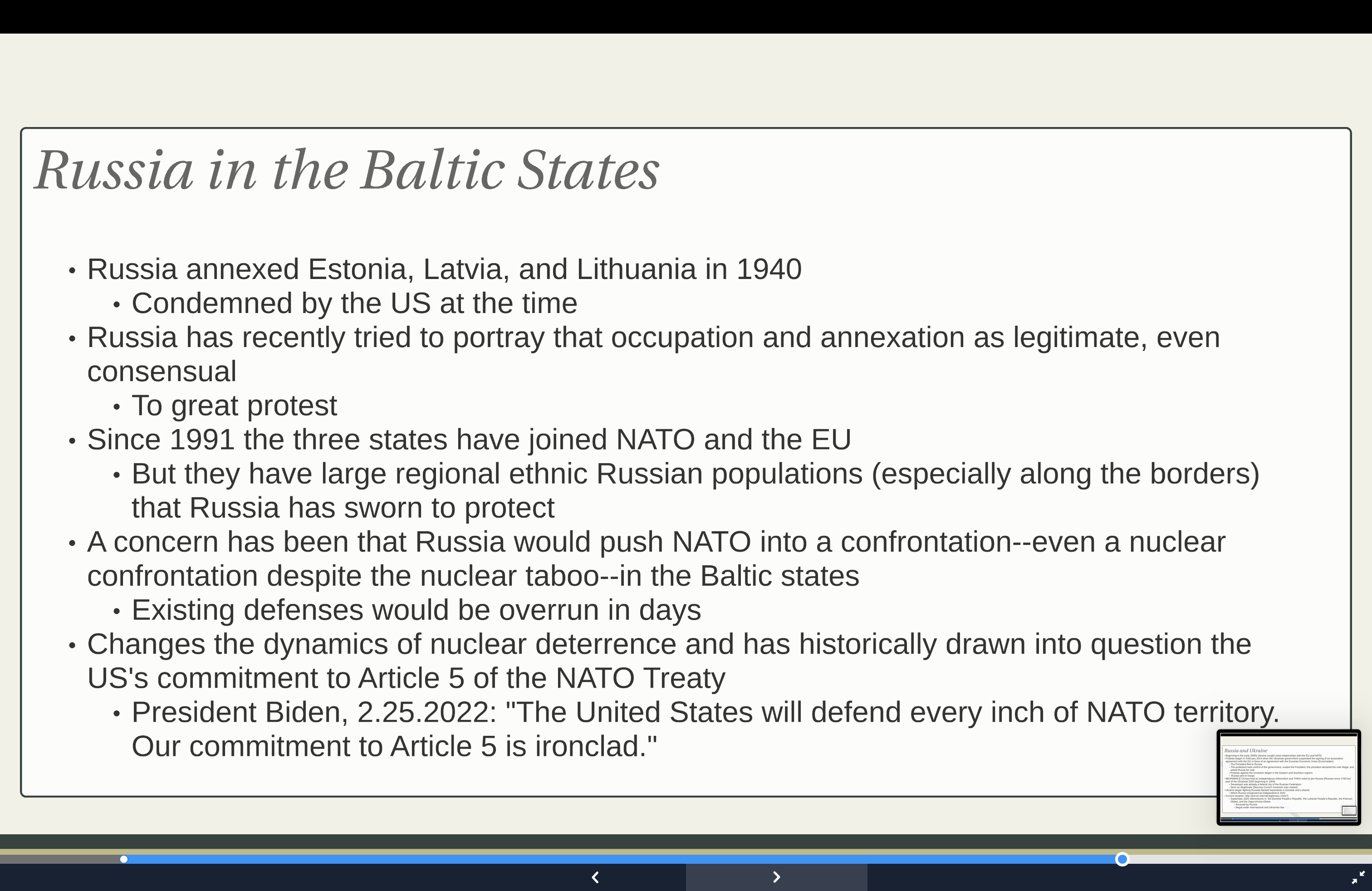
Annexation of Estonia, Latvia, and Lithuania in 1940
- Russia's annexation was condemned by the US, highlighting historical tensions and issues regarding sovereignty in the region.
- This event set a precedent for future Russian claims and actions in neighboring territories.
-
Portrayal of Occupation as Legitimate
- Recently, Russia has attempted to frame its actions in the Baltic States as consensual, which has faced significant backlash and protests.
- This portrays a narrative that undermines the sovereignty of these states, potentially complicating international relations.
-
NATO and EU Membership Since 1991
- The Baltic States have integrated into NATO and the EU, which enhances their security but also brings challenges due to the sizeable ethnic Russian populations living within their borders.
- These populations are often seen as a leverage point for Russia, as they claim to protect their interests.
-
Concerns of Confrontation Involving NATO
- There are fears that Russia may instigate a situation to push NATO into a conflict, potentially leading to nuclear confrontations.
- This reflects the fragile security situation in Eastern Europe and the risk of miscalculation leading to a larger conflict.
-
Potential Overrun of Defenses
- The assertion that existing defenses could be quickly overwhelmed emphasizes the urgency and seriousness of the situation in the Baltic region.
- Military preparedness and strategic planning are essential to counter potential aggressions.
-
Changes in Nuclear Deterrence Dynamics
- The changing landscape affects how nuclear deterrence is viewed, particularly Article 5 of the NATO Treaty, which mandates collective defense.
- A strong commitment to NATO's collective defense is crucial for deterrence against any acts of aggression.
-
Biden's Commitment to NATO
- President Biden’s statement reinforces the US's dedication to NATO, indicating a strong stance against threats to member states.
- Such commitments can serve to bolster confidence among NATO members and deter Russian aggression in the region.
Extended readings:
Hegemony in Eurasia
-
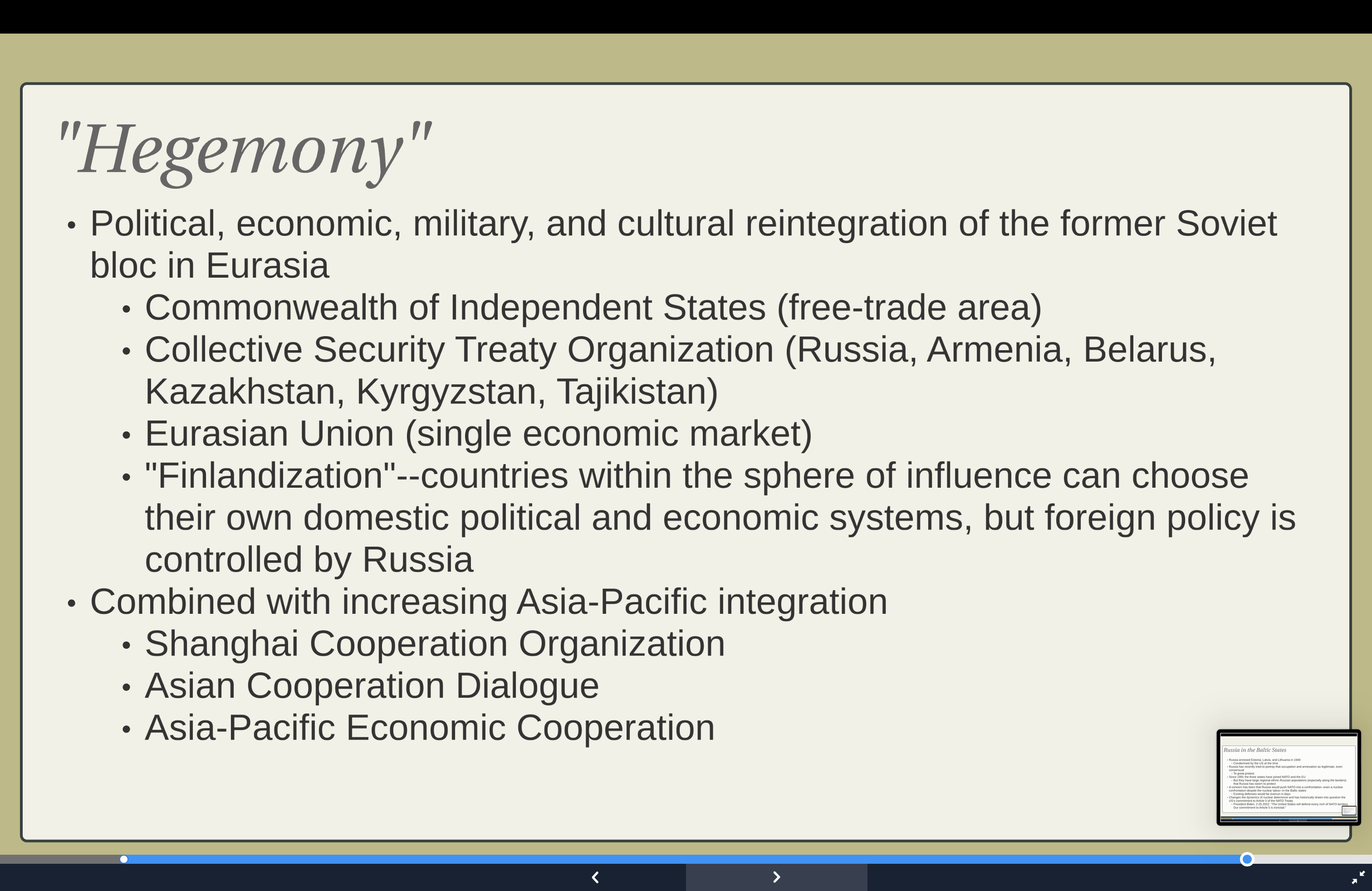
Political, economic, military, and cultural reintegration of the former Soviet bloc in Eurasia
This concept refers to the various mechanisms through which Russia is seeking to re-establish influence over the countries that were once part of the Soviet Union. Understanding this hegemony is crucial for analyzing current geopolitical dynamics in Eurasia. -
Commonwealth of Independent States (CIS)
- Type: Free-trade area
- Insight: The CIS serves as a platform for member states to enhance economic cooperation and facilitate trade. It reflects an effort to sustain economic ties that existed during the Soviet period.
-
Collective Security Treaty Organization (CSTO)
- Members: Russia, Armenia, Belarus, Kazakhstan, Kyrgyzstan, Tajikistan
- Insight: The CSTO is a military alliance that addresses security concerns among member states. It illustrates how military collaborations can reinforce political ties and mutual defense commitments.
-
Eurasian Union
- Type: Single economic market
- Insight: Similar to the European Union, the Eurasian Union aims to create a seamless economic area that fosters trade, investment, and movement among its members. This idea is central to Russia’s strategy of regional integration.
-
"Finlandization"
- Concept: Countries within the sphere of influence can choose their own domestic political and economic systems, but foreign policy is controlled by Russia
- Insight: This term describes a form of indirect control whereby countries maintain nominal sovereignty while aligning with Moscow's broader strategic interests, particularly in foreign policy.
-
Combined with increasing Asia-Pacific integration
- Shanghai Cooperation Organization
- Asian Cooperation Dialogue
- Asia-Pacific Economic Cooperation
- Insight: This highlights how Russia is not only focused on its immediate neighborhood but is also looking to establish itself as a key player in the larger Asia-Pacific region. This strategy may involve various economic and security partnerships to strengthen its global influence.
Summary Table
| Organization | Type | Members |
|---|---|---|
| Commonwealth of Independent States (CIS) | Free-trade area | Former Soviet states |
| Collective Security Treaty Organization (CSTO) | Military alliance | Russia, Armenia, Belarus, Kazakhstan, Kyrgyzstan, Tajikistan |
| Eurasian Union | Single economic market | Member states of the Eurasian Union |
| Shanghai Cooperation Organization | Regional security cooperation | Various Asian countries including China and Russia |
| Asian Cooperation Dialogue | Economic cooperation | Asian regional members |
| Asia-Pacific Economic Cooperation | Economic forum | Asia-Pacific nations |
Extended readings:
What is Genocide?
-
Definition of Genocide:
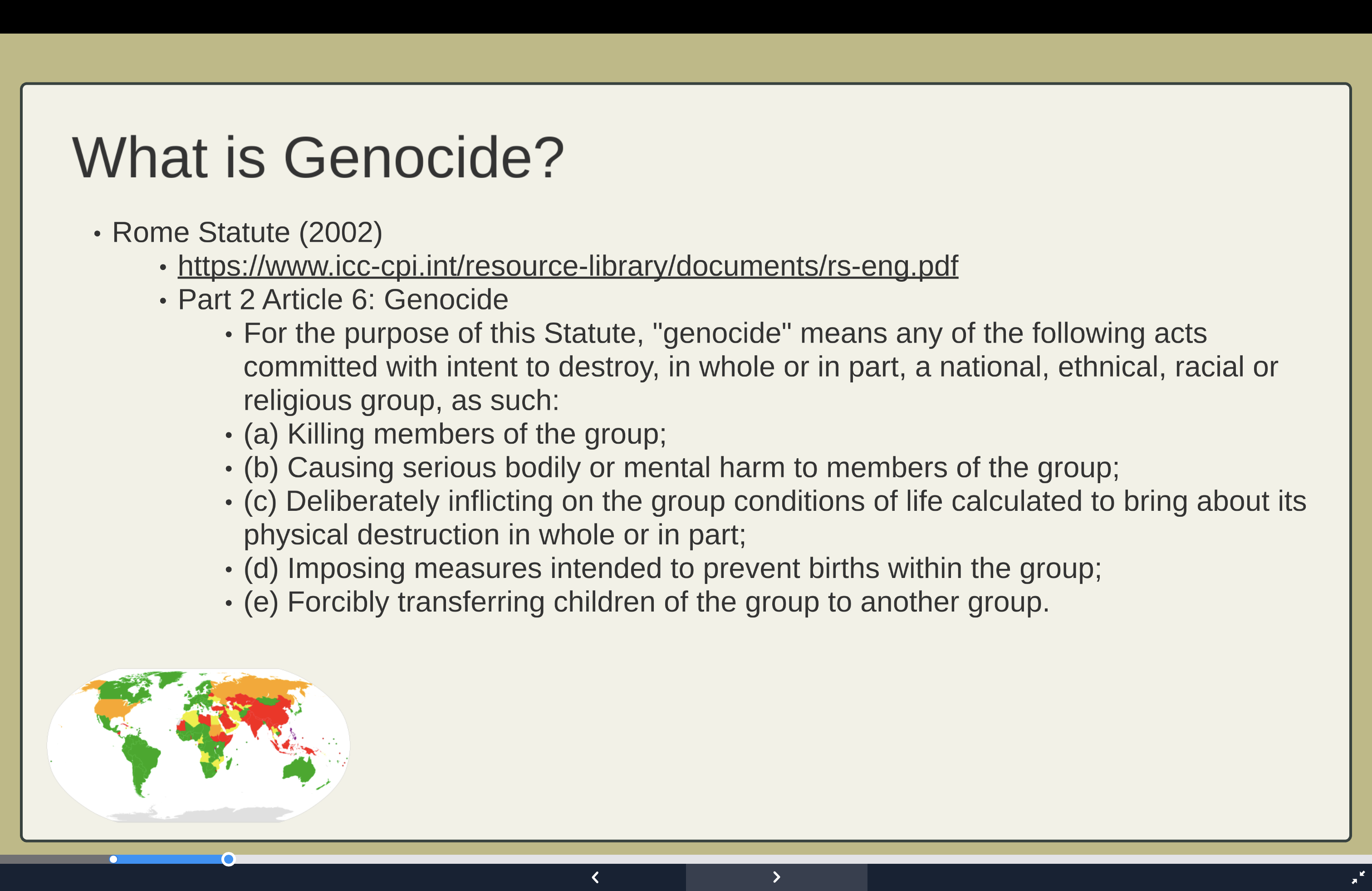
- Genocide is defined by the Rome Statute (2002) as acts committed with the intent to destroy, in whole or in part, a national, ethnic, racial, or religious group.
- This definition emphasizes the intent behind the actions, distinguishing it from other forms of violence or mass killings.
-
Acts Constituting Genocide:
-
(a) Killing members of the group:
- This is the most straightforward act of genocide, where individuals are targeted and murdered based on their group identity.
- Historical examples include the Holocaust and the Rwandan Genocide, where systematic killings were executed.
-
(b) Causing serious bodily or mental harm to members of the group:
- This includes torture, rape, and other forms of violence that cause lasting physical or psychological damage.
- Such harm can also lead to the destruction of cultural identity, as victims may be left traumatized.
-
(c) Deliberately inflicting on the group conditions of life calculated to bring about its physical destruction in whole or in part:
- This can include deprivation of resources, restrictions on movement, or other actions that lead to death.
- The intent is often to create a situation where the targeted group cannot survive.
-
(d) Imposing measures intended to prevent births within the group:
- This includes forced sterilization, abortion, and other measures aimed at controlling the reproduction of a group.
- Such acts can have long-lasting effects on the demographic composition and survival of the group.
-
(e) Forcibly transferring children of the group to another group:
- This act involves taking children away from their families and communities, often to raise them in a different cultural environment.
- This practice has been used to assimilate minority groups and erase their cultural identity.
-
Additional Thoughts
- The definition of genocide as outlined in the Rome Statute is crucial for international law and human rights, as it provides a framework for prosecution.
- Understanding these acts not only helps in identifying genocide but also in preventing it by addressing the underlying causes of such violence.
- Global awareness and education about genocide can play a significant role in prevention efforts and in supporting survivors.
Extended readings:
Diez Etapas del Genocidio
-
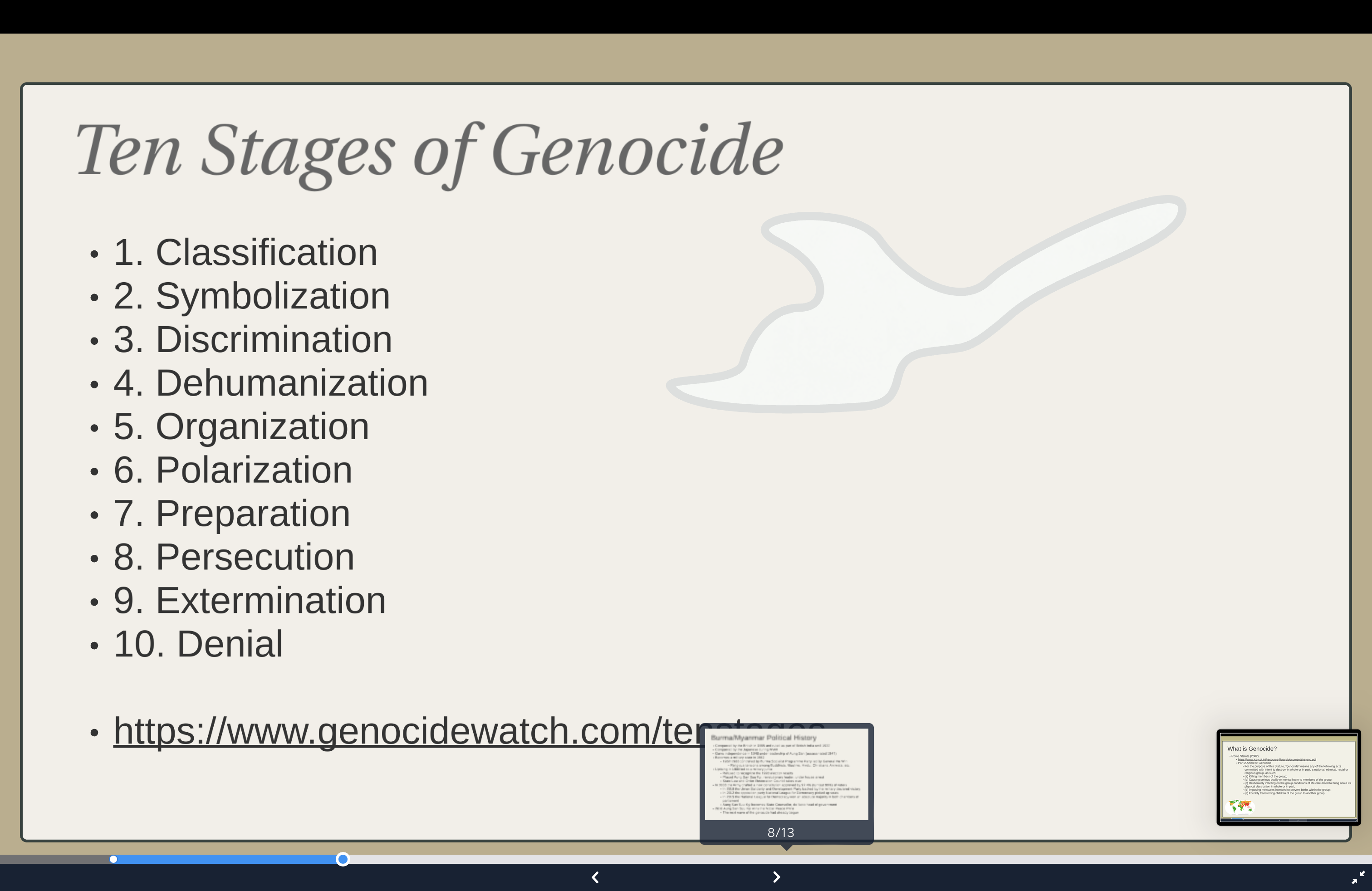
1. Clasificación
- Se refiere a la división de la sociedad en grupos diferenciados (por ejemplo, "nosotros" versus "ellos"). Esta etapa establece las bases para futuras discriminaciones y violencia. La clasificación puede basarse en la etnia, religión, nacionalidad o género, y es fundamental para identificar a las potenciales víctimas del genocidio.
-
2. Simbolización
- En esta etapa, se da un significado simbólico a la diferencia entre los grupos. Esto puede incluir el uso de insignias, vestimenta o etiquetas que identifican y diferencian a los grupos entre sí. La simbolización retroalimenta la división y fomenta el odio y la exclusión.
-
3. Discriminación
- Las leyes y políticas que discriminan a un grupo específico son implementadas, reforzando el estigma social y la exclusión. Los derechos de los grupos identificados son restringidos, lo que les impide participar plenamente en la sociedad.
-
4. Deshumanización
- Se presenta a los miembros del grupo victimizado como seres subhumanos, lo que justifica su maltrato y la violencia organizada en su contra. Esta etapa es crucial, ya que elimina la empatía y humanización del otro, permitiendo actos de violencia sin reparos morales.
-
5. Organización
- En esta fase se estructura la maquinaria del genocidio, reclutando y organizando a perpetradores. Las milicias y otros grupos organizados son formados con el objetivo de ejecutar la violencia de manera sistemática.
-
6. Polarización
- Se intensifica el conflicto entre grupos, donde se promueven ideologías extremas. Los medios de comunicación a menudo juegan un papel en esta etapa, amplificando la propaganda y el odio hacia el grupo objetivo.
-
7. Preparación
- Se llevan a cabo planes concretos para llevar a cabo el genocidio, incluyendo la construcción de campos de concentración y el almacenamiento de armas. En esta etapa, las comunidades atacadas pueden ser alertadas, pero a menudo no pueden actuar para protegerse.
-
8. Persecución
- Esta etapa implica la detención y deportación masiva de los grupos perseguidos. La violencia se hace más visible, y a menudo incluye la ejecución de líderes y miembros de la comunidad objetivo.
-
9. Exterminio
- Es el acto final y sistemático de eliminar al grupo victimizado. Aquí se llevan a cabo asesinatos en masa, muchas veces utilizando métodos organizados y eficaces. Esta etapa se considera finalmente como genocidio.
-
10. Negación
- La etapa final implica la negación del genocidio, donde se minimizan los actos o se culpa a las víctimas. La negación perpetúa el ciclo de violencia y puede ocurrir incluso años después de que se haya completado el genocidio.