New Notebook
What is "Ethnic Cleansing"?
-
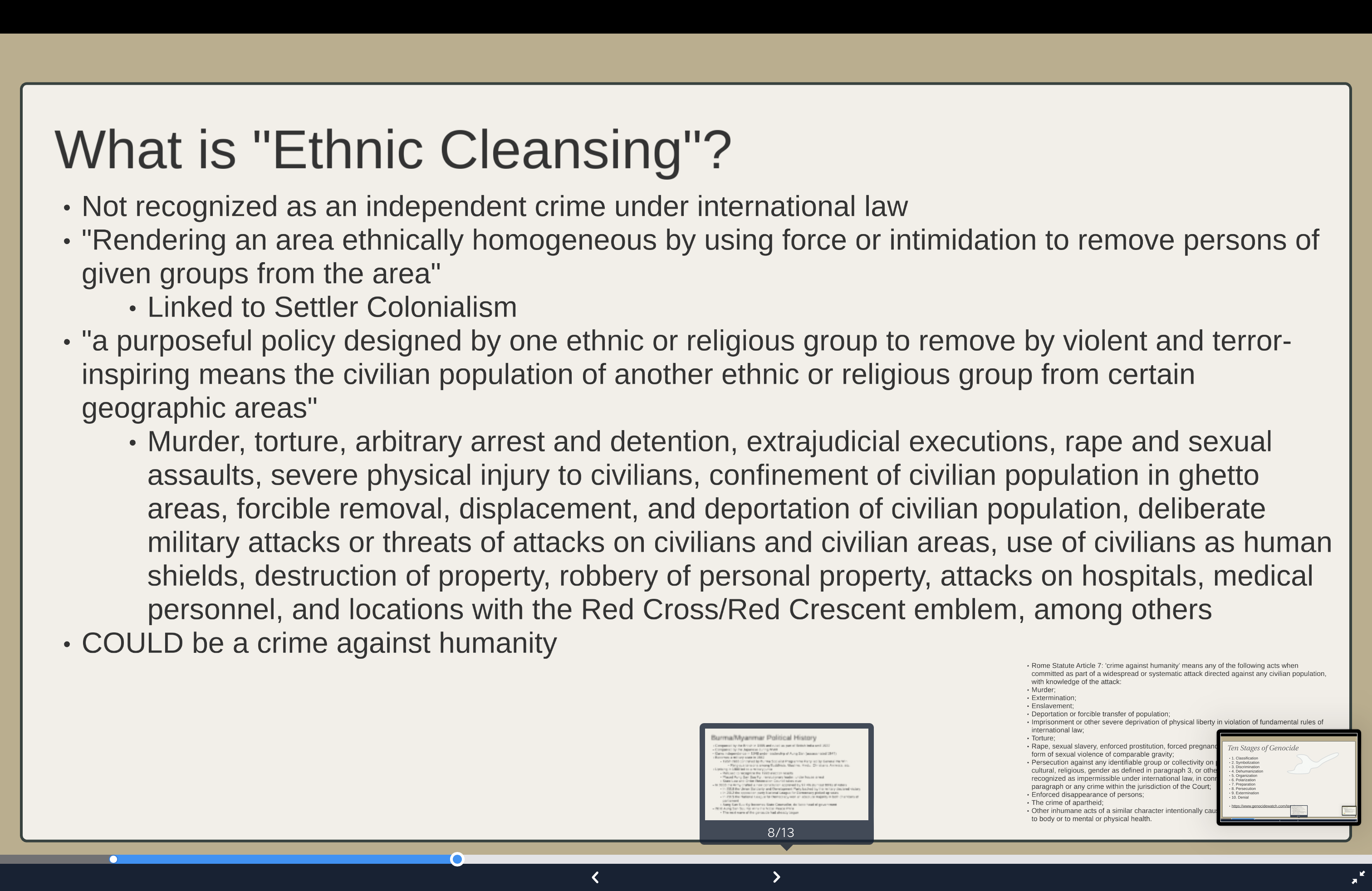
Not recognized as an independent crime under international law
- Ethnic cleansing does not have a specific legal definition that classifies it as a stand-alone crime, which complicates accountability for those who engage in such acts.
-
"Rendering an area ethnically homogeneous by using force or intimidation to remove persons of given groups from the area"
- This definition highlights the intention to create a singular ethnic identity in a geographic location, often connecting this practice to historical settler colonialism, where indigenous populations were removed or oppressed.
-
Purposeful Policies
- It involves calculated efforts by one ethnic or religious group to eliminate the presence of another. This can manifest in various severe violations of human rights.
-
Acts Associated with Ethnic Cleansing:
- Murder and Torture: These heinous acts are often employed to instill fear and compel migration.
- Arbitrary Arrest and Detention: Individuals may be unjustly imprisoned to target specific ethnic groups.
- Extrajudicial Executions: Targeted killings without legal process often form part of a broader strategy to eliminate an ethnic identity.
-
Severe Physical Injury and Sexual Assaults: These acts signify both a tactic of domination and a means to terrorize communities.
-
Displacement and Deportation: Forcing individuals from their homes is a core tactic of ethnic cleansing, aiming to alter the demographic composition.
-
Military Attacks on Civilians: Such actions generally violate international humanitarian law, denoting a direct assault on non-combatants.
-
Destruction of Property: Destroying homes and institutions serves to erase cultural identity and history.
-
Potential Classification as a Crime Against Humanity
- Although not specifically categorized as such in international law, elements of ethnic cleansing overlap with crimes against humanity, especially when widespread and systematic as part of a larger policy.
This summary emphasizes the complexities and realities surrounding the concept of ethnic cleansing, reinforcing the serious human rights implications involved.
Extended readings:
Notes on Rome Statute Article 7: Crimes Against Humanity
-
Definition of 'Crime Against Humanity'
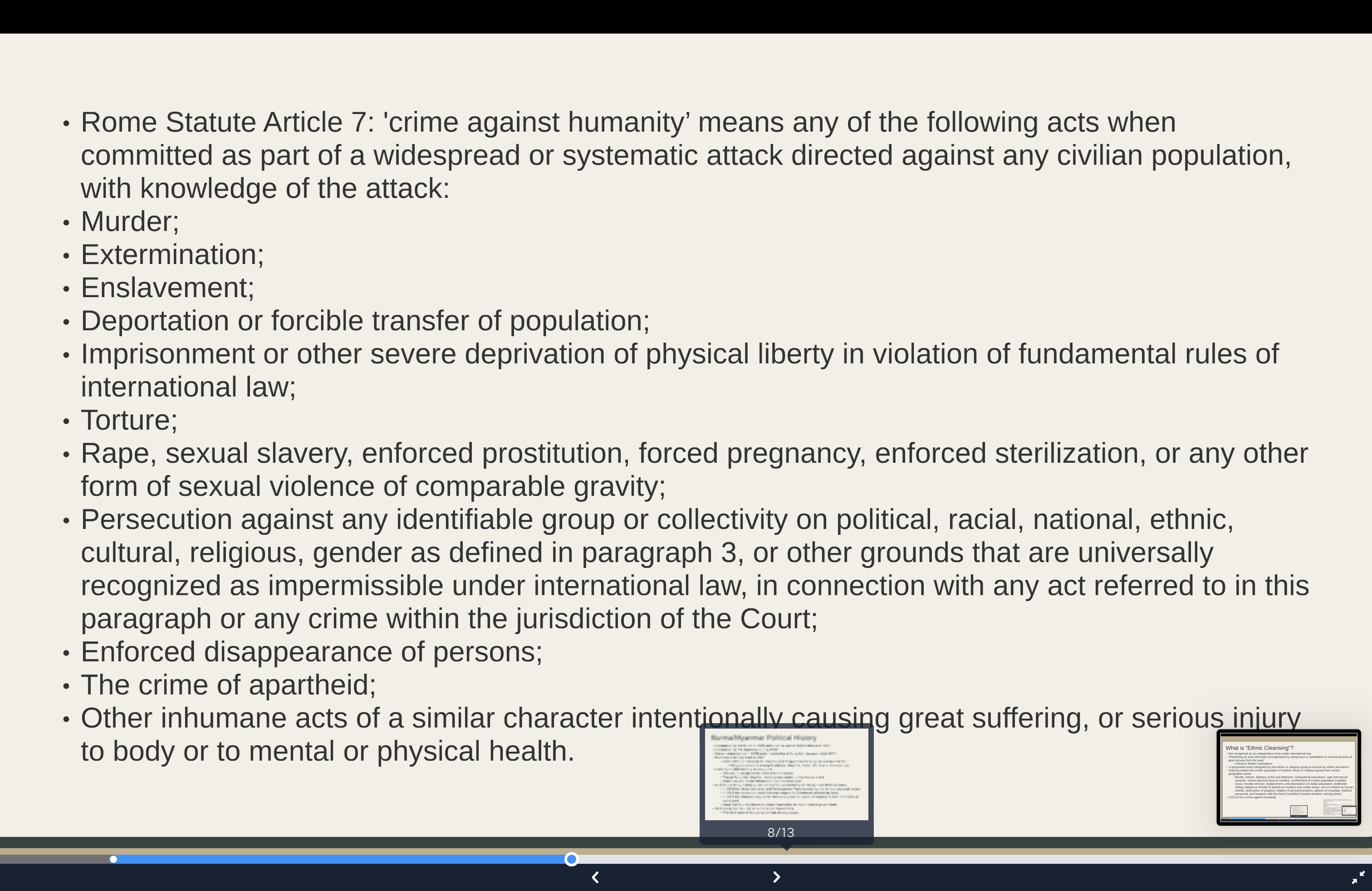
- Refers to acts committed as part of a widespread or systematic attack against any civilian population, with knowledge of the attack.
- This definition is pivotal for international law, establishing accountability for severe breaches of human rights.
-
List of Crimes Included:
-
Murder: The unlawful premeditated killing of individuals.
- Significance: Represents one of the most serious violations of personal rights, often serving as a foundational crime in cases of genocide.
-
Extermination: Acts aimed at causing mass death, particularly of groups.
- Thought: This can include actions that are indirectly destructive, such as systematic deprivation of resources.
-
Enslavement: The act of making individuals property.
- Additional Info: Enslavement has persisted in various forms globally, highlighting ongoing human rights abuses.
-
Deportation or Forcible Transfer of Population: The forced removal of people from their homes.
- Reflection: This often occurs in the context of ethnic cleansing and can lead to long-term trauma for affected communities.
-
Imprisonment or Severe Deprivation of Liberty: Restricting the freedom of individuals without legal justification.
- Context: Such actions often violate basic human rights principles.
-
Torture: Inflicting severe pain or suffering for purposes such as punishment or intimidation.
- Consideration: Torture is often used as a tool of oppression in authoritarian regimes.
-
Rape and Sexual Violence: Includes a range of actions from rape to enforced prostitution.
- Importance: Acknowledges the gendered nature of violence and the specific vulnerabilities faced by women in conflict.
-
Persecution: Targeting identifiable groups based on attributes such as race or political beliefs.
- Insight: This crime highlights systemic discrimination and can lead to broader societal unrest.
-
Enforced Disappearance: The act of abducting individuals and denying their fate or whereabouts.
- Thought: This creates terror in communities and undermines trust in governmental institutions.
-
Crime of Apartheid: Systematic oppression and domination by one racial group over another.
- Context: Apartheid as a crime emphasizes global recognition of institutionalized discrimination.
-
Other Inhumane Acts: Actions causing great suffering or serious injury to mental or physical health.
- Reflection: This broad category allows for the prosecution of numerous human rights violations not specifically listed.
-
-
Overall Significance
- Article 7 serves as a critical framework for holding individuals accountable in international law.
- It underlines the international community's responsibility to prevent and punish such crimes, reflecting the commitment to uphold human dignity globally.
Who Are The Rohingya?
-
Historical Background
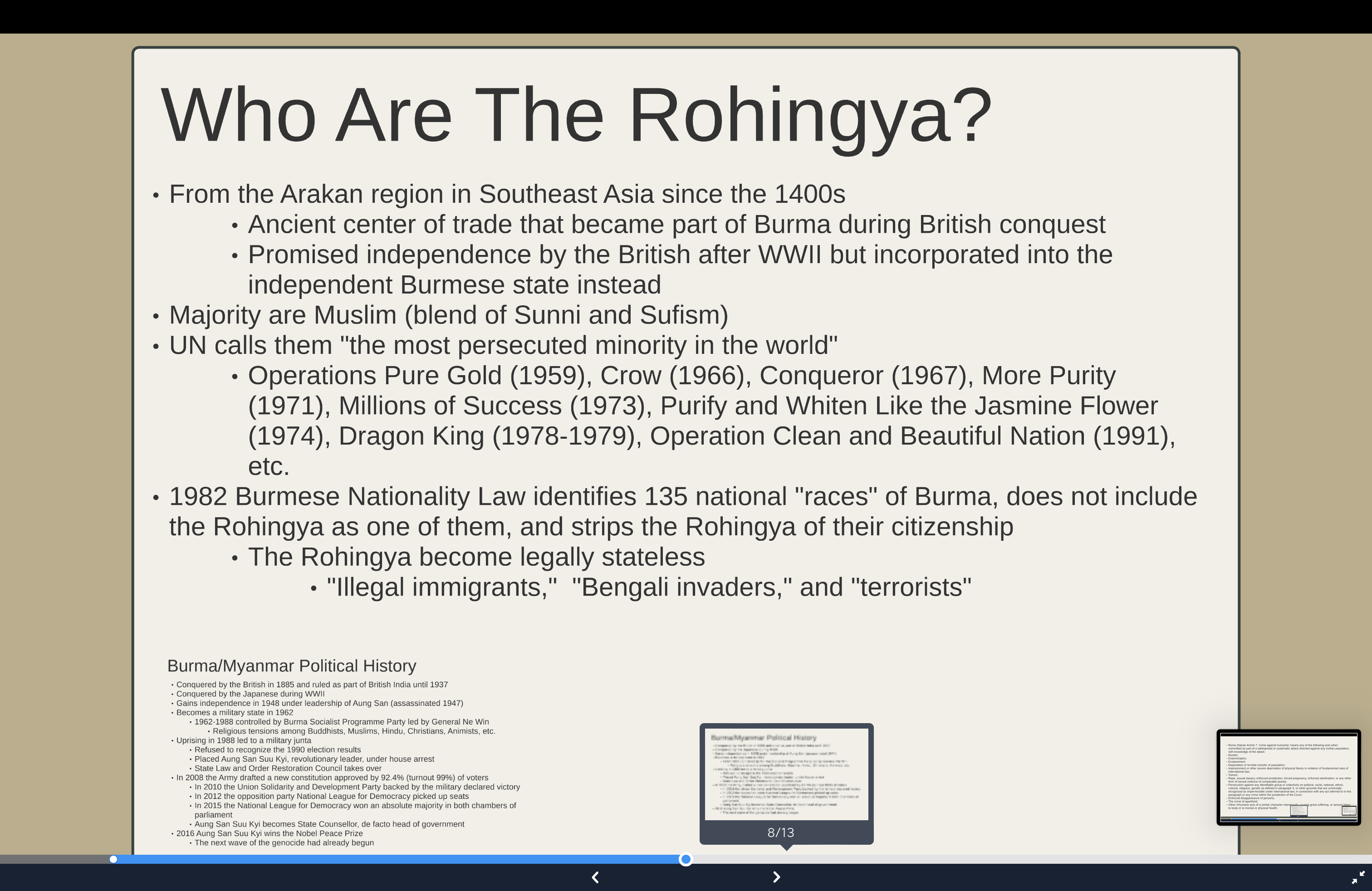
- From the Arakan region in Southeast Asia since the 1400s.
- Became part of Burma during British conquest; promised independence by the British after WWII but were incorporated into an independent Burmese state instead.
- This reflects the colonial legacy that often disregards ethnic and cultural distinctions, leading to tensions post-independence.
-
Demographics
- Majority are Muslim (a blend of Sunni and Sufism).
- This diversity in belief systems can lead to cultural distinctions even within the Muslim community.
- Majority are Muslim (a blend of Sunni and Sufism).
-
Recognition and Persecution
- The United Nations calls them "the most persecuted minority in the world."
- Their persecution is marked by a series of military operations:
- Operations: Pure Gold (1959), Crow (1966), Conqueror (1967), More Purity (1971), Millions of Success (1973), Purify and Whiten Like the Jasmine Flower (1974), Dragon King (1978-1979), Operation Clean and Beautiful Nation (1991), etc.
- These operations highlight ongoing systemic discrimination and efforts to suppress the Rohingya identity.
- Operations: Pure Gold (1959), Crow (1966), Conqueror (1967), More Purity (1971), Millions of Success (1973), Purify and Whiten Like the Jasmine Flower (1974), Dragon King (1978-1979), Operation Clean and Beautiful Nation (1991), etc.
- Their persecution is marked by a series of military operations:
- The United Nations calls them "the most persecuted minority in the world."
-
Citizenship Issues
- The 1982 Burmese Nationality Law identifies 135 national "races" of Burma but excludes the Rohingya, rendering them stateless.
- This legal exclusion underscores the systematic denial of rights based on ethnic identity, which can lead to further marginalization.
- The 1982 Burmese Nationality Law identifies 135 national "races" of Burma but excludes the Rohingya, rendering them stateless.
-
Status as Immigrants
- The Rohingya are labeled as "illegal immigrants," "Bengali invaders," and "terrorists."
- Such terminology serves to delegitimize their claims to citizenship and contribute to widespread discrimination and violence against them.
- The Rohingya are labeled as "illegal immigrants," "Bengali invaders," and "terrorists."
Burma/Myanmar Political History
| Year | Event/Development |
|---|---|
| 1885 | Conquered by the British as part of British India until 1937 |
| 1947 | Coup against the Japanese during WWII |
| 1947 | Gains independence under the leadership of Aung San (assassinated 1947) |
| 1962-1988 | Military rule under Socialist Program led by General Ne Win |
| 1988 | Uprising leading to martial law, protests, and democratic calls |
| 1990 | Aung San Suu Kyi wins by a landslide but placed under house arrest |
| 2010 | Military-backed government held elections; Aung San Suu Kyi becomes a key political figure again |
| 2016 | Aung San Suu Kyi becomes State Counsellor, de facto head of government |
| (No date) | The next wave of the genocide had already begun |
- Contextual Note:
- The political history reveals the cyclical nature of oppression and resistance in Myanmar, with the Rohingya being a recurrent subject of exclusion and violence amidst broader national conflicts.
Extended readings:
Burma/Myanmar Political History
-
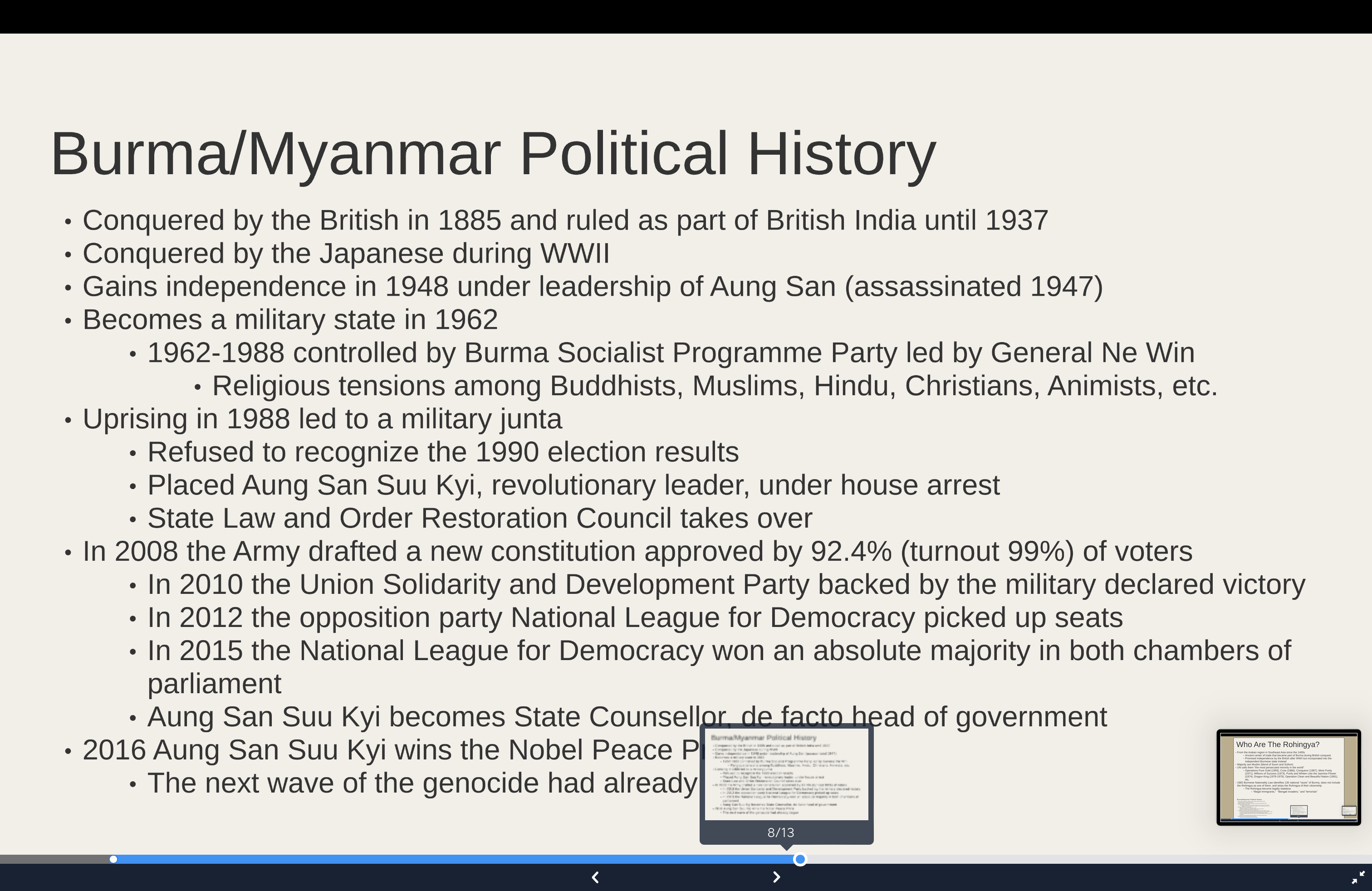
Conquered by the British in 1885 and ruled as part of British India until 1937
- This period marked the beginning of British colonial influence, which altered the social and economic structures of Burma, resulting in long-term impacts on the political landscape.
-
Conquered by the Japanese during WWII
- Japan's occupation led to significant hardship for the Burmese population, but also sowed the seeds for nationalistic movements against colonial powers.
-
Gains independence in 1948 under leadership of Aung San (assassinated 1947)
- Aung San is recognized as a pivotal figure in the independence movement. His assassination just a year before independence created a political vacuum that contributed to future instability.
-
Becomes a military state in 1962
-
General Ne Win’s coup d'état resulted in the suppression of political dissent and the establishment of a single-party socialist state.
-
1962-1988 controlled by Burma Socialist Programme Party led by General Ne Win
- This era was characterized by economic mismanagement and isolation from the international community, leading to widespread poverty.
-
Religious tensions among Buddhists, Muslims, Hindu, Christians, Animists, etc.
- The discriminatory policies exacerbated existing ethnic and religious divisions, laying the groundwork for future conflicts.
-
-
Uprising in 1988 led to a military junta
-
Triggered by public discontent, the protests were met with violent suppression, marking a turning point in Burmese resistance movements.
-
Refused to recognize the 1990 election results
- The military junta’s refusal to acknowledge the electoral outcome demonstrates the persistent challenges of democratic governance in Myanmar.
-
Placed Aung San Suu Kyi, revolutionary leader, under house arrest
- Aung San Suu Kyi became a prominent symbol of the struggle for democracy and human rights, earning international recognition.
-
State Law and Order Restoration Council takes over
- The junta formally reorganized its control over the state, further centralizing power and limiting civil liberties.
-
-
In 2008 the Army drafted a new constitution approved by 92.4% (turnout 99%) of voters
- The constitution was controversial and viewed by many as a means to legitimize military power while giving a veneer of democracy.
-
In 2010 the Union Solidarity and Development Party backed by the military declared victory
- This electoral victory was suspected of being manipulated to ensure military interests remained entrenched in power.
-
In 2012 the opposition party National League for Democracy picked up seats
- This indicated a shift in public sentiment and a demand for more representative governance despite ongoing military influence.
-
In 2015 the National League for Democracy won an absolute majority in both chambers of parliament
- This election marked a significant moment in Myanmar’s political transition, yet challenges remained as the military retained considerable power.
-
Aung San Suu Kyi becomes State Counsellor, de facto head of government
- Her leadership brought hope, but criticisms arose regarding her handling of ethnic conflicts, especially in Rakhine State.
-
2016 Aung San Suu Kyi wins the Nobel Peace Prize
-
This recognition was bittersweet, as increasing reports of human rights abuses, particularly against the Rohingya, cast a shadow on her legacy.
-
The next wave of the genocide had already begun
- The ongoing humanitarian crisis stemming from ethnic violence highlighted deep-seated issues in Myanmar’s sociopolitical landscape that remain unresolved.
-
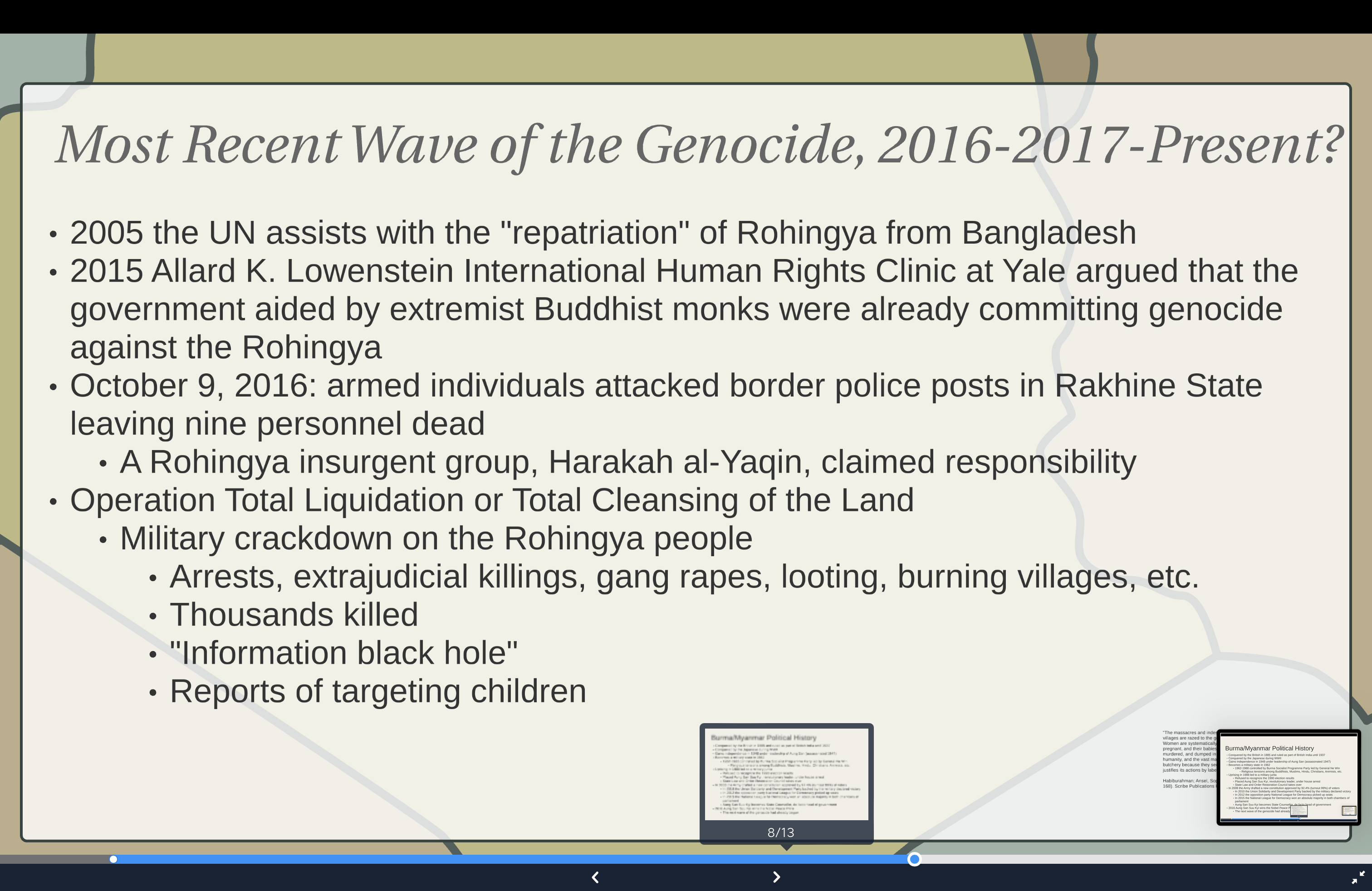
Most Recent Wave of the Genocide, 2016-2017-Present?
-
2005 the UN assists with the "repatriation" of Rohingya from Bangladesh
- This indicates early involvement of the UN in Rohingya issues, which might have set the stage for ongoing conflicts. The term "repatriation" suggests a forced return rather than a voluntary movement.
-
2015 Allard K. Lowenstein International Human Rights Clinic at Yale argued that the government aided by extremist Buddhist monks were already committing genocide against the Rohingya
- This highlights academic and human rights organizations' recognition of the deteriorating situation for the Rohingya prior to the most severe violence, emphasizing that systematic persecution was not a new issue.
-
October 9, 2016: armed individuals attacked border police posts in Rakhine State leaving nine personnel dead
- The attack marks a significant escalation in the conflict, suggesting that extremist elements within the Rohingya community were responding to the oppression. This event may have triggered a violent military response.
-
A Rohingya insurgent group, Harakah al-Yaqin, claimed responsibility
- The recognition of a formal insurgent group indicates an organized resistance movement, which can complicate the conflict further as it introduces armed opposition.
-
Operation Total Liquidation or Total Cleansing of the Land
- This operation reflects a military strategy aimed at eradicating the Rohingya population, analogous to ethnic cleansing attempts seen historically in significant conflicts around the world.
-
Military crackdown on the Rohingya people
-
This term encompasses a range of violent actions by the military and illustrates the systematic approach to forcibly removing the Rohingya from their homeland.
-
Arrests, extrajudicial killings, gang rapes, looting, burning villages, etc.
- These acts represent severe human rights violations. Such brutality tends to instill fear among the population, leading to displacement and a refugee crisis.
-
Thousands killed
- The scale of murder suggests a concerted effort at mass extermination, raising serious humanitarian concerns and the need for international intervention.
-
"Information black hole"
- This phrase suggests a lack of transparency and access to information regarding the atrocities, complicating the international community’s ability to respond effectively and monitor human rights.
-
Reports of targeting children
- Targeting vulnerable populations like children amplifies the severity of the situation and can lead to lifelong trauma and displacement, affecting future generations.
-
This summary encapsulates the critical elements of the ongoing genocide against the Rohingya people and ties various aspects of the conflict to broader themes of human rights, military aggression, and international involvement.
Extended readings:
Notes on Rohingya Violence and Human Rights Violations
-
Systematic Violence Against the Rohingya
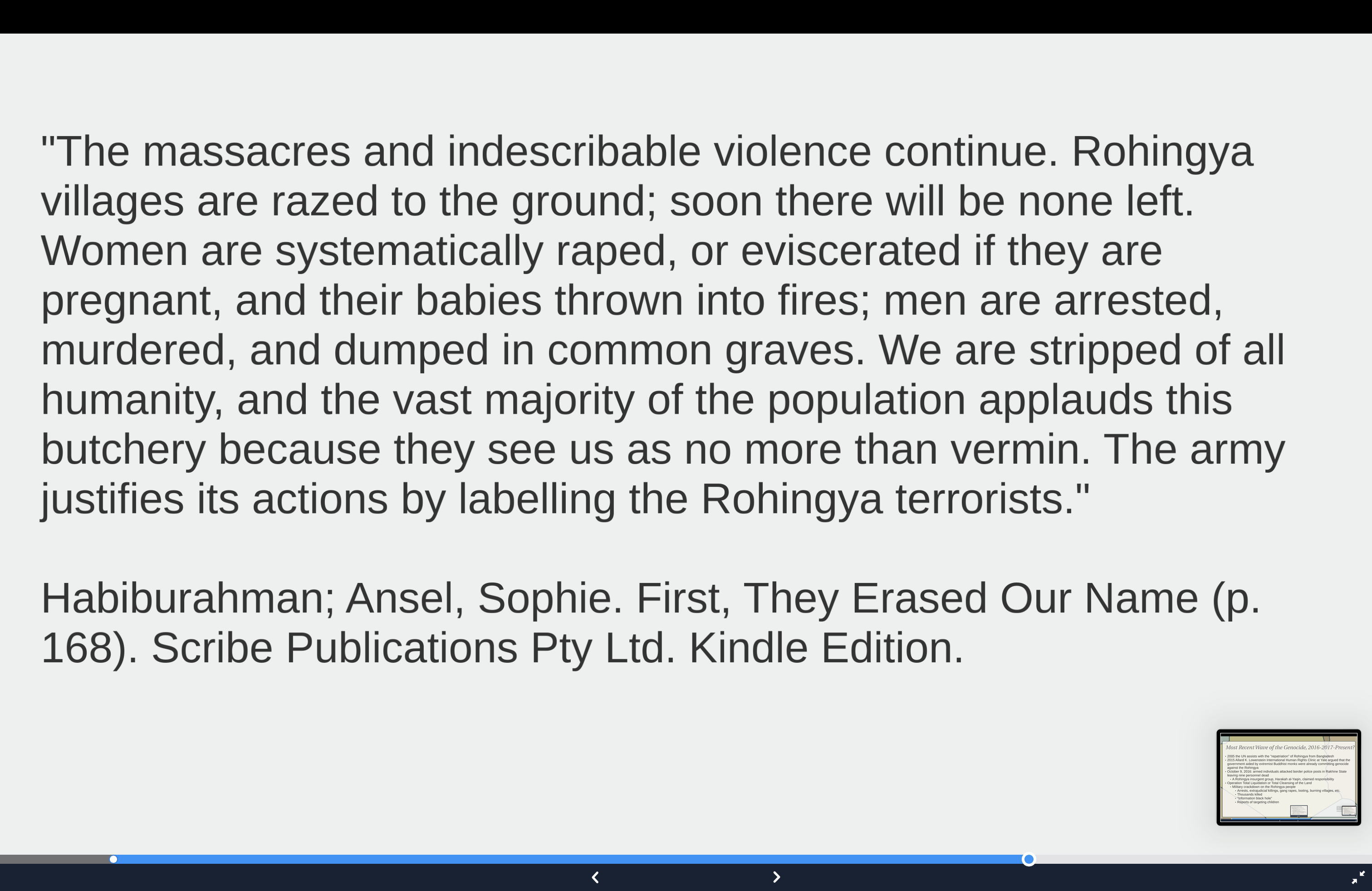
- The excerpt describes extreme violence faced by the Rohingya people in Myanmar, highlighting atrocities such as massacres, the razing of villages, and sexual violence.
- This indicates a broader issue of ethnic cleansing, where targeted groups face coordinated efforts to eliminate their presence in a region.
-
Gender-Based Violence
- The mention of systematic rape and violence against women points to a disturbing pattern seen in conflict zones, where women often bear the brunt of warfare.
- Such acts not only serve immediate terror but also aim to destabilize communities and destroy the social fabric.
-
Dehumanization and Justification of Violence
- The text points out that the perpetrators label the Rohingya as "vermin," a tactic used to dehumanize victims, making it easier to justify violence against them.
- This dehumanization is a common rhetorical strategy in genocidal contexts, often facilitating public support for violence.
-
Complicity and Indifference
- The assertion that the majority of the population applauds this brutality suggests a complicity or indifference among other community members or segments of society.
- This raises questions about the ethical responsibilities of bystanders and the societal factors that contribute to such widespread acceptance of violence.
-
Military Justification
- The army's labeling of Rohingya as "terrorists" indicates how state apparatus can redefine narratives to legitimize oppressive actions.
- This reflects a pattern seen globally where governments utilize the “terrorist” label to justify repressive measures against marginalized communities.
-
Source Citation
- The information is sourced from the book "First, They Erased Our Name" by Habiburahman and Ansel, which documents the experiences of the Rohingya people and the systematic violence they face.
- Understanding the book's context is vital for comprehending the ongoing humanitarian crisis and the historical background of Rohingya oppression.
Extended readings:
Refugee Crisis
-
Overview of the Rohingya Crisis
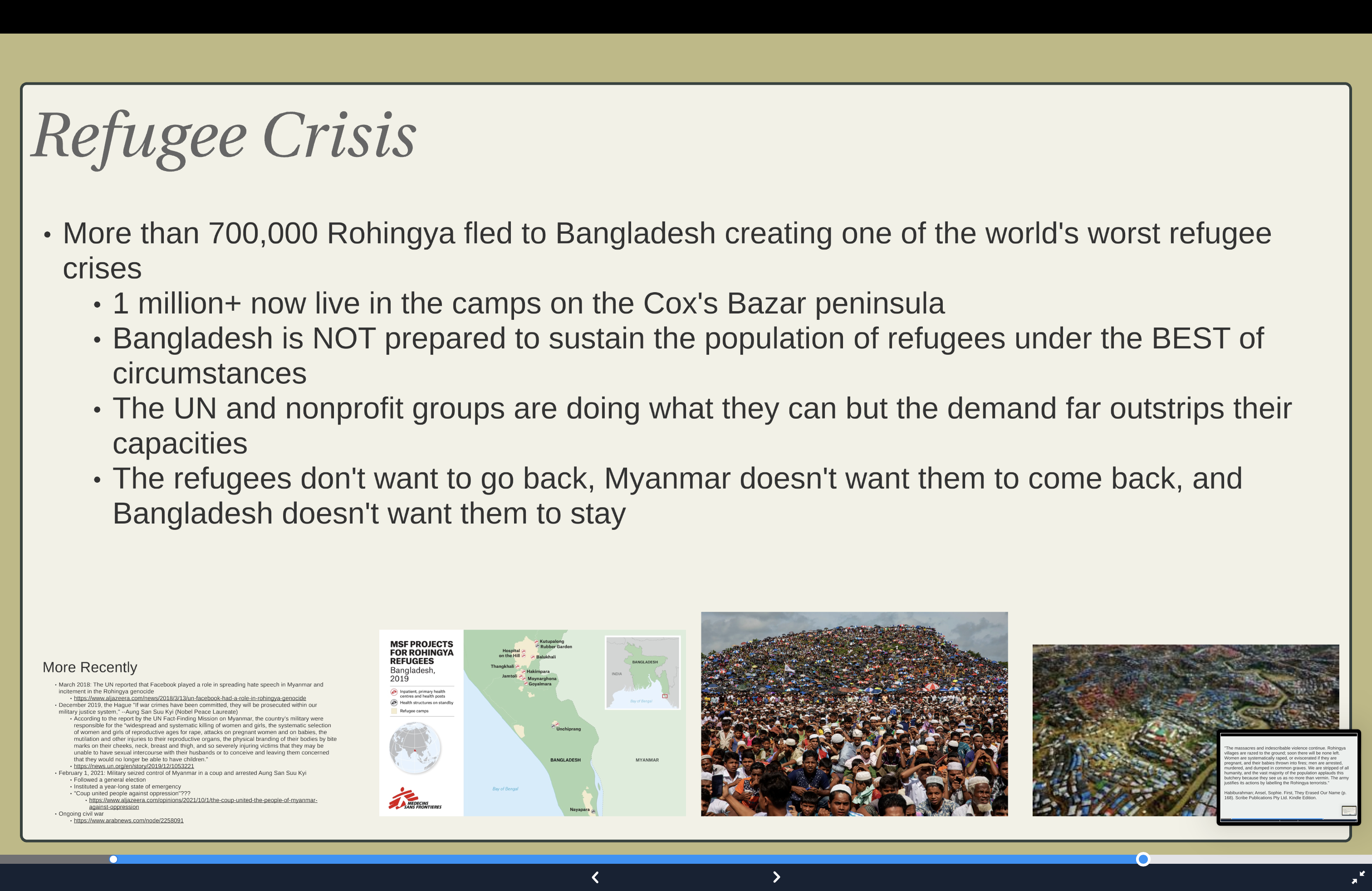
More than 700,000 Rohingya fled to Bangladesh, creating one of the largest refugee crises in the world.- Current Population: Over 1 million Rohingya now reside in camps on the Cox's Bazar peninsula. This immense influx has put significant strain on local resources and facilities, often leading to dire living conditions.
-
Challenges Faced by Bangladesh
Bangladesh is not equipped to sustain such a large population of refugees.- Infrastructure: The country's infrastructure is overwhelmed. There is a shortage of basic necessities like food, water, and healthcare services. Long-term solutions are needed to handle the situation adequately.
-
Role of International Organizations
The United Nations and various nonprofit groups are working to assist but are unable to meet the overwhelming demand.- Capacity Issues: The resources available are insufficient to meet the basic needs of the refugee population, highlighting the need for increased international support and aid.
-
Dilemma of Refugees
The refugees are caught in a precarious situation where returning to Myanmar is not an option, yet Bangladesh does not have the means or willingness to permanently accommodate them.- Forced Displacement: This scenario exemplifies the complexities of refugee situations, where geopolitical factors and local capabilities intersect.
-
Recent Developments
- March 2018: Issues surrounding social media's impact, specifically Facebook's role in inciting violence in Myanmar and leading to the crisis.
- Medecins Sans Frontieres (MSF) : Ongoing projects aimed at improving conditions for the Rohingya refugees in Bangladesh, although challenges persist.
Additional Observations
- The crisis reflects a larger issue of global refugee movements and the responsibilities of nations to provide humanitarian aid.
- Long-term strategies need to be developed to address both those displaced and the host communities.
- Global awareness and advocacy are crucial to ensuring the protection and rights of the Rohingya people are respected.
Note on Recent Events in Myanmar
-
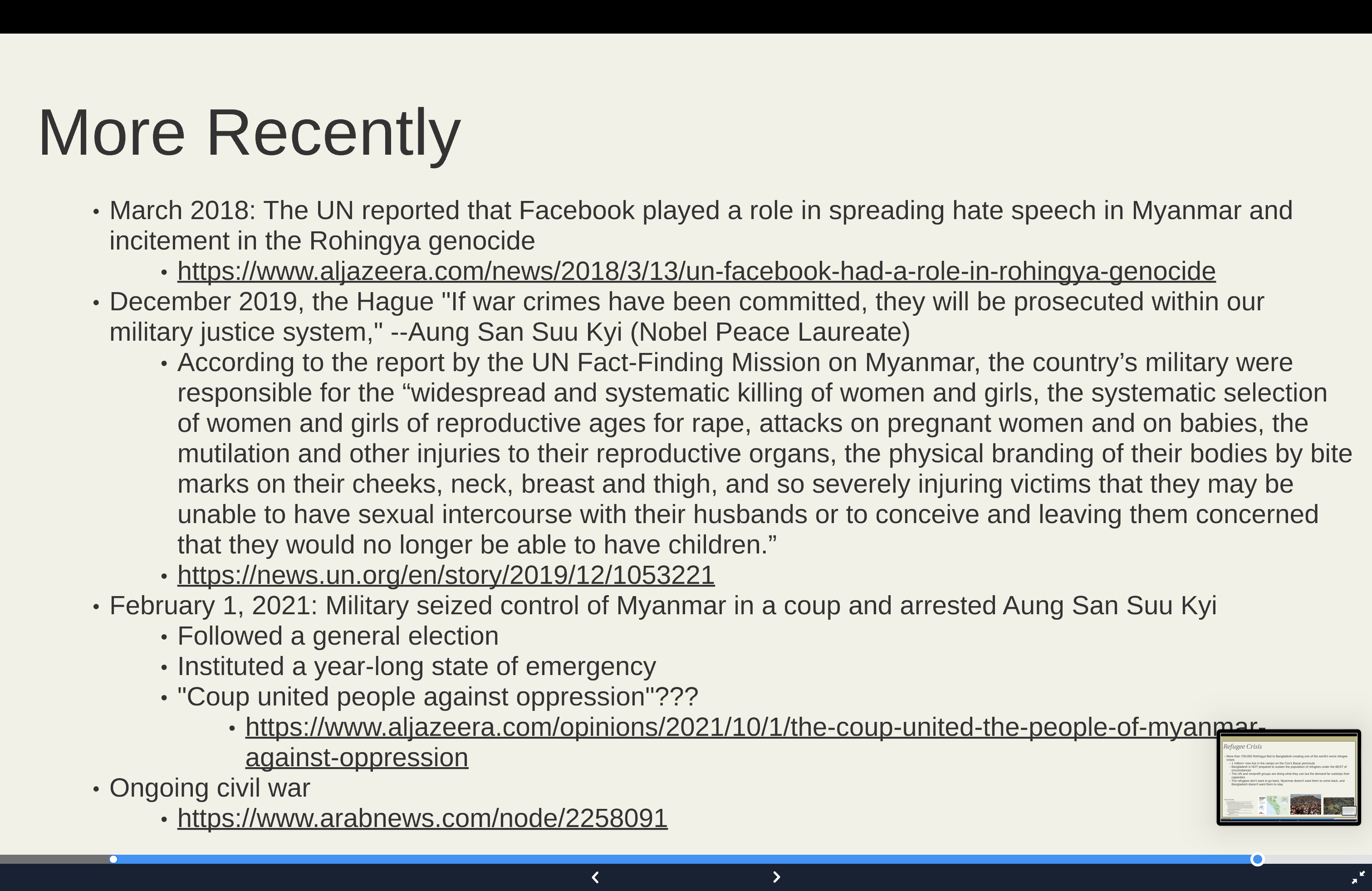
March 2018: UN Report on Facebook's Role in Rohingya Genocide
- The UN highlighted that Facebook facilitated the spread of hate speech during the Rohingya crisis. This emphasizes the responsibility of social media platforms in moderating content, especially in sensitive regions.
-
December 2019: Hague Statement by Aung San Suu Kyi
- Aung San Suu Kyi remarked, "If war crimes have been committed, they will be prosecuted within our military justice system."
- This statement reflects the challenges of accountability within Myanmar's military framework and raises concerns about the integrity of military courts.
-
UN Fact-Finding Mission Report
- The report detailed horrific abuses by the military, including systematic killings, rape, and severe bodily harm to women and girls.
- Such revelations underscore the urgent need for international intervention and support for humanitarian efforts in Myanmar.
-
February 1, 2021: Military Coup
- The military took control following a general election, leading to widespread protests.
- The coup marked a significant regression in Myanmar's political landscape, raising questions about democratic processes.
-
Ongoing Civil War
- The country has descended into a state of civil unrest, leading to continuous violence and instability.
- This situation calls for a global response to aid the affected populations and address the human rights violations ongoing in Myanmar.
| Date | Event |
|---|---|
| March 2018 | UN reported Facebook's role in hate speech |
| December 2019 | Aung San Suu Kyi's comments on war crimes |
| February 1, 2021 | Military coup and control over Myanmar |
| Ongoing | Continued civil war and humanitarian crisis |
Extended readings:
South Caucuses
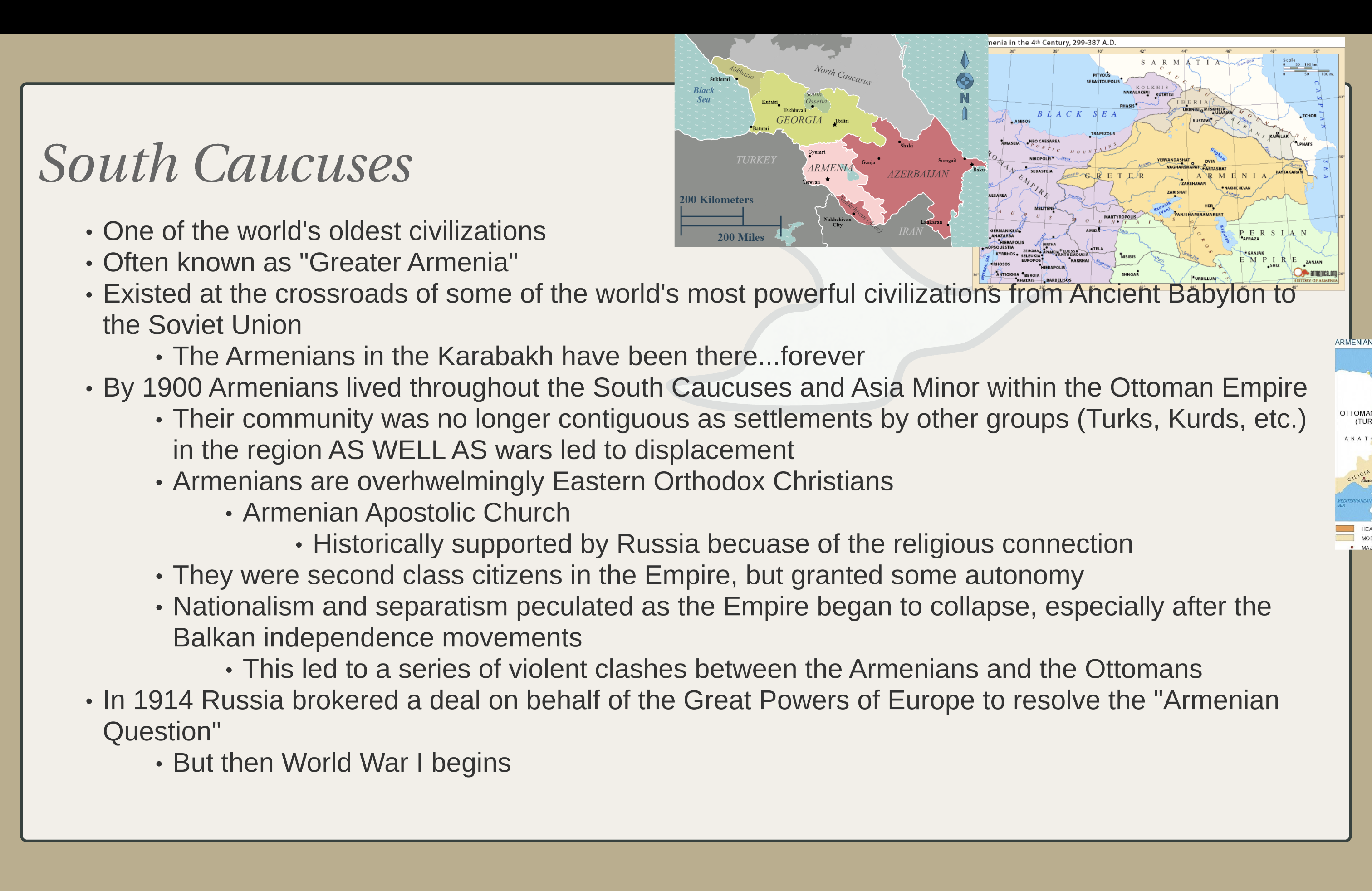
-
One of the world's oldest civilizations
- The region has a rich history and has influenced many cultures and societies throughout its existence. Its historical significance makes it essential for understanding the development of early human societies.
-
Often known as "Greater Armenia"
- This term reflects the historical and cultural expanse of the Armenian nation, which historically included more territories than present-day Armenia.
-
Existed at the crossroads of powerful civilizations
- The location of the South Caucuses made it a strategic point for trade and military conquests between major empires such as Ancient Babylon and the Soviet Union. This strategic importance continues to shape regional politics.
-
The Armenians in the Karabakh have been there...forever
- The continuous presence of Armenians in the Nagorno-Karabakh region is a crucial aspect of the ongoing conflict over this territory. Their historical roots contribute to national identity and claims to the land.
-
By 1900, Armenians lived throughout the South Caucuses and Asia Minor
- The dispersion of the Armenian community due to conflicts with Turks, Kurds, and others illustrates the complex demographic changes and tensions in the region over time.
-
Armenians are overwhelmingly Eastern Orthodox Christians
- This religious affiliation has cultural implications and has influenced Armenia's historical alliances, particularly with Russia, which shares a similar religious background.
-
Armenian Apostolic Church historically supported by Russia
- The relationship between the church and Russia highlights the intertwining of religion and politics, where religious groups often play roles in national and international relations.
-
Second class citizens in the Empire
- This status underscores the discrimination faced by Armenians within the Ottoman Empire, highlighting the socio-political hierarchy and its impact on national consciousness.
-
Nationalism and separatism peaked with Ottoman decline
- As the Ottoman Empire weakened, various ethnic groups, including Armenians, sought greater autonomy or independence, which contributed to regional instability.
-
Series of violent clashes between the Armenians and the Ottomans
- These conflicts led to significant loss of life and further entrenched animosities, setting the stage for later atrocities during the Armenian Genocide in 1915.
-
In 1914, Russia brokered a deal for the "Armenian Question"
- This diplomatic effort reflects the international dimensions of the Armenian plight and the involvement of great powers in local issues. It underscores how geopolitical interests often overshadow local realities.
-
But then World War I begins
- The onset of World War I reshaped alliances and conflicts in the region, redirecting focus and resources away from the Armenian struggle, which would have lasting consequences for its population.
Extended readings:
World War I (and a Genocide)
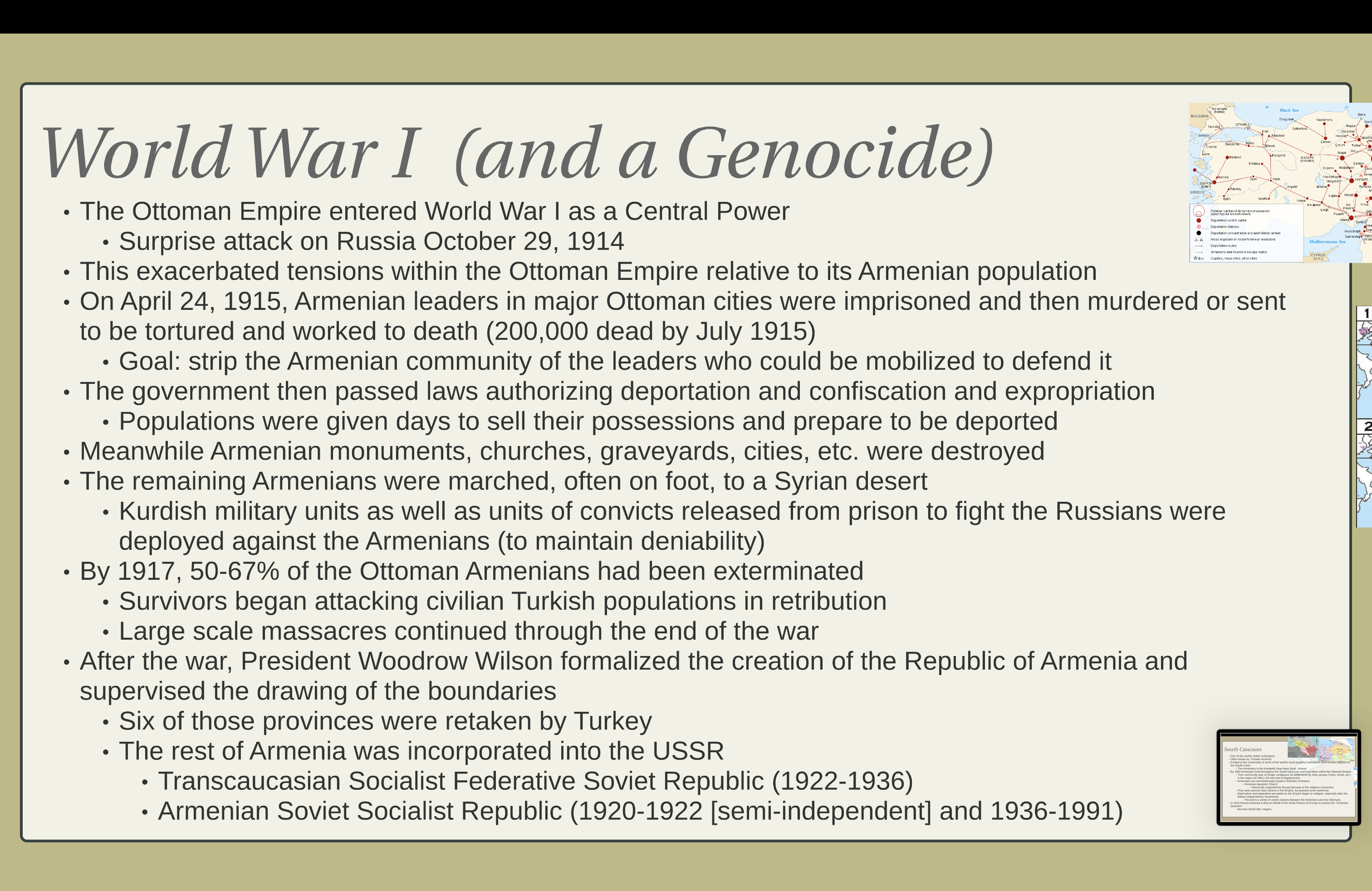
-
Ottoman Empire's Entry into WWI
- The Ottoman Empire joined World War I as a Central Power, impacting the geopolitical landscape and leading to significant internal strife.
- The surprise attack on Russia on October 29, 1914, marked the empire's entry into the conflict, intensifying existing tensions.
-
Exacerbation of Armenian-Turkish Tensions
- The internal dynamics within the Ottoman Empire grew increasingly hostile towards the Armenian population, exacerbated by the war.
- The Armenian community had historically faced discrimination and pressures, which escalated under the threat of war.
-
Imprisonment and Murder of Armenian Leaders (April 24, 1915)
- On this date, Armenian leaders were systematically imprisoned, tortured, and killed, with approximately 200,000 dead by July 1915.
- This act aimed to render the Armenian community leaderless and prevent organized resistance.
-
Government Laws for Deportation and Expropriation
- Laws were enacted that allowed for the deportation of Armenians and seizure of their properties.
- Populations received little time to settle their affairs before facing forced relocation.
-
Destruction of Armenian Cultural Heritage
- Many Armenian monuments, churches, and communities were destroyed systematically, indicating an effort to erase Armenian presence and culture.
-
Mass Marches to the Syrian Desert
- Surviving Armenians were forcibly marched to the Syrian desert, exposing them to further violence and hardship.
- Kurdish units and ex-convicts were employed against Armenians, complicating the situation and creating a façade of deniability for the Ottoman authorities.
-
Extermination of Armenians by 1917
- By 1917, it was estimated that 50-67% of the Ottoman Armenian population had been exterminated.
- Remaining survivors often retaliated against civilian Turkish populations, highlighting the spiral of violence and revenge.
-
President Woodrow Wilson's Post-War Involvement
- After the war, U.S. President Woodrow Wilson oversaw the drawing of Armenia's boundaries, reflecting international interest in the fate of Armenians.
- Despite some provinces being retaken by Turkey, significant portions became part of the newly created Armenian Republic.
Table of Key Events and Outcomes
| Event | Date | Outcomes/Consequences |
|---|---|---|
| Entry of Ottoman Empire into WWI | Oct 29, 1914 | Intensified tensions within the empire |
| Armenian leaders imprisoned/murdered | Apr 24, 1915 | 200,000 deaths by July 1915 |
| Passage of deportation laws | 1915 | Forced relocations, property confiscations |
| March to Syrian desert | 1915-1917 | High mortality, cultural destruction |
| Extermination of Ottoman Armenians | By 1917 | Loss of 50-67% of the population |
| Post-war boundary drawing | After WWI | Creation of the Republic of Armenia |
- Republic of Armenia Creation
- The Armenian Soviet Socialist Republic (1920-1922) was established, later becoming part of the USSR until 1991, highlighting the complex historical evolution of Armenian governance in the region.
Extended readings:
Fall of the USSR Notes
-
Voting for Independence:
- The UNION REPUBLICS (e.g., Ukraine) had the right to vote for independence, while the Autonomous Soviet Socialist Republics (like Crimea and Chechnya) did not.
- This distinction shows how governance and political rights were structured within the Soviet Union, favoring larger republics over smaller autonomous regions.
-
Nagorno-Karabakh's Status:
- Nagorno-Karabakh was assigned to Azerbaijan despite being predominantly Armenian.
- The historical context as an ancient Armenian region complicates its current governance and has led to significant ethnic tensions.
-
Nagorno-Karabakh War:
- The conflict began in 1988 when Nagorno-Karabakh voted to unite with Armenia, escalating into a war that lasted until 1994.
- This highlights issues of self-determination and national identity, particularly in multi-ethnic regions.
-
Ethnic Cleansing and Displacement:
- The war is characterized by themes of ethnic cleansing and mass displacement, which are critical to understanding the humanitarian impacts of the conflict.
- This aspect underscores the need for international awareness and intervention in such conflicts.
-
Russian Mediation:
- In 1994, Russia brokered a ceasefire, but a formal peace treaty was never signed.
- This leaves a legal and political limbo in the region, affecting stability and governance.
-
De Facto Autonomous Status:
- Despite not being recognized internationally, Nagorno-Karabakh functioned as a de facto autonomous political unit.
- This situation illustrates the complexities of post-Soviet territories where borders and governance remain disputed.
-
Implications for Future Relations:
- The unresolved status and historical grievances between Armenia and Azerbaijan continue to affect regional stability and international relations.
- Future negotiations may be hindered by the legacy of the war and the ongoing tensions over territorial claims.
Extended readings:
Republic of Artsakh
- Referendum of 2006
- The Nagorno-Karabakh Republic held a referendum with a turnout of 87.2% and an approval rating of 98.6%.
- This vote declared the Republic of Artsakh as a "sovereign, democratic state," highlighting the region's intent for independence.
- Political Structure
- Artsakh is established as a presidential democracy with a unicameral legislature.
- This suggests a centralized executive power, where the president plays a key role in governance.
- Military Oversight
- The army operates under civilian control, indicating a democratic principle of military oversight to prevent military domination in governance.
- Most military supplies, including tanks and personnel, were sourced from Armenia, which underscores the close military cooperation between the two.
- Lack of External Recognition
- There is no external recognition of Artsakh's independence, not even from Armenia, which complicates its international standing and diplomatic relations.
- Regional Politics
- Russia's Role
- Historically supports Armenia and by extension, Artsakh, while maintaining a strong alliance with Azerbaijan. This duality can create tension in regional stability.
- Turkey's Position
- Turkey's support for Azerbaijan juxtaposed with its membership in NATO presents a complex relationship, particularly with Armenia, which views Turkey with hostility due to historical grievances.
- Armenia and Iran
- Armenia and Iran have developed a cooperative relationship, indicating shared strategic interests in the region.
- Azerbaijan's Strategy
- Azerbaijan attempts to mediate relationships between the US and Russia, which signifies its strategic importance in geopolitics and balancing influences.
- Russia's Role
This information enhances understanding of the political and military dynamics in the region, especially concerning the aspirations and challenges faced by the Republic of Artsakh amidst tense relations with Azerbaijan and the influence of external powers such as Russia and Turkey.
Extended readings: